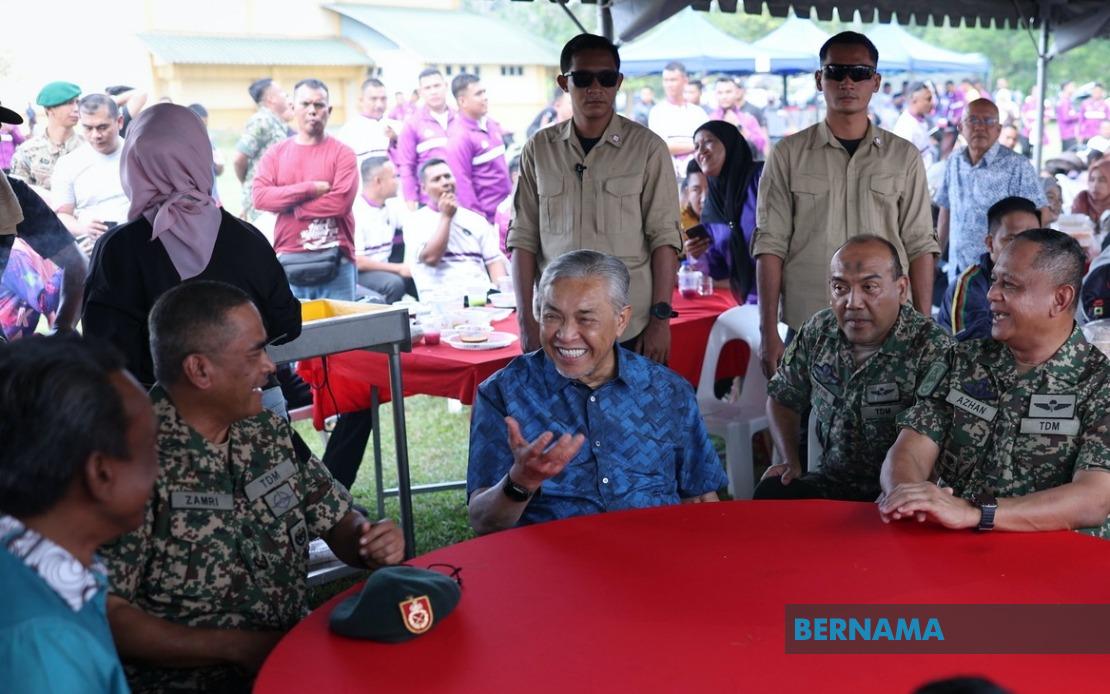
Deputy Prime Minister Datuk Seri Dr Ahmad Zahid Hamidi has declared that no individual, regardless of their position or standing, will escape accountability should their names appear in the Royal Commission of Inquiry report investigating Lembaga Tabung Haji. Speaking at the Malaysian Armed Forces Southern Zone Family Day Carnival at Kem Syed Sirajuddin in Gemas on Saturday, the Barisan Nasional chairman underscored the government's commitment to handling the sensitive matter through established legal channels, a statement that carries significant weight given the institution's prominence in Malaysian civil society and the government's own financial interests in the entity.
The RCI's investigation into Tabung Haji has been a focal point of public concern, given the hajj fund's critical role in managing savings for millions of Malaysian Muslims preparing for their pilgrimage to Mecca. Ahmad Zahid's emphasis on transparency reflects growing pressure on the administration to release findings that have already been completed but withheld from public view. His insistence that any evidence of wrongdoing—ranging from abuse of power to criminal breach of trust—will be processed through proper legal mechanisms suggests the government is preparing the ground for potentially significant disclosures that could implicate senior figures across various institutions and political circles.
The timing of Ahmad Zahid's remarks is particularly noteworthy, coming just days before early voting in the Negeri Sembilan state election on Tuesday, with polling day scheduled for August 1st. The coincidence raises questions about whether the release of the RCI report might influence voter sentiment in the peninsular state. However, when pressed on this issue, Ahmad Zahid expressed confidence that Negeri Sembilan's electorate possessed the maturity and wisdom to separate governance performance from potential scandals, a position that reflects either genuine faith in voter discernment or political calculation that the BN's campaign machinery remains sufficiently robust to weather any negative headlines.
Prime Minister Datuk Seri Anwar Ibrahim has previously indicated that the Cabinet would likely approve public release of the RCI findings following a formal tabling, signalling a significant policy shift. Anwar, who also holds the Finance Ministry portfolio, attributed the earlier decision to suppress the report to concerns about eroding public confidence in Tabung Haji during a period when the institution required stabilisation. This rationale, while administratively sound, underscores the delicate balance governments must maintain between transparency and institutional stability—a tension particularly acute in matters involving religious trust and public savings.
The changing circumstances Anwar referenced—specifically Tabung Haji's recent strengthening and international recognition—appear to have convinced the administration that the institution can now withstand public scrutiny without suffering a confidence crisis. This assessment suggests that internal reforms at the hajj fund have been more substantial than previously acknowledged, potentially including leadership changes, governance restructuring, or financial consolidation that officials believe will insulate the organisation from reputational damage once revelations emerge.
The RCI's investigation itself represents a critical institutional reckoning for Tabung Haji, an organisation that has served as a trusted intermediary between Malaysian Muslims and the pilgrimage experience for decades. Any findings of systemic irregularities or individual misconduct would carry implications far beyond mere financial accountability, touching on questions of religious institutional integrity and the government's stewardship of Muslim community assets. The prospect of high-profile figures facing legal consequences adds another layer of complexity, particularly if such individuals span multiple political parties or hold senior positions in current or former administrations.
For Malaysian investors and depositors in Tabung Haji, the impending disclosure represents both risk and potential reassurance. While negative findings might temporarily shake confidence, they could also signal that investigative mechanisms are functioning and that accountability is being pursued—factors that ultimately strengthen institutional credibility. The challenge for the government will be managing the narrative to ensure that consequences are seen as applying uniformly rather than selectively, a perception issue that has plagued previous corruption investigations in Malaysia.
Ahmad Zahid's statement that appropriate legal processes would follow any evidence of wrongdoing implies several possible pathways: police reports to the Commercial Crime Investigation Department, civil suits for recovery of misappropriated funds, or referrals to the Malaysian Anti-Corruption Commission. The complexity of determining jurisdiction and prosecution in cases involving state-linked institutions means that legal proceedings could extend over years, potentially maintaining this issue in public discourse well beyond the immediate electoral cycle.
The Negeri Sembilan state election itself provides a testing ground for how voters respond to governance issues and institutional accountability narratives. The state has traditionally been a BN stronghold, and early assessments suggest the ruling coalition remains competitive despite various national-level challenges. If Ahmad Zahid is correct in his assessment that voters will compartmentalise institutional scandals from electoral choices, the RCI report's release could proceed without dramatically reshaping the state political landscape. However, the converse risk—that damaging revelations energise opposition-aligned voters—cannot be dismissed, particularly if the report identifies patterns of systemic abuse rather than isolated incidents.
Looking forward, the government's handling of the TH RCI report will set precedent for how other pending investigations are managed, particularly those involving significant public institutions or prominent political figures. The principle that no one stands above the law, if genuinely implemented, could reshape public expectations around accountability in Malaysia. Conversely, any perception that powerful individuals receive preferential treatment would further erode institutional trust and deepen public cynicism about governance reform efforts. The coming weeks will reveal whether Ahmad Zahid's statement represents genuine commitment to accountability or political theatre designed to manage near-term electoral risks.

