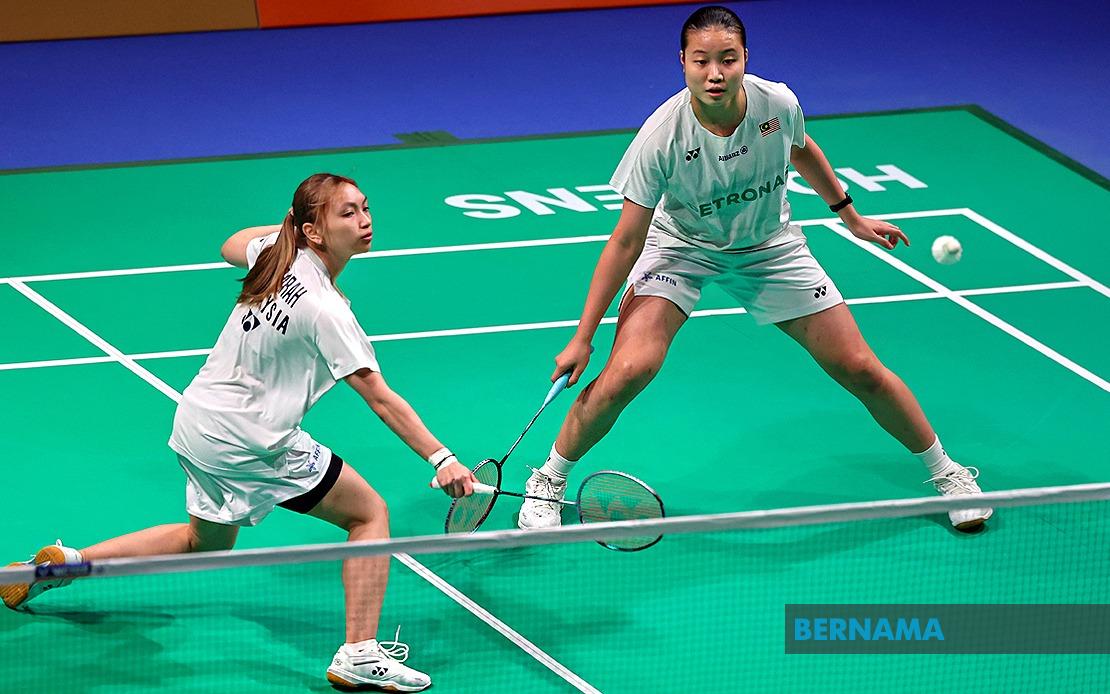
Eighteen-year-old sensation Noraqilah Maisarah Ramdan and her partner Low Zi Yu are charting a deliberately methodical course through international badminton, prioritising incremental advancement over ambitious leaps that could distract from their foundational development. The pair, currently sitting at 70th in the world rankings, have rejected the temptation to chase elite targets immediately, instead anchoring their strategy around reaching the world's top 50 as their immediate objective—a stepping stone rather than a final destination. This approach reflects maturity unusual in teenage athletes operating in the high-pressure environment of professional mixed doubles competition.
The national duo's philosophy centres on sustainability and measured growth across tournament cycles rather than pursuing breakthrough results that might create unrealistic expectations. Noraqilah articulated this vision during a recent training session, emphasising that the partnership requires time to develop consistency against elite opposition. The top 50 ranking serves as a meaningful benchmark—not because it represents their ultimate ceiling, but because it represents the next logical stage in their evolution as competitors. This incremental mindset contrasts sharply with the tendency in youth sports to constantly reach for seemingly impossible targets, often resulting in burnout or tactical missteps.
Breaking into the world's top 32, an additional tier that Noraqilah acknowledged as strategically important, would unlock entry to more prestigious tournaments and enhance exposure to world-class competition. However, the pair recognises that such advancement requires foundations currently being solidified. The top 32 threshold carries genuine significance in badminton's qualifying structures, determining access to major circuits and building the experience necessary for sustained high-level performance. Rather than treating this as an immediate goal, Noraqilah and Zi Yu view it as a natural consequence of persistent excellence once they have stabilised their top-50 position.
Recent competition has validated their development trajectory in concrete ways. At the Australian Open last week, the Malaysian partnership delivered a statement victory by defeating Taiwan's Hsieh Pei Shan and Hung En Tzu, then ranked eighth in the world. This result carries particular significance because it demonstrates tangible progress against elite competition—the kind of evidence that justifies their patient, process-oriented approach. Two months prior, the same Malaysian pairing had faced comparable Taiwanese opposition but lacked the tactical polish and court presence required to challenge meaningfully. The turnaround illustrates how focused training and accumulated match experience translate into measurable improvements.
The psychological dimension of their victory extends beyond the ranking points earned. Noraqilah explicitly noted the confidence gained from knowing they can now impose pressure on world-elite pairs consistently. In badminton's mixed doubles format, confidence against top-tier opponents often proves as valuable as technical skill, influencing shot selection, positioning, and recovery between points. When a rising partnership demonstrates they belong in exchanges with the sport's elite, they begin cultivating the mental fortitude necessary for sustained progression. This psychological shift—from aspiring challengers to credible competitors—often precedes ranking breakthroughs.
Malaysia's badminton infrastructure has traditionally produced world-class singles and men's doubles players, yet mixed doubles development has received comparatively less international prominence in recent years. The emergence of Noraqilah and Zi Yu as a partnership with genuine potential adds depth to Malaysian badminton's competitive depth. Their success trajectory carries implications beyond their individual careers, suggesting the national system can still identify and nurture talent across disciplines. The pair's willingness to adopt a long-term vision, rather than succumbing to pressure for immediate results, reflects coaching philosophy focused on sustainable excellence rather than short-term publicity.
The contrast between Malaysia's badminton heritage and the current competitive landscape shapes context for their ambitions. Neighbouring countries have invested substantially in mixed doubles programmes, producing deep talent pools at various ranking levels. In this environment, Malaysian prospects like Noraqilah and Zi Yu cannot afford shortcuts or plateaus. Their realistic target-setting acknowledges that world-class badminton rewards consistency and patient improvement more than occasional heroic performances. The pair's measured approach thus represents rational strategy rather than lack of ambition—a sophisticated understanding that tennis, badminton's racket-sport cousin, and badminton itself, are sports where peak performance typically emerges from compounding small gains across years.
Looking forward, Noraqilah and Zi Yu's near-term focus involves consolidating improvements in specific technical and tactical areas. Every training session and tournament appearance contributes data about their competitive profile—which opponents exploit weaknesses, where their serve-return combinations succeed, how fatigue affects decision-making in rallies. This analytical approach, combined with their recent success against world-ranked opposition, positions the pair as one of Malaysian badminton's interesting projects. Their refusal to be rushed toward lofty targets, despite evident potential, suggests they have internalised lessons from athletes whose early promise dissolved when sustained growth failed to materialise.