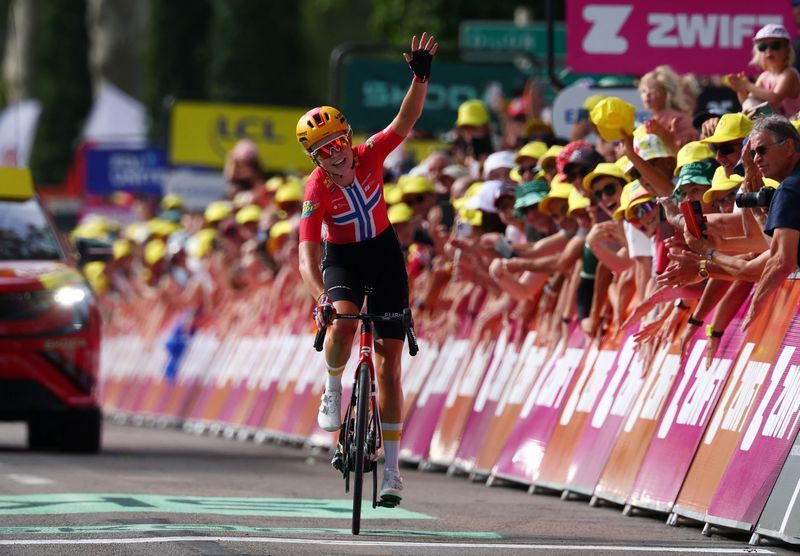
Sigrid Haugset of Norway crossed the finish line alone on Monday to secure the first stage victory by a Norwegian rider at the Tour de France Femmes, a historic moment that also elevated her to the overall race lead. The Uno-X Mobility rider's dominant performance in the mountains marked a breakthrough for Scandinavian cycling on the sport's biggest women's stage, with Haugset now holding a commanding advantage of two minutes and 22 seconds ahead of Mauritius-born Kimberly Le Court in second place.
The victory came after Haugset mounted her decisive attack during the climb to Col de la Savine, a manoeuvre that would prove decisive over the 156.5-kilometre stage. Belgian rival Lotte Kopecky, who had shown the strongest chase throughout the day, eventually finished one minute and 24 seconds behind, while Dutch veteran Marianne Vos claimed the final podium spot in Poligny. The stage marked the first significant test of the race as the peloton ventured into hillier terrain, and Haugset's ability to sustain her effort under duress demonstrated both tactical maturity and physical capacity that few in the field could match.
The road to victory was far from straightforward. A mass crash during the opening category one-climb to Col de la Faucille created chaos in the early kilometres, claiming several prominent contenders including reigning world champion Magdeleine Vallieres and former Tour de France winner Demi Vollering. Though all riders remounted quickly and the peloton stabilised, the incident set a chaotic tone for the stage and underscored the unpredictability of women's cycling at the highest level. The absence of sustained breakaway attempts after this point suggested that most teams preferred consolidation and recovery over aggressive tactics.
Where Haugset truly separated herself was in her mental fortitude during the closing kilometres. As the Norwegian's legs grew heavier and exhaustion threatened to overwhelm her efforts, Kopecky mounted a determined chase that cut the deficit to just ten seconds with ten kilometres remaining. At this critical juncture, many riders might have surrendered to the inevitable, but Haugset instead summoned unexpected reserves of energy, expanding her margin to nearly a minute with only three kilometres to go. This surge vindicated the aggressive approach she had committed to earlier, when she consciously chose not to settle for a respectable second-place finish despite the relative security it would have offered.
Haugset's own words after the race revealed the emotional weight of her achievement. She admitted she had harboured doubts about her ability to hold off Kopecky's chase, and that thoughts of supporters back home in Norway had ultimately steeled her resolve to push harder rather than accept defeat. The victory also brings with it the yellow jersey, making Haugset the first Norwegian woman ever to lead the Tour de France Femmes. This distinction carries particular significance in Scandinavian cycling culture, where Norway has historically produced strong male cyclists but has struggled to establish a comparable women's tradition at the Grand Tour level.
The stage dynamics reflected broader patterns emerging in women's Grand Tour racing. Yellow jersey holder Lorena Wiebes of the Netherlands, the pre-stage leader, proved unable to follow the accelerations in the mountains and found herself thirteen minutes down at the twenty-kilometre mark. This was less a collapse than an illustration of the different strengths required across varied terrain—Wiebes' sprinting prowess that has served her well on flat stages cannot compensate for the sustained climbing power that stage finishes like this demand. Le Court and Vollering, who entered the day in second and third overall, similarly struggled to maintain contact with the leaders, losing over two minutes in the process.
For Malaysian and Southeast Asian cycling enthusiasts, Haugset's performance underscores how European-based teams and riders continue to dominate women's professional cycling. While Malaysia has produced talented cyclists, the pathway to competitive success at Grand Tour level remains challenging, with most top Asian riders still operating in domestic or regional competitions rather than sustained European campaigns. Haugset's breakthrough demonstrates the value of sustained investment in women's cycling infrastructure and the importance of having talented riders embedded within professional European teams where they can develop consistently against world-class opposition.
The remaining stages of this year's Tour de France Femmes will present Haugset with fresh challenges as she seeks to protect her lead. The two-minute-and-twenty-two-second cushion is healthy but not insurmountable, particularly if flatter stages suit Wiebes' sprinting abilities or if mountain stages continue to separate the climbing specialists from the field. Kopecky's performance on Monday suggests she remains dangerous, having demonstrated both the aerobic capacity to stay competitive and the tactical awareness to pursue opportunities when they present themselves. The Belgian may yet capitalise if fortune and terrain align in her favour during subsequent stages.
Haugset's victory also carries symbolic importance for women's cycling development in Norway and the Nordic region. Success at the Tour de France Femmes has historically translated into increased sponsorship opportunities, media attention, and grassroots participation in cycling. Should Haugset sustain her current position through to Paris, the impact on Norwegian cycling could be substantial, potentially inspiring a new generation of female cyclists to pursue the sport seriously. In this respect, her Monday triumph represents more than a single stage victory—it marks a potential inflection point in the trajectory of women's cycling in Scandinavia.

