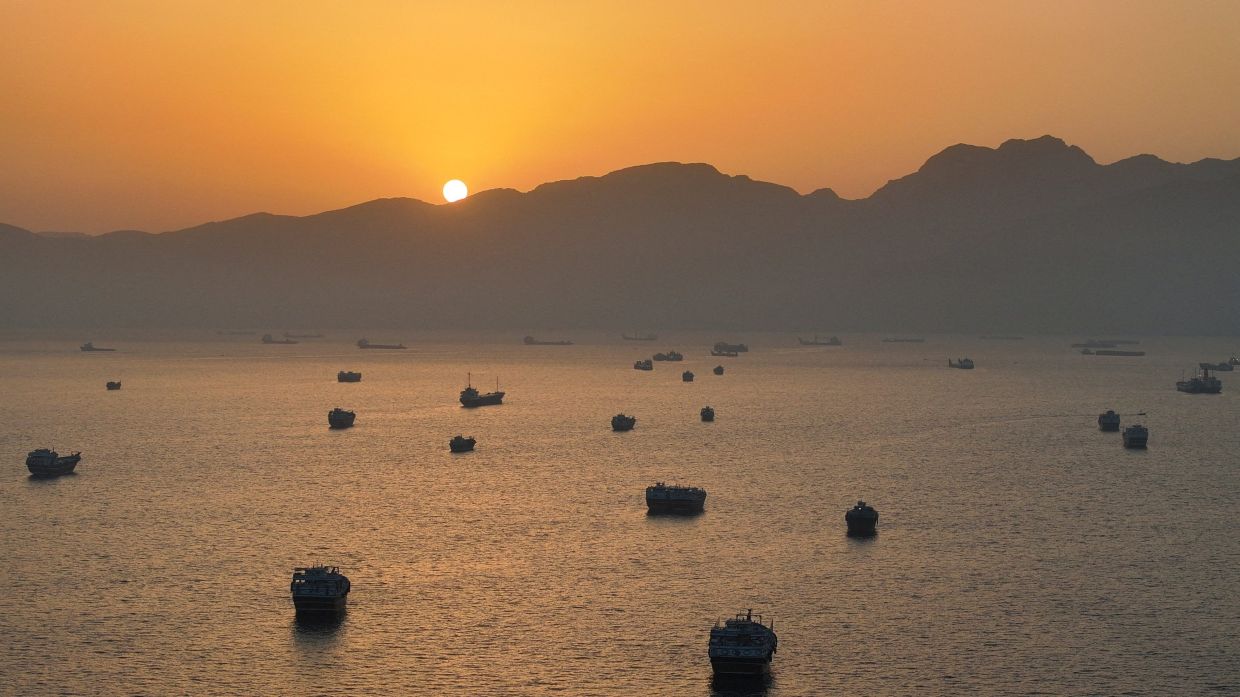
The exodus of trapped oil tankers from the Strait of Hormuz is accelerating, with three major vessels carrying a combined 5 million barrels of crude departing the critical waterway on Wednesday. The movement represents a significant step toward clearing the substantial bottleneck that has accumulated in the Persian Gulf since the Middle East conflict escalated, while simultaneously applying downward pressure on global crude oil prices amid the tentative thaw between Iran and the United States.
Shipping data tracked by LSEG and Kpler identified the VL Breeze, a South Korean-flagged Very Large Crude Carrier, passing through the strait en route to Daesan carrying 2 million barrels of Qatari condensate and Abu Dhabi crude. The supertanker, operating under a charter agreement with South Korea's Hyundai Oilbank, represents the resumption of refined fuel flows into East Asian markets where demand remains robust. Simultaneously, the VLCC Plata Carrier, chartered by India's Oil Corporation, began its departure with 2 million barrels of Saudi crude, while the Suezmax tanker Prudent Warrior cleared the waterway with 1 million barrels of Iraqi Basrah crude destined for Sohar in Oman. Both vessels sail under the Liberian flag, reflecting the international complexity of maritime operations in this strategically vital corridor.
The clearing of these three carriers follows weeks of congestion that has constrained global energy supplies and weighed on economic activity throughout Asia and beyond. Prior assessments by analysts at Kpler and Vortexa indicated that approximately 90 million barrels of crude remained landlocked within the Persian Gulf, creating a substantial overhang on the market. This accumulated inventory represented not merely a commercial problem but a potential macroeconomic headwind, as the unavailability of crude supplies forced refineries across Asia to operate at reduced capacity or seek alternative sources at premium prices.
South Korea's maritime ministry confirmed on Wednesday that four vessels operated by South Korean shipping companies have successfully exited the Strait of Hormuz and are proceeding toward their designated ports, with one destination being South Korea itself and others bound for regional trading hubs. Nevertheless, the broader picture remains one of incomplete clearance, with eighteen of the twenty-six vessels originally stranded since the outbreak of regional hostilities still remaining within the Gulf. This suggests that while the dam has begun to crack, the full release of supply will necessarily unfold over an extended period, preventing any sudden shock to markets even as supply constraints gradually ease.
The passage of these tankers has proceeded under emergency protocols established collaboratively by Oman and the International Maritime Organization to ensure the safe transit of vessels transiting one of the world's most congested and geopolitically sensitive shipping lanes. Oman has declared its commitment to maintaining the Strait of Hormuz as an open shipping corridor without imposing transit tolls, a reassuring signal to the international maritime community. The sultanate has designated two temporary alternative shipping routes—one positioned north of the established lane and another to the south—specifically to allow departing vessels to navigate around the zone of greatest congestion and risk. This pragmatic arrangement reflects Oman's strategic interest in maintaining stability in regional maritime commerce while supporting the broader international economic system.
Parallel developments in liquefied natural gas markets signal an even broader unlocking of Gulf energy supplies. Two additional empty LNG tankers, the Shandong Redwood and Milaha Qatar, have been identified transiting westward through the strait toward Qatar's export terminals to collect cargoes. This movement brings the total number of empty LNG vessels currently in transit to load Qatari gas to nine, the highest count since the regional conflict began. The surge in empty LNG tanker movements suggests that international buyers and traders anticipate an imminent resumption of normal Qatari production, reversing months of supply uncertainty that have driven global liquefied gas prices to elevated levels.
Qatar's Prime Minister Sheikh Mohammed bin Abdulrahman al-Thani has provided a timeline for normalizing the nation's LNG production, signalling to international markets that output disruptions are entering their final phase. According to reporting by the Financial Times, the Gulf state expects to restore full production capacity within a matter of weeks, a considerable relief for industrial consumers and utility companies across Europe, Asia, and beyond who have grappled with constrained supply and volatile pricing. The prospect of returning Qatari LNG to the global market would represent a substantial addition to international supply, with potential implications for energy security across the Indo-Pacific region where Japanese, South Korean, and other buyers depend heavily on such sources.
For Malaysia and other Southeast Asian economies, the gradual clearing of bottlenecks in the Strait of Hormuz carries multiple dimensions of significance. Regional economies remain acutely dependent on stable energy supplies at predictable prices; disruptions to oil and gas flows have ripple effects throughout manufacturing, transportation, and electricity generation. A return to normal flux through the world's most critical energy chokepoint would stabilize planning horizons for petrochemical industries, utilities, and transportation operators across the region. Additionally, the preliminary thaw in Iran-US relations that underlies this tanker exodus potentially signals broader regional stabilization that could reduce risk premiums embedded in energy and commodity pricing.
The interim agreement facilitating this release of trapped oil represents a pragmatic diplomatic achievement that has begun translating into tangible economic benefits for consumers and producers globally. While negotiations between Tehran and Washington remain fluid and uncertain in their ultimate trajectory, the fact that substantive accords on energy-related matters have been reached demonstrates the possibility of managing geopolitical tensions through structured dialogue. For Southeast Asian policymakers and business leaders, the current developments offer a window of opportunity to recalibrate supply chains and energy procurement strategies around more normalized conditions, rather than the crisis-driven calculus that has prevailed since the conflict intensified earlier in the year.

