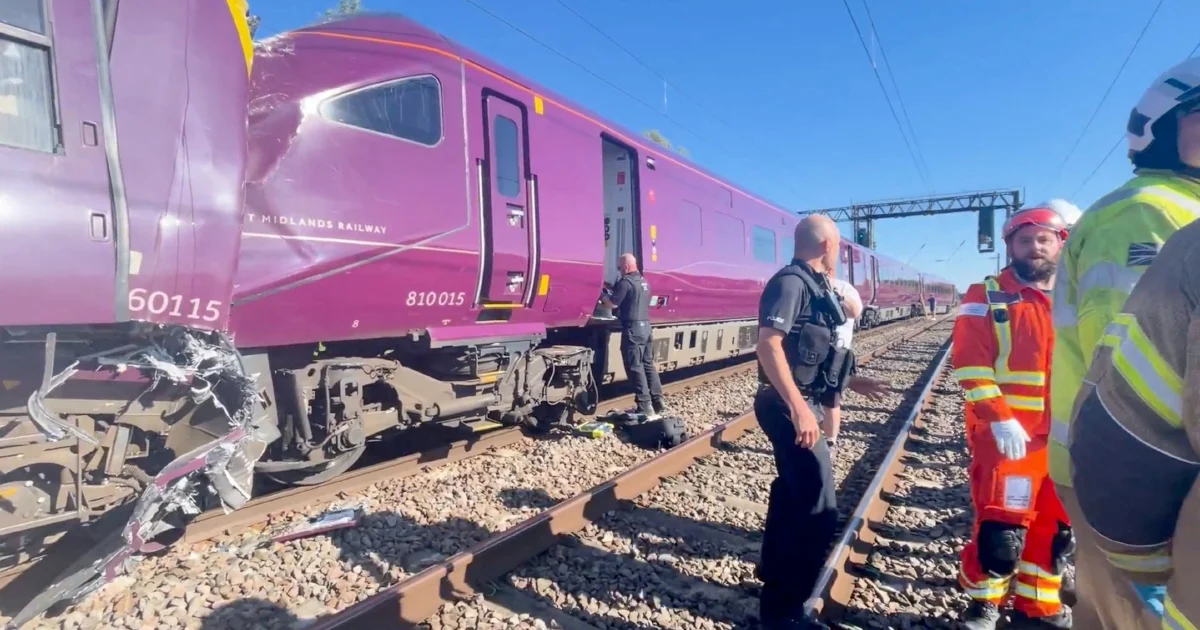
A serious railway accident unfolded Friday when two passenger trains collided in an area north of London, resulting in one fatality and extensive injuries across multiple victims. UK emergency services confirmed the incident, disclosing that eleven of the injured sustained injuries classified as very serious, amplifying concerns about safety protocols and emergency response capabilities on Britain's rail network.
The magnitude of this accident underscores the inherent risks present in rail transport, even within one of Europe's most developed transportation systems. Such collisions, whilst statistically uncommon given the volume of daily train movements across the UK, carry disproportionately severe consequences when they do occur. The concentration of very serious injuries among the casualty figures suggests the impact forces were substantial, potentially indicating a high-speed collision or a configuration that exposed passengers to particular vulnerability.
For Malaysian readers with experience of the Klang Valley Double Track Project or the Mass Rapid Transit expansion, this incident carries particular resonance. Southeast Asia's rapidly expanding rail networks, including Malaysia's own planned extensions and upgrades, must absorb lessons from incidents such as this. The UK's rail infrastructure, despite advanced signalling and monitoring systems, demonstrates that technological safeguards require constant vigilance and maintenance to function effectively.
Emergency response coordination in the immediate aftermath of such incidents proves critical to minimising fatalities and managing mass casualties. The mobilisation of resources by UK emergency services reflects established protocols that prioritise rapid triage, medical intervention, and scene stabilisation. These procedures have informed international best practices, including those adopted by Malaysian emergency management agencies, though the effectiveness of any response depends substantially on pre-existing infrastructure and training levels at individual facilities.
The investigation that inevitably follows such accidents typically examines multiple contributing factors: driver actions, signalling systems, track maintenance records, weather conditions, and vehicle mechanical integrity. In the UK context, the Rail Accident Investigation Branch would assume responsibility for determining causation, a process that frequently requires months of detailed analysis. The findings from such investigations often result in regulatory adjustments and procedural modifications across entire rail networks, reflecting how single incidents can influence safety standards across entire industries.
Passenger confidence in rail travel bears direct correlation with perceived safety standards. Public perception of risk following high-profile accidents such as this one can influence modal choice, with some passengers potentially shifting towards alternative transport methods despite statistical evidence suggesting rail remains one of the safer travel options available. This psychological dimension presents particular challenges for rail operators balancing transparency and reassurance messaging in the aftermath of disasters.
The broader context of UK railway operations reveals an ageing infrastructure inherited from the Victorian era, a characteristic shared with rail systems across several Commonwealth nations and parts of Europe. Modernisation initiatives ongoing within Britain's rail system represent substantial capital investments, yet the sheer complexity of maintaining extensive networks means that comprehensive simultaneous upgrades remain practically impossible. This reality applies equally to transport authorities across Southeast Asia developing their own rail ambitions.
Medial facilities and trauma services in areas surrounding major rail corridors require particular preparedness for mass casualty incidents. The speed with which emergency departments mobilise to accommodate sudden influxes of injured patients depends on advance planning, staffing allocation, and equipment availability. Health authorities in regions traversed by major transport arteries, whether in the UK or Malaysia, must maintain surge capacity protocols enabling rapid response when routine accident scenarios escalate unexpectedly.
Communication with affected families and the broader travelling public represents another critical challenge following such incidents. Rail operators and governmental authorities must provide timely, accurate information whilst preserving the dignity and privacy of those directly impacted. The media environment within which such incidents occur has transformed dramatically over recent decades, with social media platforms amplifying information—accurate and inaccurate—far more rapidly than traditional media channels ever could.
The ripple effects of major rail accidents extend beyond immediate casualty management into operational disruption affecting thousands of dependent commuters and commercial stakeholders. Service diversions, capacity reductions, and schedule modifications cascade through regional transport networks, creating secondary economic consequences that extend well beyond the accident site itself. Malaysian commuters familiar with disruptions to LRT and KTM services following maintenance incidents understand these cascading effects intimately.
International rail safety standards continue evolving through mechanisms including the International Railway Union and bilateral knowledge-sharing arrangements between national rail authorities. Each significant accident contributes to this accumulated understanding, refining protocols and technological solutions progressively. The incident north of London will undoubtedly inform international discussions on collision avoidance systems, communication protocols, and emergency response procedures.
As investigations proceed and authorities compile preliminary findings, attention will focus on whether existing safety mechanisms functioned as designed or whether systemic deficiencies emerged. This distinction carries substantial implications not merely for the UK rail sector but for aspirational transport planners across Southeast Asia developing world-class rail infrastructure. The technical and organisational lessons extracted from such incidents, though learned through tragedy, ultimately benefit travelling publics across all nations integrating advanced rail systems into their transportation portfolios.

