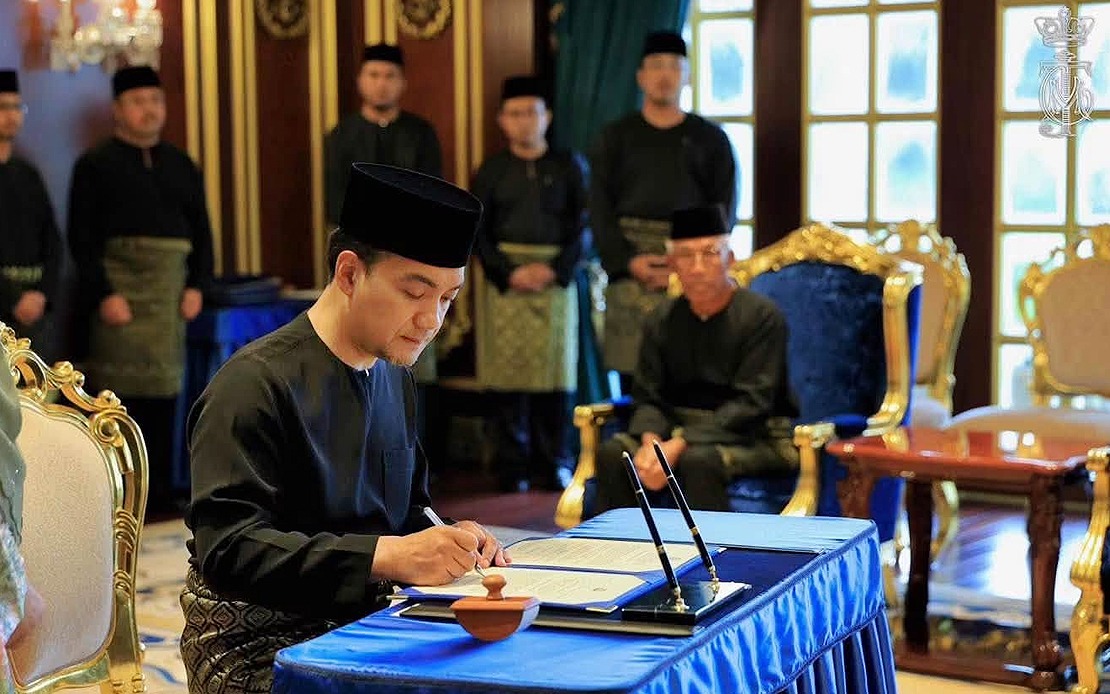
Datuk Onn Hafiz Ghazi has commenced his second term as Johor Menteri Besar following the region's decisive election outcome, positioning him to sustain momentum on the state's economic priorities while representing a continuation of one of Malaysia's most historically significant political families. The 48-year-old took his oath of office before the Regent of Johor, Tunku Mahkota Ismail, at Istana Bukit Serene on July 12, marking a formal transition into what observers expect will be a sustained period of governance focused on capital-intensive development projects across the southern state.
The electoral framework underpinning Onn Hafiz's renewed authority proved substantially stronger than his first appointment in March 2022. Barisan Nasional's victory across 48 of 56 state seats in the July 11 election represented a significant consolidation of support, gaining eight additional seats compared to the coalition's 2022 performance. This expanded numerical cushion provides considerably more political breathing room to pursue longer-term strategic initiatives without the constant pressure that typically accompanies narrow parliamentary majorities in state legislatures.
Onn Hafiz inherits a lineage that fundamentally shaped modern Malaysia's political trajectory. His position as great-grandson of Datuk Onn Jaafar, the founder of UMNO and Johor's seventh Menteri Besar, and grandson of Tun Hussein Onn, Malaysia's third Prime Minister, connects him directly to moments of constitutional significance and nation-building during the post-independence era. This genealogical backdrop carries expectations from both the establishment and the broader electorate, with many observers viewing his stewardship as a test of whether dynastic political networks can deliver substantive governance rather than merely perpetuating privilege across generations.
The personal trajectory that brought Onn Hafiz to Johor's political apex reveals a deliberate professionalization of his approach to public office, distinguishing his path from earlier generations of hereditary politicians. Born on March 2, 1976, he pursued formal education at the Royal Military College before obtaining a bachelor's degree in accounting from the University of Hertfordshire, establishing credentials in technical financial management. This grounding in auditing and corporate systems informed his subsequent career arc, including his tenure at PricewaterhouseCoopers from 2001 to 2004 and subsequent roles as director of Chin Well Holdings Berhad and chief executive officer of KMB Sdn Bhd through 2013.
His transition from the corporate sphere into elective politics occurred gradually rather than abruptly, suggesting a measured approach to political entry that contrasts with some inherited political positions. Between 2012 and 2018, Onn Hafiz accumulated grassroots party experience as a member of the UMNO Youth executive council and chief of the Sembrong UMNO Youth division, simultaneously serving as political secretary to the defence minister from 2013 to 2018. This extended period of institutional party work, coupled with technical staff experience in ministerial bureaucracy, established networks and procedural familiarity essential for subsequent advancement within UMNO's hierarchical framework.
His entry into direct electoral competition occurred in the 2018 general election when he successfully contested the Layang-Layang federal seat, immediately followed by appointment as chairman of the Johor Tourism, Youth and Sports Committee from 2019 until his elevation to Menteri Besar. The rapid ascension from first-time federal assemblyman to state-level committee chairman to chief executive of state administration, compressed into approximately four years, reflects both his family's continuing institutional influence within UMNO and a strategic perception that he possessed the requisite administrative capacity for leading a major state.
The Machap state seat victory in the 2022 Johor state election provided the constitutional basis for his appointment as Johor's 19th Menteri Besar in succession to Datuk Hasni Mohammad, representing the moment when his political trajectory shifted irreversibly toward executive responsibility. Since March 2022, he has oriented state administration around the "Maju Johor 2030" development framework, a comprehensive initiative prioritizing economic expansion and foreign direct investment. This strategic focus reflects his corporate background, emphasizing measurable outcomes and investor confidence rather than purely redistributive political economy.
Within UMNO's internal structure, Onn Hafiz has consolidated substantial party organizational authority since 2023 through his role as chairman of the Johor UMNO Liaison Committee and chief of the Simpang Renggam UMNO division, positions occupied simultaneously with his state executive responsibilities. This dual institutional positioning—controlling both state government apparatus and significant party organizational machinery—establishes him as a powerful figure within Peninsular Malaysian UMNO politics, though potential tensions between party discipline and state administrative autonomy may emerge during contentious policy implementation.
The significance of Onn Hafiz's second-term commencement extends beyond Johor's local governance context into broader patterns of political succession and family-based political dominance within Malaysia's constitutional framework. His tenure demonstrates how hereditary advantage, when combined with professional credentials and institutional patience, can sustain political power across generations even as formal democratic processes nominally operate to select leaders. The electoral endorsement of BN in Johor suggests voter acceptance of his leadership, though the degree to which this reflects genuine confidence in his administrative competence versus traditional support for establishment coalition politics remains analytically contested among political observers.
The expanded majority provided by Onn Hafiz's strengthened electoral base enables pursuit of more ambitious development and infrastructure projects with reduced parliamentary obstruction, potentially allowing Johor to position itself as a demonstration case for state-level economic modernization within Malaysia. However, this enhanced governing capacity simultaneously intensifies scrutiny regarding substantive delivery against public commitments, as expanded mandates typically generate heightened expectations for tangible improvements in service provision, employment generation, and investment flows. The balance between rhetorical commitment to development and actual implementation capacity will substantially influence his political trajectory through the next electoral cycle.

