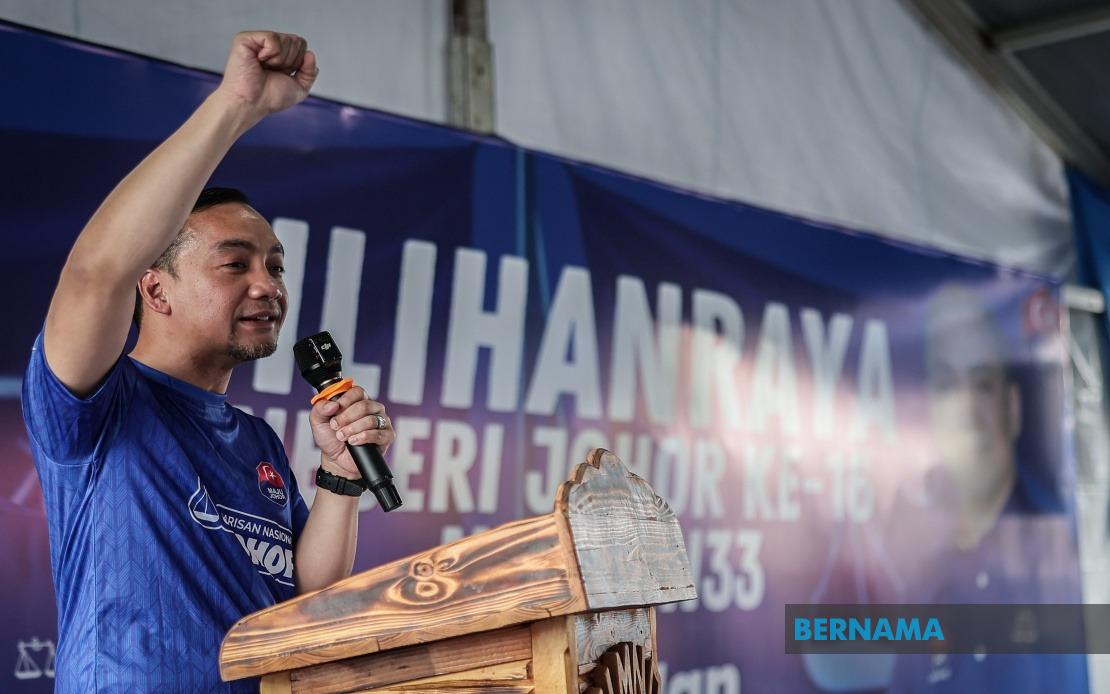
Johor's Menteri Besar Datuk Onn Hafiz Ghazi has expressed confidence that Barisan Nasional's campaign is gaining traction in the state, underpinned by what he characterises as an encouraging grassroots reception for the coalition's Endau candidate, Alwiyah Talib. Speaking at a campaign event in Mersing on June 29, Onn Hafiz highlighted the positive voter sentiment towards Talib, widely known as Kak Awi, as evidence that BN's messaging is resonating with constituents ahead of the July 11 polling date. The Johor leader's upbeat assessment reflects coalition confidence in what has historically been a competitive constituency, where margins have proven narrow.
Alwiyah's candidacy carries particular symbolic weight within BN's strategic calculus. A political veteran who held the Endau seat under the BN banner during the 14th General Election, she subsequently defected to Bersatu and contested the 2022 Johor state election under the Perikatan Nasional ticket, which she won with a majority of just 3,041 votes in a five-way race. Her return to the BN fold represents a recalibration of coalitional politics in Johor, where party realignments have remained fluid and incentives for candidates to switch allegiances continue to shift based on electoral prospects and access to state machinery.
Onn Hafiz anchored his narrative around what he termed the "Rumah Bangsa" concept, a unifying framework championed by UMNO president Datuk Seri Dr Ahmad Zahid Hamidi that purports to emphasise solidarity and inclusive governance across the BN coalition structure. By framing Alwiyah's return not as a transactional political move but as an expression of principled unity centred on serving Johor's constituents, BN leadership attempts to neutralise potential criticism that the coalition is accommodating defectors opportunistically. This rhetorical positioning seeks to emphasise continuity of service rather than party-hopping instability, presenting Alwiyah's prior opposition tenure as irrelevant to her credibility as a representative.
The Johor Menteri Besar's confidence in BN's preparedness extends beyond the Endau seat. He indicated that the party machinery across multiple constituencies, including Tenggaroh where Mohd Youzaimi Yusof carries the BN standard, operates at full operational capacity with adequate volunteer mobilisation and voter contact infrastructure. Such assertions of organisational readiness typically precede election campaigns where leadership expects competitive rather than dominant victories, suggesting BN acknowledges the electoral terrain in Johor remains contested despite the coalition's incumbency advantage at state level.
For Malaysian and regional observers, the dynamics unfolding in Johor carry broader implications for how BN sustains relevance in an era of volatile voter preference and fragmentary coalition politics. The state has emerged as a crucial testing ground for the renewed BN project, where the coalition must demonstrate it can arrest the defection patterns that characterised recent electoral cycles and simultaneously attract candidates with cross-party experience. Alwiyah's trajectory—from BN to opposition to BN—encapsulates the oscillatory movement of political figures in Malaysia's post-2018 realignment, where the normative boundaries between government and opposition have become increasingly porous.
Onn Hafiz's public statements regarding campaign smoothness and the absence of "untoward incidents" constitute an implicit acknowledgment that electoral campaigns in Johor have occasionally been marked by communal tensions or organisational friction. His emphasis on orderly proceedings serves both to project an image of controlled governance and to preemptively frame any election-day complications as anomalies rather than systemic failures. This framing becomes particularly relevant in Johor, where the state's demographic complexity and industrial base generate multiple constituency-specific grievances that can surface during intense campaign periods.
The July 11 polling date represents the culmination of an election cycle triggered by political developments that destabilised the prior government, necessitating fresh electoral validation. Early voting scheduled for July 7 provides logistical flexibility but also introduces variables regarding participation rates and turnout patterns that may diverge from general polling dynamics. BN's campaign strategy appears predicated on mobilising its traditional support base while converting swing voters through candidate-centric appeals, a model tested extensively in recent Malaysian electoral contests.
Alwiyah's particular positioning in Endau warrants scrutiny beyond leadership rhetoric. The seat's narrow 2022 victory margin suggests structural vulnerability to organised opposition campaigns or voter fatigue with any single candidate. Her gender and prior cross-party experience may generate differential appeal across age cohorts and educational demographics, potentially enabling BN to fracture opposition unity if voters view her as transcending conventional partisan divides. Conversely, opposition parties may attempt to weaponise her party-switching history as evidence of opportunism, framing her return to BN as motivated by access to state resources rather than ideological or principled commitment.
Johor's electoral trajectory has consistently served as a bellwether for national political sentiment, given the state's size, urban-rural mix, and historical significance within Malay-Muslim politics. A confident BN performance would potentially reverse recent trends of opposition gains in peninsular Malaysia, whereas coalition underperformance might signal persistent structural challenges that executive leadership changes have failed to address. The Endau race specifically encapsulates these broader stakes, with Alwiyah's fate functioning as a microcosm of whether BN can credibly reposition itself as an inclusive, modernised alternative to opposition governance narratives.
Onn Hafiz's public optimism, while standard pre-election rhetoric, reflects genuine organisational assessments about electoral competitiveness. The Menteri Besar's willingness to foreground Alwiyah's candidacy and dedicate campaign presence to the Endau constituency indicates BN considers the seat strategically important, either for symbolic reasons relating to coalition regeneration or because internal polling suggests the contest remains genuinely competitive. The invocation of prayer and reliance on divine providence, whilst culturally resonant, also implicitly concedes that campaign outcomes remain contingent on variables beyond immediate control—a subtle acknowledgment that BN's confidence, however projectively expressed, incorporates awareness of genuine electoral uncertainty.
The broader campaign environment in Johor heading into July 11 will be shaped not only by candidate appeals and organisational performance but also by broader macroeconomic conditions, perception of state government efficacy, and the national political narrative surrounding Anwar Ibrahim's federal administration. Voters' assessment of whether federal-state coordination has generated tangible development benefits or administrative improvements will condition their willingness to either reinforce or punish the incumbent coalition. In this context, Alwiyah and fellow BN candidates function not merely as individual aspirants but as representatives of the coalition's comprehensive value proposition to Johor's diverse electorate.

