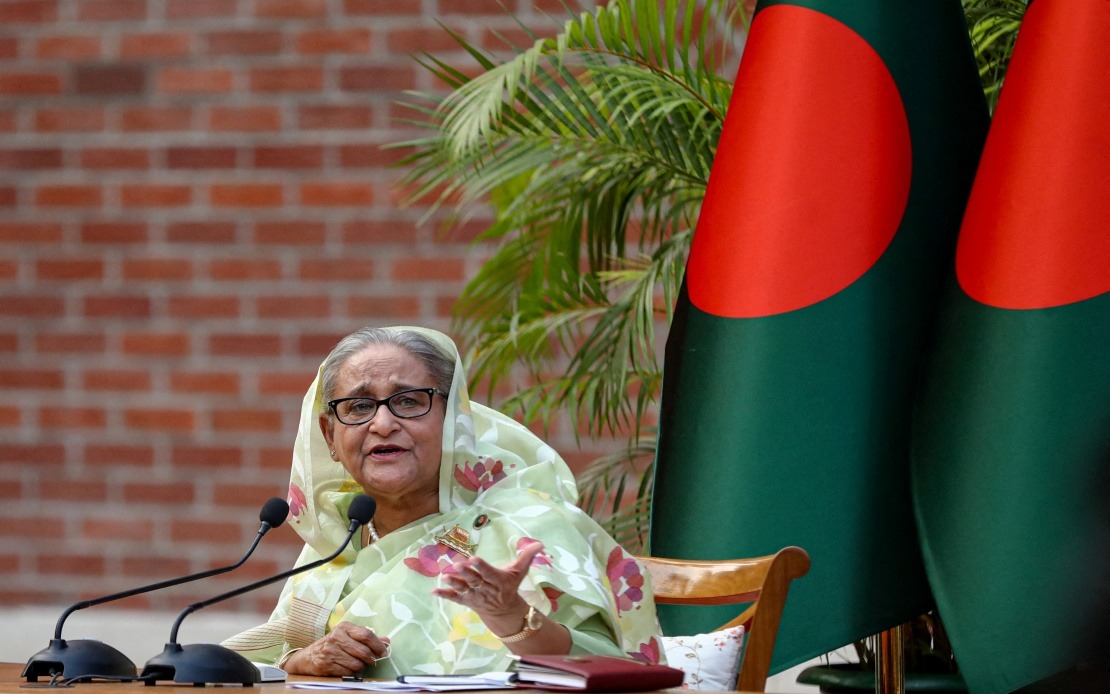
Sheikh Hasina, Bangladesh's ousted Prime Minister now living in exile in India, has publicly committed to returning to her homeland to face trial, even as she confronts a death sentence handed down by her country's war crimes tribunal. In a written interview, the 78-year-old acknowledged the grave personal risks involved, stating she understands authorities may imprison her or execute her, yet remains resolute in her determination to appear before the courts. Her defiant stance represents a striking assertion of political resolve amid one of South Asia's most turbulent transitions of power, with profound implications for regional stability and the future trajectory of Bangladesh's democratic institutions.
Hasina's conviction stems directly from the violent suppression of protests that erupted in mid-2024, originally triggered by a court decision to reinstate a 30 percent job quota for descendants of Bangladesh's 1971 independence war veterans. What began as student demonstrations evolved rapidly into a broader anti-government uprising that convulsed the nation. Security forces responding to the unrest killed large numbers of protesters, with United Nations estimates suggesting approximately 1,400 people lost their lives during the escalating violence. The bloodshed fundamentally weakened Hasina's political position and ultimately forced her resignation and flight to India in August 2024, after more than a decade and a half in power across multiple terms dating back to 1996.
The war crimes tribunal proceeded to try Hasina in absentia and issued its death sentence in November 2025, charging her with crimes against humanity connected to the crackdown. This development prompted Bangladesh's new authorities to formally request India's extradition of the former premier. India's Ministry of External Affairs has confirmed receipt of the request and indicated it is considering the matter carefully, examining relevant legal and judicial frameworks that govern such proceedings. The extradition question remains unresolved, keeping Hasina's legal status in a state of suspension as her homeland undergoes significant political reorganisation.
Hasina's assertion of innocence hinges on a two-fold argument that resonates within significant opposition circles. She consistently denies having issued orders that resulted in the deaths of protesters, insisting instead that the protest movement itself was manipulated and weaponised by political rivals seeking to exploit legitimate grievances for factional advantage. More provocatively, she has called for independent forensic investigation by foreign experts to establish how individual deaths occurred, what weapons caused them, and whether her government bore direct responsibility. This demand for transparency, whether genuine or rhetorical, underscores ongoing contestation over how Bangladesh's violent recent history should be officially narrated and adjudicated.
The interim government that assumed power following Hasina's departure, initially led by economist and Nobel laureate Muhammad Yunus as chief adviser, subsequently held general elections in February 2026. The opposition Bangladesh Nationalist Party secured victory, with its leader Tarique Rahman assuming the office of Prime Minister. Rahman's government has pursued assertive measures against Hasina's political legacy, including a nationwide ban on all activities of her Awami League party implemented in May 2025. Rahman's spokesperson articulated the new government's position clearly, stating that Bangladesh authorities aim to bring Hasina back to face trial while guaranteeing her opportunity to mount a legal defence, suggesting at least surface commitment to procedural legitimacy.
The geopolitical dimensions of Bangladesh's internal crisis extend beyond its borders in ways that demand Malaysian and broader Southeast Asian attention. Japan, which maintains significant development partnerships with Bangladesh including investment in major infrastructure projects such as a rapid railway system in Dhaka, has specific stakes in the country's stability. During Hasina's tenure, the nation was struck by a major terrorist attack in July 2016 when militants assaulted the Holey Artisan Bakery, killing 20 people including nine Italians, seven Japanese nationals, two Bangladeshis, one Indian, and one American of Bangladeshi origin. The incident underscored how instability in Bangladesh reverberates throughout the Indo-Pacific region and affects citizens of multiple nations.
Hasina's rhetoric regarding her prospective return emphasises national reconciliation rather than retribution. She has acknowledged that Bangladesh requires healing but rejected the notion that reconciliation should entail impunity for those accused of wrongdoing. Instead, she advocates for proper legal processes to hold perpetrators of abuses accountable, suggesting a measured approach to post-conflict justice. This framing attempts to position her as a statesperson concerned with institutional integrity rather than as someone seeking to evade accountability. Whether international observers and domestic constituencies accept this narrative remains highly contested, particularly given the extraordinary violence that preceded her departure.
Human Rights Watch has complicated the legal picture by expressing concerns about the war crimes tribunal's decision to proceed with trial and conviction in Hasina's absence. While the international human rights organisation acknowledges that those responsible for abuses under Hasina's government warrant accountability, it has flagged the legitimacy and fairness questions raised by conducting such proceedings without the defendant's presence or ability to mount a live defence. This position highlights the tension between justice and procedural propriety that characterises Bangladesh's current moment, a tension that will likely intensify should Hasina actually return and pursue vigorous legal contests.
Hasina's reflection on Bangladesh's regional importance carries strategic weight that extends throughout South Asia and beyond. She emphasises that her country's stability matters not only for its 170 million residents but also for broader South Asian development, the Bay of Bengal region, and international partners including Japan that have invested substantially in Bangladesh's progress. This invocation of interdependence attempts to reframe the domestic political conflict as one with consequences for the entire region's security architecture and economic cooperation frameworks. Malaysian policymakers monitoring Bangladesh developments should recognise that political instability there can create ripple effects across Southeast Asia through migration pressures, maritime security concerns, and disruptions to regional trade networks.
Looking forward, Hasina's declared commitment to return and face trial will test both her personal resolve and India's willingness to potentially extradite her despite complex diplomatic considerations. Should she actually return, Bangladesh would enter a critical phase of judicial reckoning that could either consolidate democratic legitimacy or devolve into victor's justice that delegitimises the new political order. The question of whether Bangladesh can construct a credible legal process that simultaneously protects due process rights while delivering accountability for genuine abuses remains fundamentally unresolved. Her invocation of the need for democracy restoration and popular self-determination suggests she intends to position herself as a voice for democratic renewal rather than a discredited leader clinging to power, though this messaging will require substantiation through actual conduct upon her return.
The broader implications for Southeast Asian governance cannot be overlooked. Bangladesh's experience demonstrates how institutional vulnerabilities in managing mass protest, security force discipline, and political power transitions can precipitate state-level crises that displace leaders and necessitate complete governmental reorganisation. For Malaysia and other regional democracies grappling with managing dissent, maintaining security force accountability, and navigating competitive politics, Bangladesh serves as a cautionary case study regarding the cascading consequences of allowing conflict between state and civil society to escalate into mass violence. Hasina's explicit acknowledgment of the death toll and her attempt to frame her anticipated return as an act of political maturity rather than defiance may prove instructive for how fallen leaders elsewhere might contemplate their relationship to accountability and national healing.

