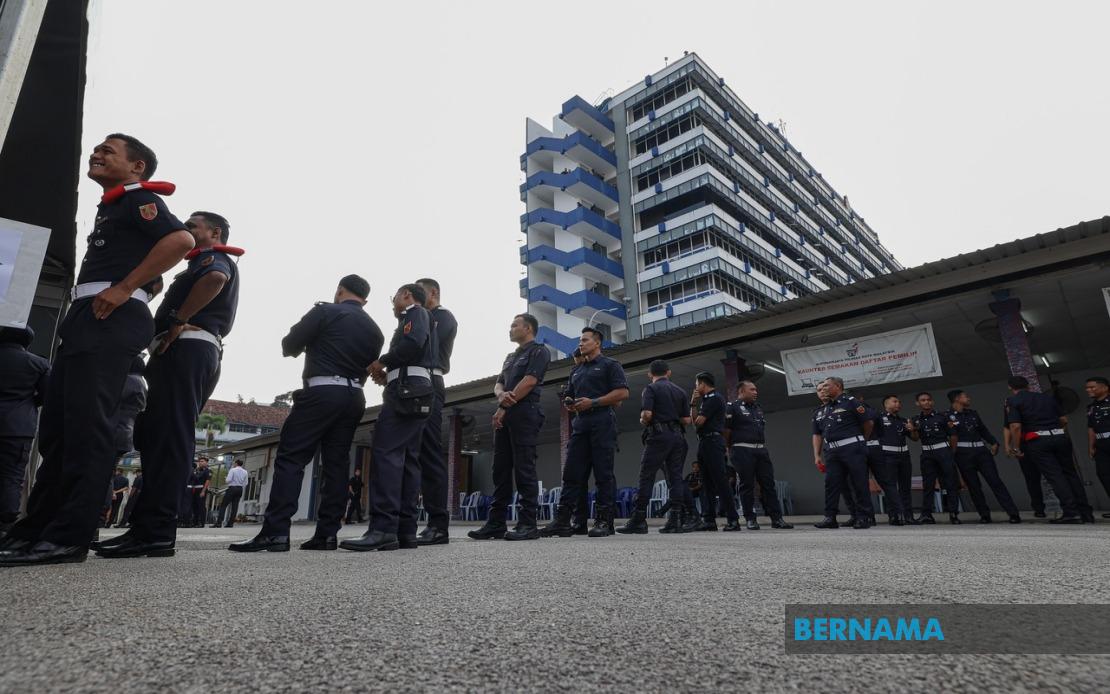
The 16th Negeri Sembilan State Election saw substantial turnout among uniformed services on July 28, as 1,481 military personnel and their spouses cast their votes at the Army Basic Training Centre (PUSASDA) in Port Dickson, while a further 979 police officers and their family members balloted at the Negeri Sembilan Police Contingent Headquarters in Seremban. These early voting arrangements underscore the logistical complexity of conducting state elections while accommodating the operational schedules of Malaysia's security forces, who must balance their electoral duties with ongoing responsibilities to the nation.
The military personnel who voted at PUSASDA were participating in the electoral process for the Bagan Pinang constituency, one of the competitive battlegrounds in this state election. The voting operation deployed 11 separate polling streams throughout the centre, functioning continuously from 8 am until 5 pm to accommodate the large cohort of eligible voters. Long queues formed well before the official start time, with personnel beginning to line up from 7 am onwards, demonstrating the commitment of military families to participate in the democratic exercise despite the early hour and procedural requirements. The early arrival of voters reflected both the importance attached to fulfilling their civic obligations and the necessity of completing the process within the allocated timeframe to minimise disruption to military operations.
Bagan Pinang presents a closely contested three-way race that will test voter sentiment across multiple political camps. The incumbent representative, Abdul Fatah Zakaria from Perikatan Nasional, faces challenges from Sheikh Junaidy Jamaludin of Parti Pribumi Bersatu Malaysia and Nasir Raman representing Pakatan Harapan. The participation of military voters in this constituency carries symbolic weight, as defence personnel have historically been seen as a demographic group with particular significance in electoral contests. Army Chief General Tan Sri Azhan Md Othman's decision to observe the PUSASDA voting process at 11 am further highlighted the institutional attention being paid to these early ballots and their role in the broader electoral narrative.
Police personnel voting at the Negeri Sembilan Police Contingent Headquarters were casting ballots for the Temiang constituency, where the pattern of competitive politics mirrors that seen in Bagan Pinang. The three-cornered contest in Temiang involves Ho Weng Wah of Pakatan Harapan, Leaw Kok Chan representing Barisan Nasional, and Fazly Hamid from Bersatu. ASP Harminder Singh Pritam Singh was recorded as the first police voter to cast his ballot at Stream 1 of the polling centre in Seremban. The participation of high-ranking uniformed personnel provided visibility to the voting process, with Datuk Ahmad Dzaffir Mohd Yussof, a Crime Prevention Board member at the Home Ministry who previously served in senior policing roles within Negeri Sembilan, among the early voters who came forward to fulfil their electoral responsibilities.
The early voting arrangement for security personnel reflects a longstanding electoral practice in Malaysia that recognises the operational constraints facing military and police organisations. These services require continuous staffing and deployment, making it impractical for all members to vote on the standard polling day. By establishing dedicated polling centres and allocating sufficient resources to facilitate voting well in advance of Saturday's main election day, the Election Commission demonstrates institutional flexibility while ensuring that no citizen is disenfranchised by their professional obligations. This approach strengthens the legitimacy of electoral outcomes by maximising participation across all demographic segments.
The scale of eligible voters among uniformed services in Negeri Sembilan is substantial, with 16,884 military personnel and their spouses, alongside 5,455 police officers and their spouses, all entitled to participate in this state election. These figures represent a considerable electorate within the broader Negeri Sembilan voting population, suggesting that the early voting process significantly influences the overall electoral outcome. The decision to create multiple polling streams at each facility, with variations in closing times statewide, indicates careful planning to balance logistical efficiency with the need to accommodate large numbers of voters across 38 designated polling centres.
Negeri Sembilan's police chief, Datuk Alzafny Ahmad, undertook an inspection of the voting process at police headquarters, emphasising the institutional oversight being applied to early voting operations. His scheduled press conference at the Nilai District Police Headquarters allowed for public communication regarding the voting proceedings and any matters of concern. Such engagement by senior security force officials reinforces the professionalism and transparency of the early voting mechanism and provides assurance to voters and the general public that the process is being conducted with appropriate scrutiny and adherence to electoral protocols.
The staggered closing times for polling centres across Negeri Sembilan, with 18 facilities closing at noon, two at 2 pm, and the remaining 18 at 5 pm, suggest geographic variation in voter concentration and operational requirements. This graduated approach reflects realistic assessments of demand at different locations and allows poll staff to manage workload more effectively. For voters and election observers, understanding these variations is important to tracking the overall early voting progress and anticipating the volume of ballot papers that will be counted prior to Saturday's main election day.
The early voting results from military and police personnel provide preliminary indicators of electoral sentiment within these demographically distinct groups, though caution must be exercised in extrapolating broader conclusions from voting patterns limited to uniformed services. These constituencies within Bagan Pinang and Temiang will be closely scrutinised when full results become available, particularly given the three-cornered contests in both areas. The participation of security force voters ahead of Saturday's polling day contributes to a more complete picture of the state's electoral dynamics and reduces the risk of administrative complications or disputes on the main voting date.
As Negeri Sembilan moves toward Saturday's main polling day, the successful completion of early voting for military and police personnel demonstrates the Election Commission's capacity to manage complex logistical challenges while maintaining democratic principles. The orderly queues, adequate polling streams, and senior leadership engagement observed at both PUSASDA and the police headquarters suggest that preparations for the state election are proceeding smoothly. For Malaysian voters more broadly, the efficiency of these early voting operations reflects positively on the country's electoral infrastructure and its ability to accommodate diverse voter populations within structured but inclusive democratic processes.

