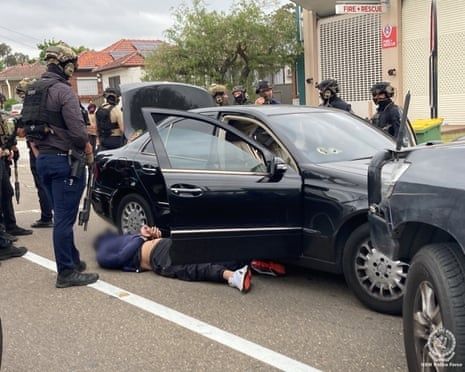
New South Wales police forces have intensified their efforts against criminal activity on public transport, announcing the arrest of 356 individuals across a concentrated three-day enforcement campaign. The latest phase of Operation Waratah, which concluded Saturday, represents the sixth iteration of a sustained strategy aimed at deterring and apprehending offenders who commit violent and sexual crimes aboard trains, light rail trams, buses and ferries throughout the state. This latest sweep has pushed cumulative arrests under the entire operation beyond 1,800 since the initiative began in 2024, underscoring the scale of the challenge facing Australia's eastern seaboard.
The operation mobilised substantial police resources to saturate the public transport network with enforcement presence. More than 400 officers were deployed daily across NSW's sprawling transport infrastructure during the three-day period from Thursday through Saturday, patrolling 539 trains, 127 buses and 29 light rail trams. This visible and concentrated police presence serves a dual purpose: providing immediate intervention capability against active offenders while simultaneously creating a deterrent effect for would-be perpetrators who might otherwise exploit the vulnerability of commuters in transit spaces. The resource allocation reflects a strategic recognition that public transport environments require tailored policing approaches distinct from general community safety operations.
Beyond raw arrest figures, authorities seized substantial quantities of prohibited items during the operation. Police recovered 28 knives and other weapons from individuals encountered across the network, highlighting the armed nature of some transport-related offences and the genuine safety risks faced by commuters and staff. Additionally, officers recorded 137 drug detections, revealing the nexus between substance abuse and criminal behaviour in public spaces. These seizures indicate that transport-related crime encompasses a broader ecosystem of unlawful activity beyond the headline offences of violence and sexual assault, suggesting that comprehensive enforcement must address multiple dimensions of antisocial behaviour simultaneously.
The 356 arrests resulted in a combined 645 criminal charges, indicating that many individuals were apprehended for multiple offences or serious matters warranting numerous counts. This charging profile suggests police are not simply conducting sweep operations designed to produce arrest numbers, but rather targeting individuals engaged in persistent or serious criminal patterns. The breadth of charges—spanning violent offences, sexual crimes, weapons possession, and drug-related matters—demonstrates that transport security problems are multifaceted and require responses calibrated to address different criminal typologies.
For Malaysian observers, the NSW experience offers instructive lessons regarding transport safety management in densely populated urban environments. Like Malaysia's major cities, Australian metropolitan areas grapple with ensuring that public transport systems remain accessible, efficient and safe. The prevalence of violent and sexual offences on public transport in NSW, sufficient to warrant a dedicated year-long operation with multiple phases, suggests these are structural challenges rather than isolated incidents. Countries throughout Southeast Asia, including Malaysia, manage significantly higher public transport volumes than NSW, raising questions about how scale affects the feasibility and effectiveness of similar enforcement models.
Operation Waratah's continuation into a sixth phase demonstrates that neither the initial launch nor subsequent phases have produced permanent reductions in offending sufficient to conclude the operation. This persistence implies that supply-side enforcement—arresting offenders—may require complementary demand-side interventions such as improved environmental design, better lighting, expanded CCTV coverage, increased staff presence, and community education initiatives. Police operations alone, however well-resourced, may lack capacity to address root causes driving individuals toward predatory behaviour in transport settings.
The operation also reflects broader Australian law enforcement priorities around sexual violence and personal safety. The explicit focus on sexual offenders suggests that harassment and assault of female and vulnerable passengers represents a significant concern, consistent with international evidence indicating that women and marginalised groups experience disproportionate victimisation on public transport. This gendered dimension of transport crime rarely receives standalone attention in enforcement narratives but warrants consideration when evaluating whether policing strategies adequately address victim needs and perceptions of safety.
The timing and intensity of Operation Waratah phases may also serve psychological and statistical purposes beyond immediate crime reduction. Cyclical operations generate measurable outcomes—arrest numbers, weapons seizures, media attention—that demonstrate governmental action and responsiveness to public concerns about transport safety. Whether such tactical operations produce sustained behavioural change or merely displace criminal activity remains an open question requiring longitudinal analysis comparing offence patterns before, during and after each operational phase.
Sustainability considerations loom large for ongoing initiatives of this magnitude. Maintaining deployment of 400+ police officers on dedicated transport duty continuously diverts resources from other public safety priorities. Police forces must ultimately balance intensive periodic operations with baseline permanent investment in transport security infrastructure and staffing. The question facing NSW authorities—as it does counterparts managing Malaysian transport networks—is whether episodic enforcement surges can substitute for sustained, embedded security systems designed into transport environments from inception.

