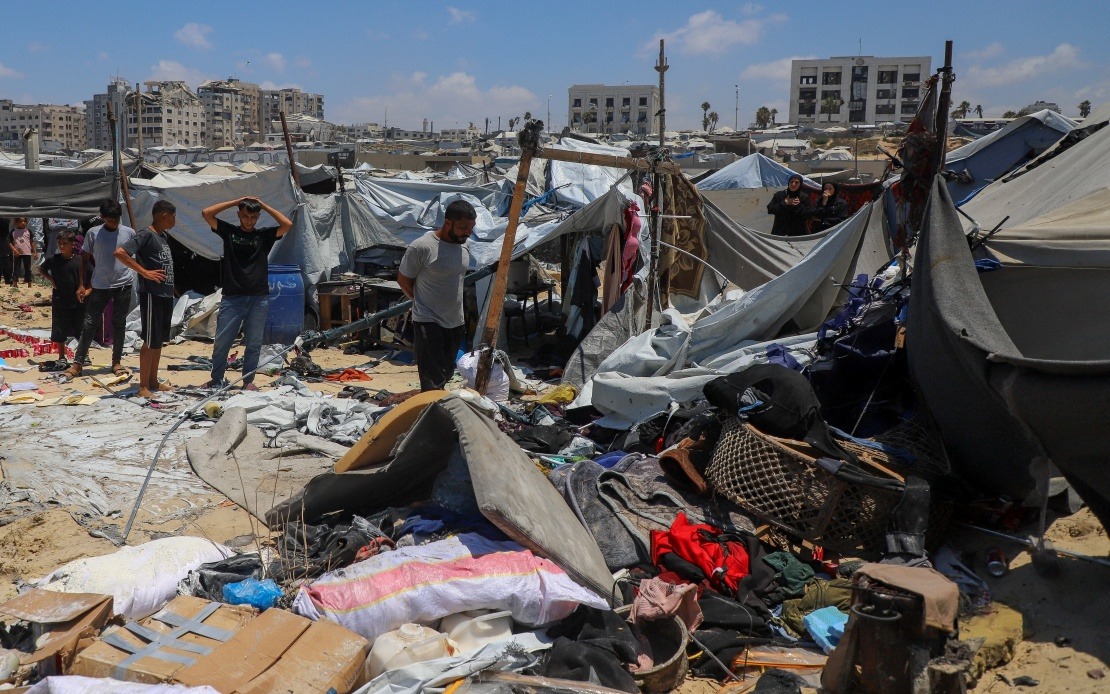
The extent of destruction across the Gaza Strip has reached alarming levels, according to documentation released by the Palestinian Government Communication Centre operating under the Prime Minister's Office. More than 90 per cent of the Gaza Strip has been destroyed, while Israeli occupation forces now command control over approximately 80 per cent of the war-affected territory, based on assessments cited in a Palestinian government weekly situation report made public on Monday.
The scale of military operations has accelerated significantly during the final week of June and opening days of July. Between June 29 and July 6, the Palestinian Government Communication Centre documented that Israeli military activities intensified substantially across multiple population centres, particularly in Khan Younis, Rafah, and Gaza City. Local medical sources attributed eight Palestinian deaths to military operations during this week-long period, reflecting the human toll of the ongoing conflict.
Beyond direct military engagement, Israeli forces have engaged in systematic demolition of residential structures across Gaza. The Palestinian government report documented instances in which occupied forces shelled populated neighbourhoods and razed homes, actions that have forced additional Palestinian families into displacement. The targeting of civilian infrastructure has compounded the humanitarian crisis, leaving families without shelter and basic services in an already devastated landscape.
Parallel operations continue across the occupied West Bank, extending the military presence beyond Gaza's borders. The Palestinian Government Communication Centre noted that Israeli occupation forces conducted extensive military raids throughout the West Bank during the same period, employing tactics including forced entry into homes, detention of Palestinians, restrictions on movement, and closure of key transportation routes. Major Palestinian urban centres have been affected, among them Ramallah, Nablus, Hebron, Bethlehem, Jenin, Qalqilya, Tulkarem, and sections of occupied Jerusalem.
Beyond official military operations, Israeli colonial settler militias have independently launched attacks targeting Palestinian communities and their economic assets. These groups have committed acts including arson against Palestinian commercial establishments, physical assaults on shepherds engaged in traditional pastoral activities, attempted livestock theft, and deliberate blockading of village access points. A cafeteria in the village of al-Lubban ash-Sharqiya fell victim to fire-setting, while Palestinian shepherds east of Bethlehem experienced coordinated attacks aimed at their livelihoods.
The disruption extends deeply into Palestinian agricultural systems, an economic sector already struggling under occupation. The Palestinian Ministry of Agriculture compiled separate documentation revealing a marked intensification in Israeli actions specifically targeting farming communities across the West Bank. This escalation has dismantled productive capacity that Palestinians depend upon for subsistence and income generation.
The destruction of agricultural resources has reached substantial proportions according to ministry records. A total of 2,559 olive trees have been uprooted, incinerated, or otherwise rendered unproductive during the reporting period. These trees, concentrated primarily in the governorates of Salfit, Jenin, and Nablus, represent assets accumulated over generations and central to Palestinian rural economies. The damage extends across at least 125 farming families, meaning more than one hundred separate household economies have suffered direct material losses.
The financial impact of agricultural destruction carries immediate and long-term consequences. The Palestinian Ministry of Agriculture calculated documented direct economic losses at approximately US$11.78 million from the week's activities targeting agricultural assets alone. This figure represents only quantifiable, immediately documentable losses and does not encompass indirect economic harm, lost future productivity, or costs associated with eventual replanting and recovery efforts that Palestinian farmers will necessarily undertake.
For Malaysian observers and policymakers, these developments underscore the expanding scope and intensity of military and settler operations across Palestinian territories. The systematic nature of destruction—from residential demolition to agricultural devastation—suggests a coordinated approach extending beyond conventional military engagement. The targeting of civilian economic infrastructure, particularly agriculture, indicates pressure on Palestinian civilian populations beyond immediate combat zones.
The humanitarian dimensions carry particular relevance for Southeast Asian nations emphasising civilian protection and international humanitarian law. The displacement of families, destruction of homes, and erasure of agricultural livelihoods represent situations that international humanitarian frameworks seek to prevent and regulate. Malaysia and neighbouring nations have historically advocated for civilian protection mechanisms and adherence to international legal standards in armed conflicts.
The concentration of Israeli control over approximately 80 per cent of Gaza Strip territory raises questions about governance, humanitarian access, and civilian administration in territories under military occupation. When military forces control such extensive territory, accountability mechanisms for civilian harm become complex, and the provision of humanitarian assistance and basic services faces significant obstacles. These conditions have cascading effects on food security, access to medical treatment, and the ability of civilian populations to rebuild.
The documentation released by Palestinian authorities occurs within a broader international context of ongoing scrutiny regarding conduct in the Gaza Strip and occupied West Bank. Multiple international organisations, human rights bodies, and regional observers have sought to verify claims regarding destruction levels and civilian impact. Palestinian government reporting provides one dataset within a larger body of documentation that continues to shape international discourse and policy considerations toward the region.

