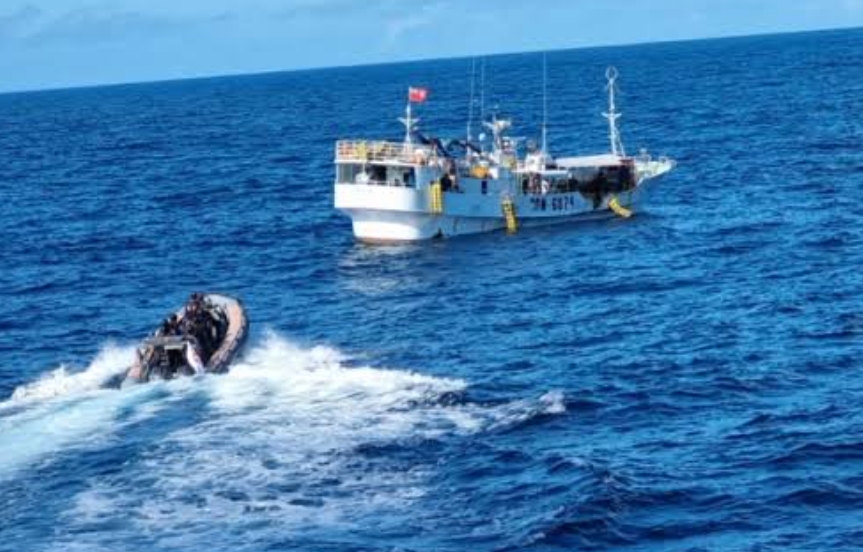
Pacific island nations have intensified their enforcement campaign against illegal fishing, with authorities in Kiribati, Palau and Papua New Guinea detaining at least four vessels flagged as Chinese or Indonesian this month. The crackdown forms part of a broader regional surveillance operation coordinated by the Pacific Islands Forum Fisheries Agency (FFA), which underscores mounting tensions between small island states and foreign fishing fleets exploiting their maritime zones.
The enforcement drive, designated Operation Island Chief, represented an unprecedented coordinated response across 11 Pacific island nations during a two-week campaign from August 3 to 14. Surveillance teams boarded more than 100 vessels across nearly 28 million square kilometres of ocean, while aerial reconnaissance missions conducted by Australian military aircraft and patrols by a United States Coast Guard vessel provided additional monitoring capacity. The scale of the operation reflects the strategic importance authorities now accord to protecting their fishing interests and detecting regulatory breaches.
The Pacific region holds exceptional economic and geopolitical significance in global seafood production. The waters controlled by these island states account for approximately half of the world's tuna catch, yet the islands themselves process or handle only 15 percent of this harvest. This asymmetry means that while foreign fleets extract enormous quantities of protein from their exclusive economic zones, Pacific islanders capture minimal value through downstream activities such as processing or distribution. The imbalance has become a focal point of policy debate, with island governments increasingly asserting their rights to harness greater economic benefit from their marine resources.
Financial revenues from fishing licenses and export arrangements provide critical income for Pacific island economies. The FFA reported that fishing-related access fees and export earnings generate approximately US$500 million and US$1.2 billion annually respectively for Pacific island states. Beyond direct government revenues, fishing supports the livelihoods of roughly one-third of all Pacific households, making maritime resource management an issue that touches nearly every community across the region. This structural dependence underscores why illegal fishing represents not merely a regulatory breach but a direct threat to economic stability and food security.
The typical arrangement governing fishing in Pacific waters involves long-distance fleets, predominantly from China, Taiwan and Southeast Asian nations, paying licensing fees to access the exclusive economic zones of small island states. These foreign operators then transport their catches directly to Asian markets, bypassing local processing infrastructure and employment opportunities. The system has generated revenue streams that Pacific governments have come to rely upon, yet it leaves island communities vulnerable to resource depletion and dependent on decisions made by distant commercial actors with little incentive to prioritize sustainability or local benefit.
The detention of vessels represents only the visible enforcement action. The FFA acknowledged identifying an additional 16 vessels as requiring further investigation during Operation Island Chief but declined to disclose details, citing sensitivities around naming foreign fishing operators. This reticence reflects deeper political complexities within the region, where China maintains substantial commercial fishing interests and joint venture partnerships with several Pacific island governments. Publicly highlighting Chinese infringements risks straining relationships with Beijing at a time when Pacific nations seek Chinese investment and diplomatic engagement, even as they simultaneously attempt to protect their maritime resources.
The sensitivity surrounding enforcement against Chinese vessels extends beyond diplomatic courtesy. Chinese fishing companies operate extensive long-distance fleets in Pacific waters and have established joint ventures with island governments, creating networks of economic interdependence that complicate straightforward enforcement. When authorities publicize actions against Chinese boats, they inevitably invite scrutiny of their own regulatory consistency and potential retaliation through withdrawal of commercial opportunities or diplomatic pressure. Papua New Guinea, Palau and Kiribati's limited response to media inquiries about Operation Island Chief likely reflects these underlying political calculations.
Recent incidents illustrate the persistent enforcement challenge. Tuvalu, which maintains diplomatic relations with Taiwan rather than the People's Republic of China, detained a Chinese fishing vessel in July after detecting false location transmissions—a technique used to conceal illegal fishing grounds. Following a 24-day detention and monetary fine, authorities released the vessel. Peter Hammarstedt, captain of the conservation vessel Sea Shepherd accompanying Tuvalu maritime police on patrol, documented the case as an example of regional enforcement capacity, yet the rapid release after penalties suggests limited appetite for sustained confrontation with major fishing nations.
Historical enforcement patterns reveal the scope of infractions. Data from the Western and Central Pacific Fisheries Commission covering the period from 2008 to 2026 documented 278 penalty notices issued to Chinese-flagged fishing boats, placing China second only to Taiwan, which accumulated 319 infringements across the same timeframe. These statistics indicate systemic non-compliance rather than isolated incidents, suggesting that economic incentives to violate regulations—whether through false position reporting, unreported catches or operating without proper authorization—substantially outweigh the risks and penalties that Pacific island enforcement mechanisms can impose.
The upcoming annual summit of Pacific island leaders scheduled for August 30 in Palau will provide a forum for discussing coordinated responses to fishing enforcement challenges. Regional leaders are expected to deliberate on developing enhanced strategies for protecting fishing rights and maximizing government revenues as climate change increasingly threatens fish stocks across the Pacific. Enhanced cooperation could include stronger information-sharing protocols, joint prosecution arrangements, and technology deployment for real-time vessel monitoring, though implementing such measures requires sustained political will and financial resources that smaller island states often struggle to maintain.
The enforcement campaign reflects broader geopolitical realignments within the Pacific, where island nations attempt to balance revenue dependence on foreign fishing access against sustainability imperatives and equitable resource distribution. As sea levels rise and marine resources face intensifying pressure, the competition for fishing rights and regulatory authority will likely intensify, placing greater demands on Pacific island governments to assert control over their maritime zones while navigating complex relationships with powerful fishing nations and their commercial operators.

