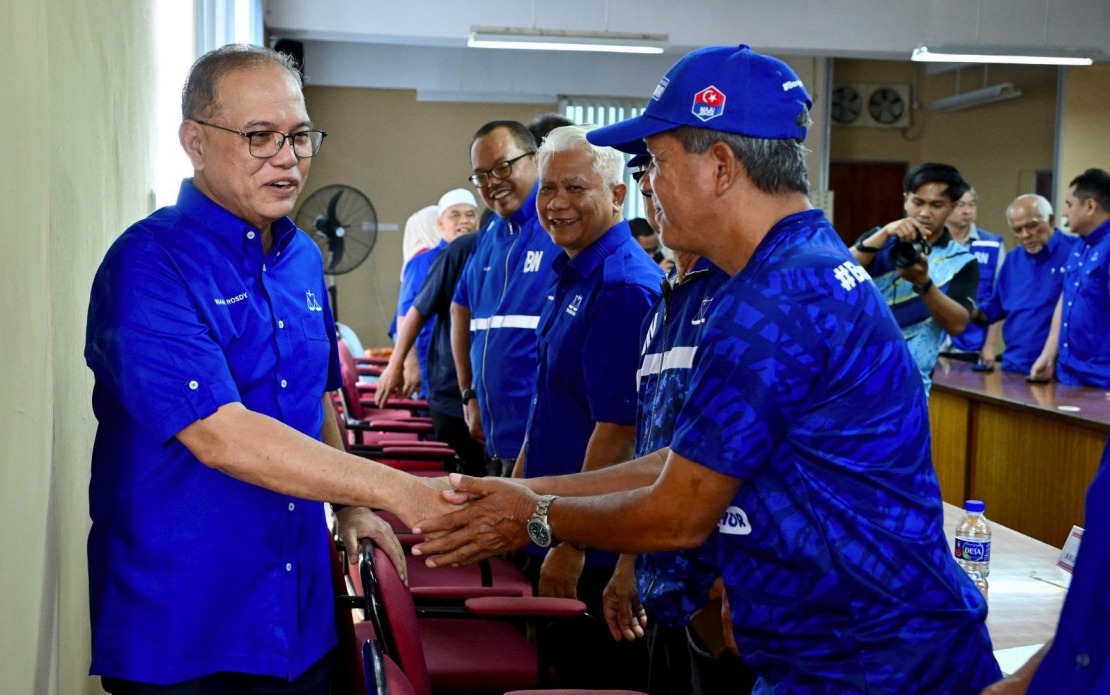
Pahang Barisan Nasional has committed significant campaign resources to the Johor state election, with party machinery members deployed across four strategic constituencies within the Tanjung Piai parliamentary division. Pahang Menteri Besar Datuk Seri Wan Rosdy Wan Ismail revealed this coordinated effort on June 30, underscoring the cross-state collaboration that has become increasingly common in Malaysian electoral contests as component parties leverage their organisational networks beyond state boundaries.
The four targeted seats—Pekan Nanas, Pulai Sebatang, Benut, and Kukup—represent a concentrated geographical campaign strategy within Tanjung Piai, a constituency historically significant in Malaysian politics. This focused approach suggests BN campaign planners have identified these seats as either vulnerable to opposition challenges or representing pickup opportunities with sufficient voter receptivity to justify intensive ground-level intervention. The concentration of external resources in these specific constituencies reflects sophisticated electoral calculus about where marginal gains might prove decisive in a competitive state-level contest.
Wan Rosdy's personal involvement in the campaign trail extends beyond directing others, with the Menteri Besar planning to visit FELDA settlements in Segamat by the following Thursday. This direct engagement by a senior ministerial figure demonstrates the campaign's escalation phase ahead of the July 11 election date. FELDA constituencies have traditionally represented crucial swing voter blocks in Malaysian politics, with agricultural and settler communities often determining electoral outcomes in rural-dependent states like Johor. The allocation of high-level political attention to these areas signals BN's recognition of their significance to overall victory calculations.
The confidence expressed by Wan Rosdy regarding BN's electoral prospects stems from assessments made during his three-day visit to Johor immediately following nomination day. His observations about party machinery morale and candidate calibre suggest internal BN evaluations have concluded that ground-level campaign enthusiasm and candidate quality meet the threshold needed for competitive positioning. However, such optimistic statements from campaign officials require contextual grounding in the actual competitive landscape and opposition mobilisation efforts across the state.
With 172 candidates contesting across 56 state seats, the Johor election represents a substantial electoral undertaking with multiple contests occurring simultaneously across diverse constituencies. This numerical scope means that single-state deployment of resources, even when supplemented by inter-state party machinery assistance, stretches party organisational capacity. The decision to concentrate Pahang BN assistance on four specific seats rather than dispersing across numerous constituencies reflects strategic triage about where incremental support delivers maximum electoral impact.
The July 7 early voting period preceding the main election day provides an additional tactical window for campaign finishing. This extended voting arrangement, increasingly adopted across Malaysian elections, potentially dilutes traditional election-day campaign concentrations and shifts strategic emphasis to reaching voters across an expanded timeframe. Campaigns must now allocate resources across multiple voting days rather than focusing efforts on a single electoral moment, fundamentally altering conventional campaign choreography that Malaysian parties developed over decades.
The participation of Pahang's BN contingent in the Johor campaign illustrates the interconnected nature of Malaysian electoral politics, where state-level contests increasingly attract participation from adjacent or ideologically aligned state party structures. This cross-state mobilisation has become particularly pronounced in contests involving BN, which maintains hierarchical coordination mechanisms enabling state-to-state personnel deployment. Opposition coalitions, lacking comparable organisational integration historically, have attempted to develop comparable coordination mechanisms in recent electoral cycles with variable success rates.
Pahang's own political position as a BN-governed state seeking to maintain its coalition control creates alignment incentives for supporting BN efforts in neighbouring Johor. Strong BN performance in adjacent states reinforces the coalition's regional dominance and provides momentum that indirectly benefits component parties in each state's particular political calculations. Conversely, any regional weakening of BN positioning would immediately threaten the coalition's hold on Pahang and create internal political pressure on state leadership to demonstrate continued electoral viability.
The campaign narrative emphasising voter receptivity and positive public sentiment requires careful interpretation against alternative explanations for campaign intensification. Campaigns traditionally escalate resource deployment as election dates approach regardless of underlying electoral strength, driven by institutional imperatives to demonstrate activist commitment and organisational capacity. The framing of ground observations as inherently favourable reflects normal campaign rhetoric rather than necessarily indicating genuine competitive advantage, particularly absent independent assessment of comparable opposition campaign dynamics and voter sentiment tracking.
Looking toward July 11, the Johor election outcome will carry implications extending beyond the state's immediate governance. As a BN-administered state since independence, Johor's electoral performance holds symbolic significance for the coalition's broader electoral credibility and component party legitimacy. Senior political figures like Wan Rosdy maintaining visible engagement through personal campaign participation serves multiple constituencies—rewarding local party activists with leadership attention, signalling superior organisational capacity through cross-state mobilisation, and reinforcing the coalition narrative of BN as a professionally managed, resource-rich electoral force.
The specific constituencies receiving Pahang BN support—all situated within Tanjung Piai—suggest campaign strategists identified this parliamentary division as a critical battleground requiring concentrated resource application. Tanjung Piai gained national prominence through a 2019 by-election that highlighted the electoral fluidity affecting Malaysian politics in recent years, demonstrating that even traditionally secure constituencies remain subject to unexpected competitive pressures. Renewed concentration of campaign effort in this division reflects institutional learning from such recent electoral surprises.

