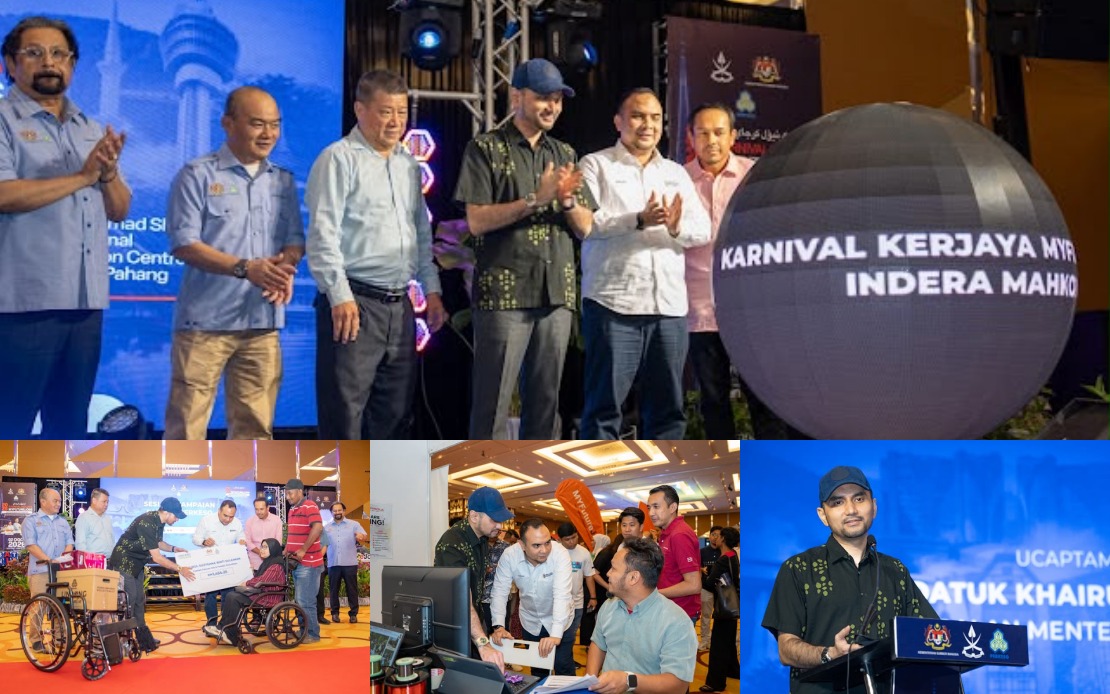
Pahang has cemented its position as the employment leader along Malaysia's east coast, posting a labour force participation rate of 65.3 per cent during the first quarter of 2026 while maintaining an unemployment rate of just 1.9 per cent. The state's performance underscores the effectiveness of coordinated federal and state-level initiatives designed to match job seekers with employers across multiple sectors, a model that regional authorities are now examining for potential replication.
The achievement was highlighted during the opening of the Indera Mahkota MyFutureJobs Career Carnival 2026, where Deputy Human Resources Minister Datuk Khairul Firdaus Akbar Khan emphasised the government's sustained commitment to narrowing joblessness through platform-based employment matching. The ministry has invested considerable resources in removing structural barriers that traditionally prevented rural and disadvantaged communities from accessing formal labour market opportunities. This event alone offered 6,000 positions sourced from 30 employers operating across diverse industrial sectors, demonstrating the scalability of the government's approach to connecting supply and demand in the labour market.
The Social Security Organisation (PERKESO) has emerged as the institutional backbone of Malaysia's employment push, operating the MYFutureJobs platform as a centralised repository for job listings and candidate profiles. Since the platform's launch in 2023 through late July 2026, Pahang has witnessed 26,877 successful job placements through PERKESO-coordinated initiatives, a figure that reflects not merely transaction volumes but tangible improvements in household income and economic security across the state. The accumulation of more than 10,000 advertised vacancies on the portal during this period reveals the depth of employer engagement, suggesting that private sector confidence in the mechanism has strengthened considerably.
Beyond raw placement numbers, PERKESO has orchestrated 1,277 interview preparation programmes and career fairs throughout Pahang, indicating a deliberate strategy to build job-seeker capacity rather than simply facilitating passive matching. This hands-on approach addresses a critical gap identified by labour economists: many unemployed individuals, particularly in underserved areas, lack interview skills, industry knowledge, and professional networks essential for successful hiring. By 2026, the platform had registered 11,857 active job seekers in Pahang, a metric that suggests growing awareness and trust among the working-age population regarding formal pathways to employment.
Khairul Firdaus articulated a vision of employment policy that transcends mere job placement, incorporating upskilling and professional development as integral components. He urged workers to engage actively with training programmes offered through government channels, recognising that sustainable employment requires workers who can adapt to evolving industry standards and technological change. This perspective reflects a shift from traditional labour market interventions toward a more comprehensive human capital development framework, one that acknowledges the intermediate role that training plays in reducing skills mismatches and wage inequality.
The government's complementary initiative, Sahabat MADANI, represents an attempt to embed employment services and community support within voluntary grassroots networks. Launched at the Kuantan event by Prime Minister's political secretary Datuk Ahmad Farhan Fauzi, the programme emphasises volunteerism, social cohesion, and citizen participation in local economic development. The scheme has already recruited 2,000 members in Pahang, though officials have signalled ambitions to expand this base substantially. By positioning volunteers as intermediaries between government agencies and communities, the initiative seeks to address information asymmetries and trust deficits that historically have limited programme uptake in rural Malaysia.
Ahmad Farhan characterised Sahabat MADANI not merely as a volunteer recruitment scheme but as a foundational community movement intended to bridge government and grassroots constituencies. This framing reflects broader governance strategies aimed at distributing administrative capacity beyond formal state structures, leveraging citizen networks to deliver services and gather intelligence on local conditions. The approach carries implications for how Malaysian policymakers envision the role of young people in nation-building; Sahabat MADANI members are explicitly encouraged to serve as "eyes and ears" for the government, suggesting a participatory model of governance that blurs boundaries between civic engagement and state function.
For Malaysia's broader labour market, Pahang's demonstrated success offers a template for policymakers confronting stubbornly high youth unemployment and regional disparities in job access. The state's combination of institutional capacity through PERKESO, employer engagement through structured career events, and volunteer mobilisation through Sahabat MADANI creates a multi-layered ecosystem that addresses employment from supply, demand, and information perspectives simultaneously. This integrated approach contrasts with earlier, narrower interventions that relied primarily on subsidised wage schemes or passive job boards.
The 1.9 per cent unemployment rate in Pahang, while commendable, warrants scrutiny regarding its composition and sustainability. Low headline unemployment figures can mask underemployment, irregular work, and labour market withdrawal among discouraged workers. Understanding whether Pahang's gains reflect genuine full-employment conditions or merely reflect improved measurement and frictional unemployment reduction would provide crucial context for assessing programme effectiveness. Regional variations in unemployment measurement and participation rate definitions across Malaysian states further complicate comparative analysis.
Looking forward, the scalability of Pahang's model across other east coast states and beyond hinges on several factors: consistent government funding, sustained employer participation, capacity of PERKESO to manage growing volumes, and the durability of volunteer networks. The success of Sahabat MADANI particularly depends on retaining volunteer commitment beyond the initial recruitment phase, a challenge that voluntary programmes frequently face in less urbanised contexts. Should these challenges be overcome, the template could inform national efforts to address the structural employment challenges facing Malaysia's youth population and regional economies.
The integration of MYFutureJobs and Sahabat MADANI within Pahang demonstrates how employment policy can function as an instrument for broader social cohesion and community participation. Rather than treating joblessness purely as an economic problem amenable to market-based solutions, the state-level approach incorporates values of mutual responsibility and inclusive development. For Malaysian policymakers and regional observers, Pahang's experience suggests that durable labour market improvements require sustained institutional commitment, multi-stakeholder engagement, and embedding employment services within trusted community structures rather than relying solely on centralised bureaucratic mechanisms.

