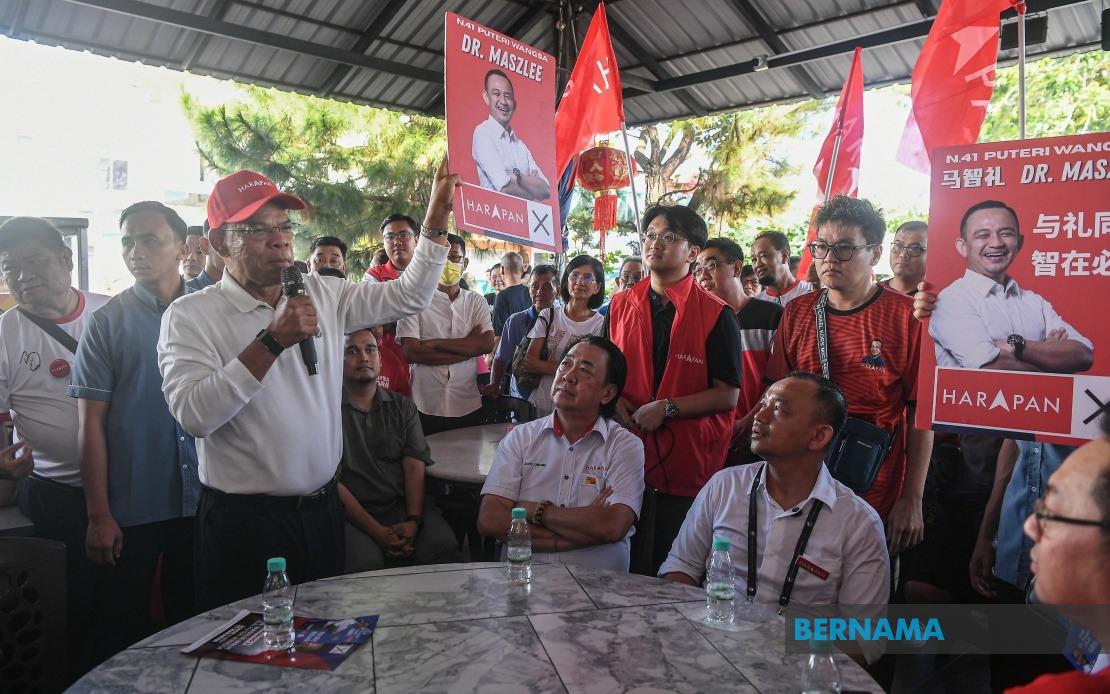
Pakatan Harapan's momentum in the Johor state election campaign rests on a methodical, data-driven approach to seat allocation and resource deployment that reflects both changing ground sentiment and strategic lessons from previous electoral contests. Party secretary-general Datuk Seri Saifuddin Nasution Ismail outlined how the coalition has categorized the 56 contested state seats into tiered priority clusters, allowing campaign resources to concentrate on battleground areas where victory remains genuinely achievable rather than spreading effort thinly across all constituencies.
The coalition's analytical framework recognizes that Johor's electoral landscape is far from uniform. Constituencies such as Puteri Wangsa and Johor Lama present fundamentally different demographic, socioeconomic, and political challenges, as do rural seats like Endau compared to urban centers such as Larkin. By assigning priority grades based on current polling data and voter sentiment patterns, PH leadership argues that the party can deploy its candidate roster, campaign machinery, and messaging in ways that maximize conversion of persuadable voters. This represents a significant departure from conventional campaigns that treat all seats as equally important irrespective of political realities on the ground.
Saifuddin Nasution, who doubles as PKR's joint election director, attributes the apparent surge in PH support not merely to the coalition's own strategic competence but also to blunders and contradictions among opposing camps. Most notably, PAS's decision to contest only 11 seats whilst explicitly directing its supporters to back Barisan Nasional candidates in the remaining 45 constituencies creates an unusual dynamic that may confuse voters and undercut Islamist party momentum. This move—counterintuitive to traditional notions of political competition—has inadvertently handed PH a narrative advantage by highlighting what coalition strategists frame as opportunistic rather than principled campaigning.
In contrast, PH has adopted what its leadership describes as a transparent, coherent approach. The coalition announced its full slate distribution upfront: 20 seats for PKR, 19 for Amanah, and 17 for DAP. This clarity, party officials argue, signals internal discipline and reduces voter confusion about coalition intentions should PH secure the state mandate. The accompanying campaign manifesto, framed as realistic and implementable, stands in implicit rebuke to what PH portrays as more grandiose or internally inconsistent opposition promises. For Malaysian voters accustomed to complex multi-coalition political dynamics, such clarity carries genuine appeal.
The defection or pivot of former UMNO figures to the PH fold adds another tactical dimension to the coalition's campaign calculus. The high-profile presence of Datuk Dr Mohd Puad Zarkashi—a former UMNO Supreme Council member—at talks with Prime Minister Datuk Seri Anwar Ibrahim in Felda Ulu Tiram signals that PH's appeal extends beyond traditional opposition bases. For rural and Malay-Muslim constituencies that historically backed UMNO, such crossovers serve as permission structures, suggesting that voting for PH does not represent a radical departure from established political identities but rather a pragmatic adjustment to changing circumstances. This is particularly significant in Johor, where Malay-Muslim voters form substantial electoral blocs in many state seats.
The specific candidate quality matters equally to strategic framing. Saifuddin Nasution highlighted Dr Maszlee Malik, PH's contender in Puteri Wangsa, as exemplifying the caliber of talent fielded by the coalition. Such endorsements serve dual purposes: they reinforce internal party morale and signal to swing voters that PH has selected competent, credible individuals capable of serving constituency interests effectively. This contrasts with voter perceptions of some opposition candidates, which may be hampered by limited track records or narrow sectional appeal.
The Johor state election, formally the 16th Johor Dewan Undangan Negeri election, encompasses a competitive field of 172 total candidates vying for 56 seats. Early voting occurred on July 7, with main polling day scheduled for July 11. The relatively high candidate density suggests genuine contest in many constituencies rather than walkover victories, placing a premium on ground-level campaigning and localized persuasion efforts. PH's granular strategy appears calibrated to this more competitive environment.
For Malaysian observers and regional analysts, the Johor contest carries implications beyond the state itself. Johor has traditionally served as a bellwether for broader peninsular political trends. A strong PH performance would validate the coalition's claim to renewed electoral viability following the Pakatan government's collapse in 2020 and subsequent political turbulence. Conversely, a disappointing result might suggest that despite tactical sophistication, the coalition continues to struggle with structural voter resistance in certain demographic segments or geographic regions. The state's economic significance—as Malaysia's major manufacturing and port hub—means that state governance decisions on taxation, land use, and labor policy carry real business consequences.
Saifuddin Nasution's emphasis on ground-level support trends and evolving voter sentiment reflects a recognition that modern electoral contests increasingly reward parties that combine technological sophistication in voter targeting with genuine attentiveness to local grievances and constituency dynamics. The classification system PH employs suggests internal polling and data analytics informing campaign resource allocation. For Southeast Asian politics more broadly, this represents a professionalization trend visible across democracies in the region, where imported campaign technologies and methodologies supplement traditional party machinery and personal networks.
The strategic calculations also reveal how coalition politics in Malaysia requires constant calibration and narrative management. PH must simultaneously appeal to urban middle-class voters concerned about institutional integrity and democratic governance, rural constituencies prioritizing economic opportunity and social services, and Malay-Muslim voters weighing religious policy preferences against material interests. The seat-specific priority system allows the coalition to tailor messaging and candidate selection to these distinct constituencies rather than imposing a uniform campaign template.
Looking beyond July 11, the outcome will test whether PH's analytical approach to campaigning has genuinely shifted underlying voter sentiment or merely optimized the coalition's performance within pre-existing political constraints. Johor's electoral verdict will clarify whether the apparent ground-level support gains Saifuddin Nasution emphasizes reflect genuine momentum building toward a PH state government or represent tactical gains insufficient to overcome Barisan Nasional's structural advantages in the state.

