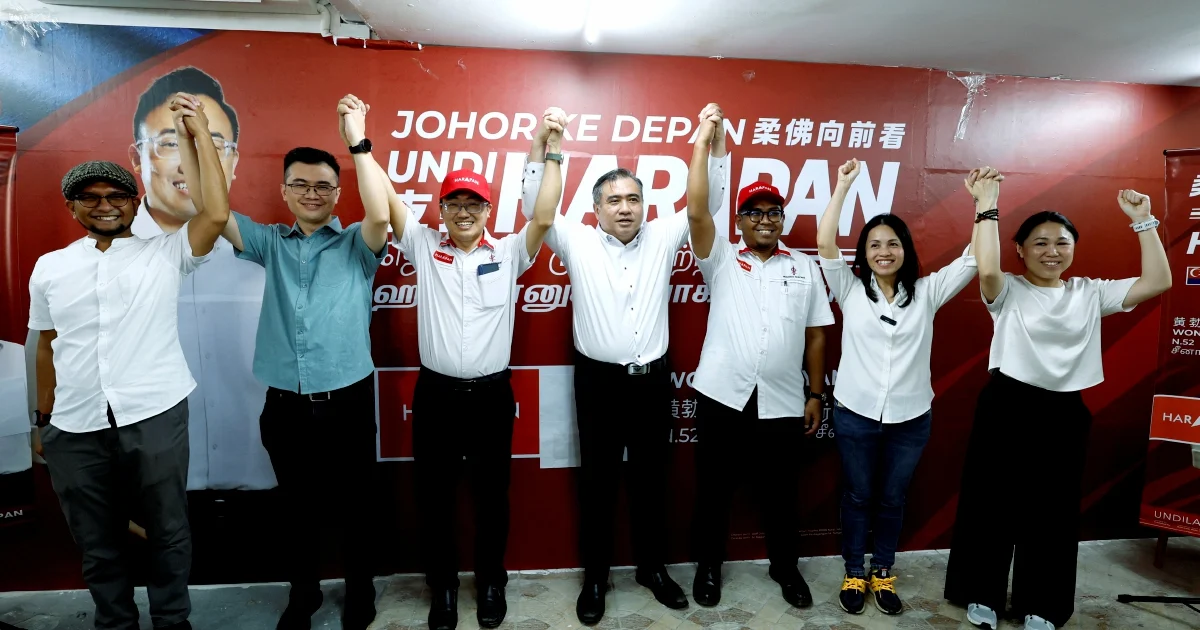
Pakatan Harapan is maintaining strategic focus on securing victory in the Johor state election before committing to a specific candidate for Menteri Besar, party leaders have confirmed. The coalition's approach reflects a deliberate decision to concentrate campaigning efforts on winning voter support rather than becoming embroiled in leadership succession debates that could distract from the electoral contest or create internal friction ahead of polling day.
The decision to postpone naming a Menteri Besar candidate—whether from within Pakatan Harapan's own ranks or through negotiation with potential coalition partners—demonstrates the political calculus underlying contemporary Malaysian state elections. By maintaining ambiguity on this front, the coalition avoids alienating competing power bases within its own structure, each of which may harbour aspirations for the top state executive position. This approach has become increasingly common in Malaysian politics, where premature announcements of candidates can trigger internal competition that undermines party unity during the crucial campaign phase.
For Malaysian voters in Johor, the deferral suggests that the broader coalition remains genuinely uncertain about post-election scenarios. The party leadership evidently recognises that the composition of the eventual state government may depend on results across multiple constituencies, the performance of different coalition partners, and the need to negotiate with independent candidates or other parties if the coalition falls short of an outright majority. Any premature commitment to a specific candidate could therefore prove diplomatically awkward if the actual election results render such commitments untenable.
The timing of such announcements carries particular significance in Johor, Malaysia's second-largest state by population and a significant economic and political powerhouse. The Menteri Besar position represents not merely a ceremonial role but direct control over state administration, development priorities, and resource allocation worth billions of ringgit annually. State-level decisions on infrastructure projects, licensing, and business development can substantially influence the fortunes of multiple sectors, making the position strategically vital for any coalition seeking to consolidate power beyond the immediate election cycle.
Pakatan Harapan's coalition structure itself complicates the nomination process. The alliance typically comprises several political parties with distinct organisational bases, electoral constituencies, and internal leadership hierarchies. Designating a candidate too early risks upsetting party leaders within the coalition who may view themselves as equally deserving of the top position, or whose constituencies contribute significantly to any coalition electoral victory. The tension between rewarding loyalty, maintaining internal balance, and achieving electoral success creates a delicate political equation that cannot be resolved through announcement alone.
From a voter perspective, however, the deferral of candidate announcements introduces a degree of uncertainty into the electoral process. Voters in Johor cannot directly evaluate the leadership qualities, policy priorities, or administrative track record of the person who will occupy the chief executive's office if their preferred coalition wins. This creates an implicit trust dynamic wherein voters must have confidence not only in the coalition's overall platform but also in the leadership council's judgment in selecting an appropriate Menteri Besar after the election concludes.
Historically, Johor has been a stronghold of the Barisan Nasional, particularly under the long tenure of Zahid Hamidi and his predecessors. Any Pakatan Harapan victory would represent a significant shift in Johor's political landscape and would likely trigger intense speculation about the state's future direction under new leadership. The coalition's reluctance to name a candidate beforehand may reflect uncertainty about whether it can actually achieve victory in the first instance, or alternatively, a sophisticated understanding that maintaining focus on the election itself provides the best path to success.
The coalition's decision also has implications for how different political actors within Pakatan Harapan position themselves during the campaign. Without a designated candidate, ambitious party figures can campaign actively and accumulate political capital—measured through constituent support, campaign effectiveness, and electoral contributions to coalition victories—that will eventually translate into credibility for post-election negotiations over who leads Johor. This dynamic transforms the campaign period into an implicit competition for resources and recognition, with each party leader or prospective candidate seeking to demonstrate their value to the coalition.
Regional political observers note that this approach contrasts with some neighbouring states where coalition partners have negotiated power-sharing arrangements before elections, sometimes including explicit agreements about which party receives certain ministerial positions. Johor's lack of such pre-election clarity may reflect genuine uncertainty about electoral outcomes, or perhaps a deliberate choice to maintain flexibility in post-election negotiations with various stakeholders.
Looking forward, the actual selection process for the Menteri Besar will likely involve consultations among Pakatan Harapan's top leadership council, and potentially discussions with other parties if the coalition configuration requires it. The process may also be influenced by considerations of ethnic and religious representation, geographic balance across Johor's different regions, and the perceived administrative competence and public appeal of available candidates.
For Malaysian politics more broadly, the decision underscores how contemporary elections increasingly function as preliminary contests whose outcomes must then be processed through post-election negotiations and power-sharing arrangements. Voters cast ballots with incomplete information about final leadership outcomes, placing considerable trust in political coalitions to make wise choices after election day. This pattern has become routine in Malaysian state and federal politics, reflecting the complexity of multi-party coalitions and the contingencies introduced by competitive electoral contests.

