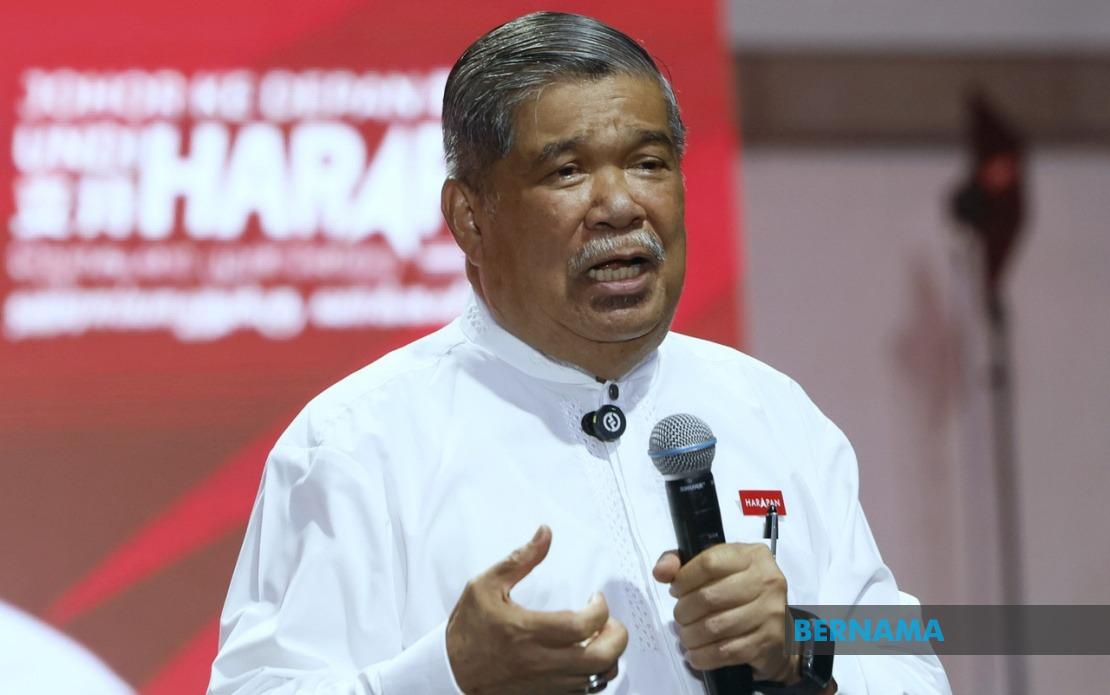
Pakatan Harapan (PH) has signalled its determination to maintain its campaign momentum despite PAS issuing instructions to its supporters to back Barisan Nasional (BN) candidates in seats the Islamic party is not directly contesting in the Johor state election. Amanah president Datuk Seri Mohamad Sabu, speaking in Johor Bahru on July 1, made clear that the coalition remains undeterred by such tactical manoeuvres from rival parties, emphasising that PH would continue its planned campaigning without allowing itself to be drawn into distractions.
The political landscape in Johor has become increasingly complex as the July 11 polling date approaches. PAS's decision to direct its voters towards BN candidates in specific constituencies represents a calculated move to consolidate the opposition to PH's dominance, yet Mohamad Sabu's comments suggest the coalition views this as a sign of weakness rather than a genuine threat to its electoral prospects. By framing the directive as a provocation that PH would simply ignore, the coalition is attempting to project confidence and maintain focus on what it considers its core message.
Mohamad Sabu, who also holds the portfolio of Minister of Agriculture and Food Security, articulated PH's strategic positioning around multiracial and multi-religious cooperation. He argued that this foundation represents not merely a political slogan but the essential basis for both political stability and economic development across the nation. This appeal to unity principles contrasts sharply with what the coalition characterises as divisive messaging from opponents, attempting to frame the election as fundamentally about competing visions for the country's future rather than mere partisan rivalry.
The Amanah president's call for Johor voters to reject racial and religious appeals in favour of assessing candidates on merit and service record directly addresses one of PH's strategic vulnerabilities. The coalition has historically struggled to maintain the same level of support among Malay-Muslim voters compared to other demographic groups, making such messaging critical to its electoral fortunes. By emphasising capability and commitment to justice rather than identity-based voting, PH seeks to reframe the conversation away from terrain where its competitors might hold advantages.
A key element of PH's strategy centres on achieving administrative alignment between the Johor state government and the federal government should voters grant it the mandate. Mohamad Sabu highlighted how such synchronisation would be essential for implementing transformative projects across multiple sectors. He specifically identified public transport system overhaul, improvements at international entry points, and investment attraction as priority areas where coordinated federal-state action would yield tangible benefits for residents. This argument attempts to move voters beyond traditional political rivalries towards considering practical governance outcomes.
Deputy Finance Minister Liew Chin Tong, speaking in his capacity as DAP strategic director, introduced voter turnout as perhaps the most critical variable determining the election outcome. His analysis pointed to the 2022 state election, where lower turnout benefited BN considerably. Additionally, he highlighted how COVID-19 travel restrictions had prevented many Johor voters working in Singapore from returning home to vote, a circumstance that will not apply in 2024. Liew's implication was clear: if younger voters and out-of-state workers participate at higher rates this time, the electoral dynamics could shift decisively in PH's favour.
Liew extended the discussion beyond political competition to emphasise the need for substantive policy debate. He argued that the second phase of campaigning ought to focus on concrete proposals addressing people's day-to-day concerns rather than remaining fixated on political rivalries. This framing reflects a broader PH strategy to shift electoral discourse from identity and affiliation towards quality-of-life issues where the coalition believes it has stronger ground.
The employment situation particularly features in PH's policy emphasis, with Liew stressing the need to create high-quality jobs offering competitive remuneration. His concern that young Johoreans increasingly seek work in neighbouring Singapore touches on an economic anxiety affecting the state's demographic profile. By positioning itself as the force capable of reversing this brain drain through economic dynamism, PH attempts to appeal directly to the aspirations of younger voters who might otherwise vote based on traditional family allegiances or communal identities.
Beyond employment, Liew identified a comprehensive agenda encompassing public transport infrastructure, flood management, drainage and river maintenance, provisions for an ageing population, and childcare facilities. These represent areas where state-federal coordination, which PH can provide through its control of both levels, would streamline implementation and resource allocation. The breadth of this agenda signals PH's ambition to govern comprehensively rather than merely to win seats.
The Johor-Singapore Special Economic Zone (JS-SEZ) emerges as a flagship project where federal-state cooperation becomes especially crucial for success. Liew's emphasis on this development initiative underscores how PH intends to position economic partnership with Singapore as beneficial rather than threatening, particularly to younger voters concerned about employment opportunities and regional prosperity. Successfully accelerating this project could generate the employment improvements PH promises.
With all 56 state seats being contested by both major coalitions, the election presents a comprehensive test of voter preferences. Early voting scheduled for July 7 followed by general polling on July 11 will reveal whether PH's emphasis on multiracial cooperation, administrative alignment, and practical governance can overcome traditional voting patterns or whether BN retains sufficient support to maintain control of the state. The turnout figures, particularly among younger voters and those working across the causeway, will prove decisive in determining which narrative prevails.

