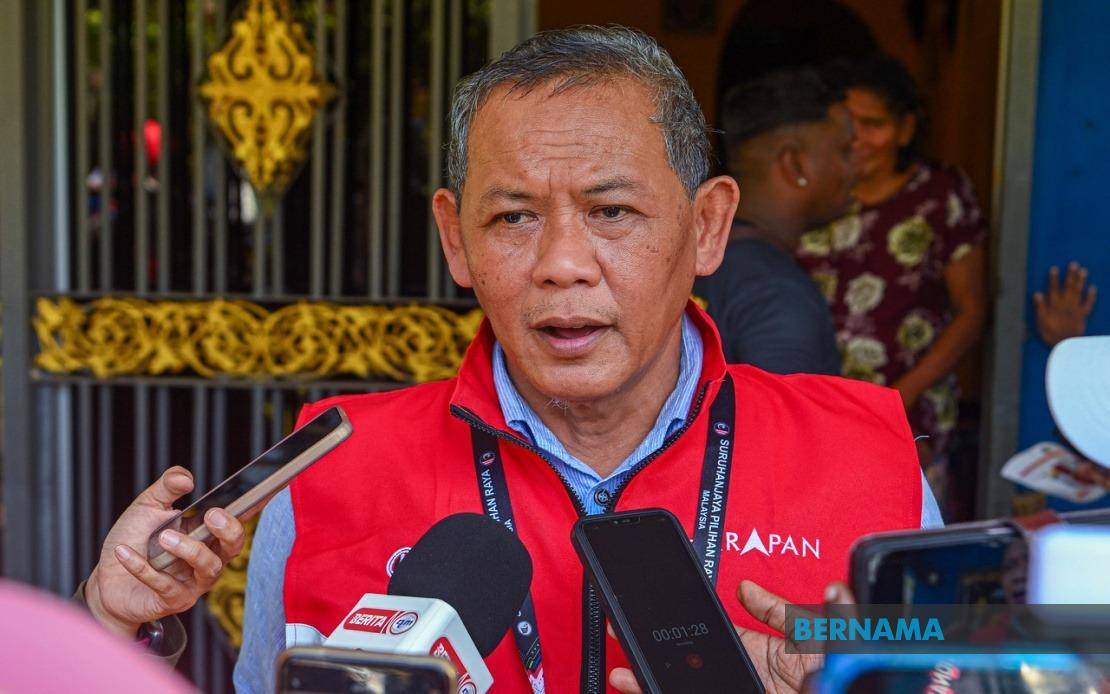
Pakatan Harapan's strategy for the upcoming Negeri Sembilan state election reflects a deliberate shift toward a broader electoral coalition, with state chairman Datuk Seri Aminuddin Harun announcing that the coalition's manifesto now encompasses support for middle-income households alongside traditional assistance for lower-income groups. The 10-point platform, unveiled under the banner 'Negeri Sembilan Kekal Harapan' (Negeri Sembilan Stays with Harapan), signals a recognition that winning the August 1 election requires appealing to a wider cross-section of the state's population rather than concentrating resources on the bottom 40 per cent of earners.
The expansion to include M40 families—those in the middle 40 per cent income bracket—represents a tactical recalibration by PH ahead of the polls. Aminuddin explained that while previous PH manifestos focused narrowly on the B40 group, the party has now extended education access and welfare initiatives to reach middle-income households. This approach acknowledges the growing political importance of Malaysia's expanding middle class and their concerns about education costs, healthcare access, and cost-of-living pressures that often fall outside the scope of purely poverty-focused programmes. For Malaysian voters across the income spectrum, this signals a move toward universal or near-universal benefit schemes rather than means-tested assistance.
The timing of this policy repositioning is significant given the electoral landscape. Aminuddin himself faces a three-cornered contest in Linggi, where he squares off against Barisan Nasional incumbent Datuk Mohd Faizal Ramli and Parti Pribumi Bersatu Malaysia's Zamri Md Said. The diverse opposition in this constituency mirrors broader fragmentation in Malaysian politics, where no single faction commands overwhelming support. By broadening the manifesto's appeal beyond traditional PH constituencies, the coalition appears to be hedging against potential vote-splitting and attempting to consolidate support across class lines.
Crucially, Aminuddin emphasised that PH does not merely present manifestos as election rhetoric but has a documented track record of implementation. He highlighted the coalition's governance of Negeri Sembilan since 2018, arguing that five years of delivering on prior commitments demonstrates institutional capacity and genuine commitment. This framing is important in a Malaysian context where voters have grown increasingly sceptical of campaign promises after experiencing multiple political transitions. The emphasis on delivery over promises represents an attempt to build voter trust through demonstrated competence.
The expansion to middle-income support also reflects broader economic realities facing Malaysian households. The M40 group, while substantially better off than the B40, nonetheless faces real pressures in areas such as education financing for children, healthcare expenses, and housing affordability. By incorporating these concerns into a state-level manifesto, PH is acknowledging that the post-pandemic economy has created vulnerabilities across income groups and that middle-income households cannot be taken for granted or ignored in political calculations. This is particularly relevant in Negeri Sembilan, which includes both prosperous urban areas near Kuala Lumpur and more modest semi-rural communities.
The manifesto's emphasis on education deserves particular attention, as it signals recognition that quality schooling and vocational training are crucial to social mobility. By extending education access initiatives to M40 families, PH is positioning itself as responsive to a key concern that transcends income categories. Parents earning RM5,000 to RM8,000 monthly often struggle with private tuition costs and supplementary education expenses, making expanded public education provision genuinely appealing across socioeconomic strata.
Aminuddin's appeal for a mature election campaign and avoidance of divisive social issues reflects awareness that Negeri Sembilan, like much of Malaysia, contains multiple ethnic and religious communities with differing priorities. His engagement with the Indian community at Sekang Estate demonstrates targeted outreach, while his call for restraint in campaign rhetoric suggests concern that inflammatory issues could fracture the broad coalition PH is attempting to build. This balancing act—pursuing votes across different groups while maintaining social harmony—remains central to Malaysian electoral politics.
The dissolution of the state assembly on June 5 set the stage for this election cycle, with polling scheduled for August 1 and early voting on July 28. The compressed timeline means that voter engagement through community programmes and manifesto launch events carries heightened weight, as there is limited time for messaging to penetrate the broader electorate. PH's decision to conduct community engagement alongside manifesto announcements reflects sophistication in recognising that policy platforms must be explained and contextualised within local communities rather than simply disseminated through media channels.
From a Southeast Asian perspective, the Malaysian approach to income-based welfare categorisation—B40, M40, and T20—offers a model distinct from purely needs-based or universal systems. By refining this framework to extend benefits upward, PH is responding to political pressures that other regional governments face as middle-class cohorts expand and expectations rise. The question of how to allocate limited state resources across increasingly fragmented income groups remains unresolved in Malaysian politics, and Negeri Sembilan's election will provide a test case for whether broadened manifestos translate into broader voter support or dilute core messaging.
The outcome in Negeri Sembilan will likely influence PH's approach in future electoral contests, particularly in federal elections where similar income-bracket considerations will apply. If the strategy of expanding the manifesto to include M40 constituencies proves electorally effective, it may signal a longer-term recalibration of how the coalition positions itself relative to its competitors. Conversely, if traditional PH supporters feel that middle-income support is receiving disproportionate attention relative to the party's traditional base, internal tensions could emerge.
Ultimately, Aminuddin's framing of the Negeri Sembilan manifesto as an expansion rather than a dilution of PH's commitment reflects political calculation that growth through broadening is preferable to consolidation through narrowing. Whether voters reward this inclusive approach or perceive it as unfocused remains to be determined on August 1.

