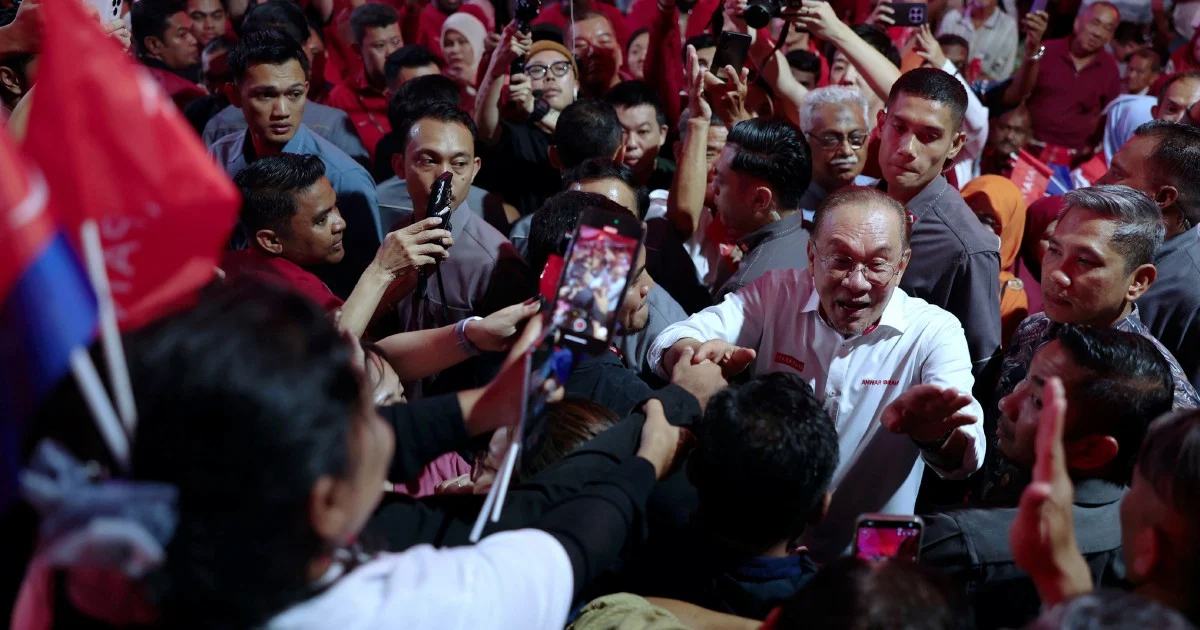
Pakatan Harapan has thrown down the gauntlet in Malaysia's political heartland by formally announcing its complete roster of 56 candidates vying for seats in the Johor state election scheduled for July 11. Coalition chairman Datuk Seri Anwar Ibrahim made the announcement at a rally in Tangkak, underscoring the opposition bloc's serious bid to wrest control of the traditionally Barisan Nasional-dominated state.
Johor represents a significant battleground in Malaysian politics, given its status as one of the country's most populous and economically important states. The state has long served as a Barisan Nasional stronghold, particularly under the governance of Umno. Any shift in power dynamics would carry substantial implications for the national political landscape and could reshape coalition alignments ahead of future federal contests. Pakatan Harapan's aggressive candidacy strategy suggests confidence in the coalition's appeal among Johor voters, despite the state's historically conservative electoral leanings.
The unveiling of a complete slate signals the coalition's organisational preparedness and demonstrates that internal negotiations among its constituent parties have reached sufficient consensus to present a united front. In Malaysian electoral contests, such coherence among opposition coalition partners historically strengthens their competitive position, enabling more focused campaigning and reducing voter confusion about candidate endorsements. The timing of the announcement, made well ahead of the July election date, provides the coalition adequate runway to mobilise grassroots support and build campaign momentum.
Johor's electoral dynamics have evolved considerably in recent years. While Barisan Nasional traditionally dominated the state, shifting demographic patterns, economic pressures, and changing voter sentiment in urban areas present opportunities for challengers. Middle and working-class constituencies have become increasingly receptive to alternative political narratives, particularly concerning cost-of-living challenges, employment opportunities, and governance quality. These factors could advantage Pakatan Harapan, which has positioned itself as an agent of reform and renewed accountability.
The composition of Pakatan Harapan's candidate list carries strategic weight. The coalition comprises several distinct political entities including PKR, DAP, and Amanah, each bringing distinct constituencies and organisational strengths. The balance of candidates across these parties reflects internal power-sharing agreements and reflects attempts to optimise electoral prospects by fielding candidates in seats where their respective bases hold comparative advantage. Such tactical deployment requires sophisticated electoral analysis and inter-party coordination, demonstrating the coalition's investment in winning Johor.
Anwar Ibrahim's personal prominence in leading the announcement underscores the political significance Pakatan Harapan attributes to this contest. As the coalition's most recognisable figure and prime minister, his presence at the Tangkak rally served multiple purposes: reinforcing internal coalition discipline, signalling top-level commitment to winning Johor, and providing organisational legitimacy to the candidacy effort. His participation elevates the contest above routine state-level politics, framing the Johor election as a meaningful test of Pakatan Harapan's national political standing.
The July 11 date represents a compressed timeframe for campaign activities compared to federal elections. Candidates and supporting organisations will need to execute rapid voter engagement strategies, leveraging digital platforms alongside traditional door-to-door campaigning. Media saturation and neighbourhood engagement become particularly critical in such accelerated electoral cycles. Johor's geographic expanse and mixed urban-rural demographic composition add complexity to campaign logistics, requiring strategic resource allocation across diverse constituencies with varying political characteristics and voter priorities.
For Barisan Nasional, the emergence of a fully constituted Pakatan Harapan slate will necessitate similarly robust organisational responses. The ruling coalition cannot assume historical voting patterns will persist unchanged, particularly given generational shifts and evolving economic anxieties among key voter demographics. A competitive Johor election may prompt Barisan Nasional to recalibrate its messaging and possibly refresh certain candidate selections to address specific constituency concerns.
Regionally, the Johor election carries implications extending beyond state boundaries. The southern region's political direction influences broader Malaysian political calculations and coalition stability at federal level. Neighbouring states and peninsular politics generally watch Johor contests carefully, as electoral verdicts there frequently foreshadow shifts in voter sentiment that subsequently ripple across other states. A strong Pakatan Harapan performance would vindicate its coalition model and potentially energise opposition supporters nationally, while a Barisan Nasional victory would reinforce perceptions of ruling coalition resilience.
The presentation of a complete candidate slate also addresses previous concerns within opposition circles about coordination capacity and internal decision-making efficiency. Successfully navigating multi-party nominee negotiations while maintaining party-specific interests requires sophisticated political management. Pakatan Harapan's achievement in producing an agreed roster demonstrates functional coalition governance, an essential credential for any opposition bloc seeking credibility as a prospective governing alternative.
Looking ahead, the campaign phase will ultimately determine electoral outcomes. Candidate quality, local constituency engagement, issue resonance, and voter mobilisation effectiveness will prove decisive. Pakatan Harapan has positioned itself competitively for this contest, but translating candidacy announcements into actual seat victories demands sustained effort, effective messaging, and successful persuasion of sufficient voters across Johor's geographically and demographically varied electoral landscape.

