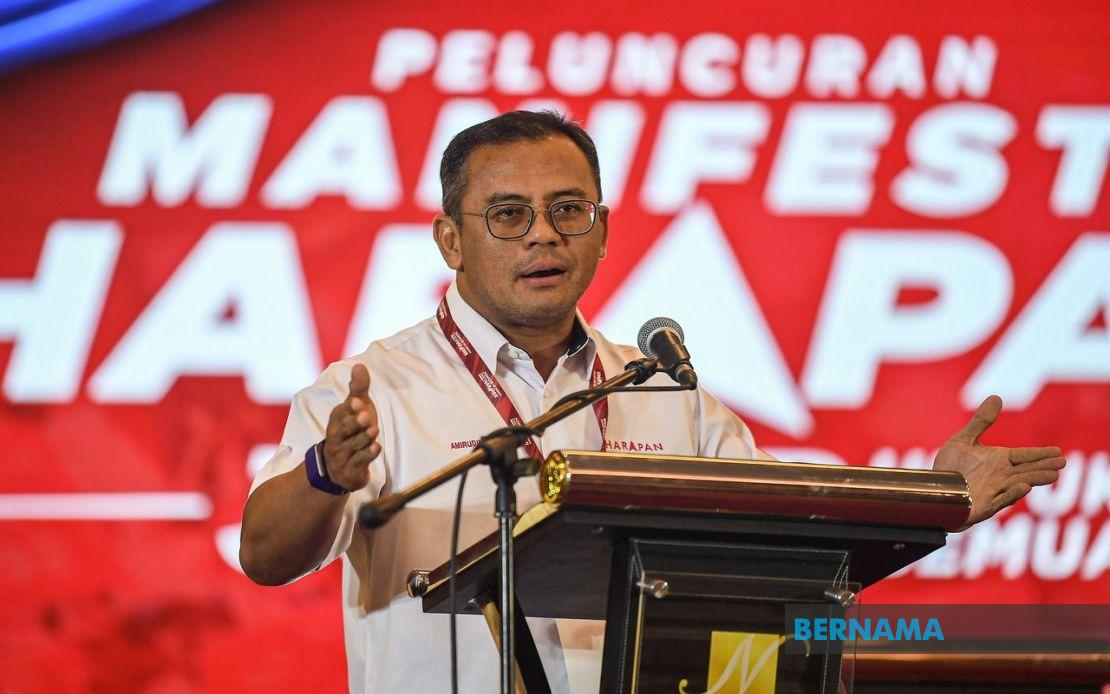
Pakatan Harapan is positioning itself as the architect of Malaysia's economic turnaround as it launches its campaign for the 16th Johor state election, with party leaders emphasising the achievements of administrations under their control at both federal and state levels. Datuk Seri Amirudin Shari, the Selangor Menteri Besar and member of PH's Presidential Council, presented an economic narrative centered on currency strength, investment inflows, and consistent gross domestic product expansion since the coalition took power.
The cornerstone of PH's economic case rests on the performance of the Malaysian ringgit, which Amirudin cited as having reached its strongest position in 16 years under the MADANI Government led by Prime Minister Datuk Seri Anwar Ibrahim and coalition partners. Currency appreciation often reflects investor confidence in an economy's fundamentals, though exchange rates are influenced by complex global factors beyond any single administration's control. Nevertheless, Amirudin framed the ringgit's recovery as evidence of successful macroeconomic management and the government's ability to insulate the country from turbulent international conditions.
Beyond currency markets, PH officials highlighted their track record in attracting foreign and domestic investment while maintaining positive GDP growth throughout their tenure. These metrics carry particular weight in Malaysia's political economy, where economic performance frequently determines voter sentiment and electoral outcomes. The emphasis on investment inflows suggests a strategy to counter narratives about economic uncertainty, positioning PH as a stabilising force amid global headwinds that have challenged economies across the Asia-Pacific region.
The manifesto launch in Johor Bahru placed particular emphasis on the contribution of two PH-governed states to Malaysia's overall economic output. Penang and Selangor together account for approximately 40 percent of national GDP, according to figures presented by Amirudin, making these states crucial engines of growth within the federal structure. This concentration of economic activity in PH-controlled territories allows the coalition to claim substantial credit for national prosperity, though it also underscores regional disparities that remain a contentious political issue.
Selangor's economic size has expanded dramatically in recent assessments. The state economy was valued at RM432 billion according to the Department of Statistics' prior evaluation, but a newly released report indicated growth to RM460 billion—an increase of RM28 billion that Amirudin presented as evidence of accelerating expansion. More strikingly, he noted that Selangor's economy now measures roughly twice the size of Johor's economy, a comparison laden with political implications for a Johor electorate evaluating which coalition offers better economic prospects.
This economic comparison between Selangor and Johor carries subtle messaging. Johor has historically been economically significant as Malaysia's southern industrial and agricultural hub, yet the figures suggest that Selangor—under PH stewardship—has grown into a substantially larger economic contributor. For voters in Johor, this raises questions about whether opposition-governed states achieve comparable growth rates or whether PH-administered territories enjoy structural advantages in attracting investment and fostering expansion.
The timing of these claims during the Johor state election campaign reflects a broader political strategy across Southeast Asia, where incumbent coalitions frequently leverage economic data to justify continued support. In Malaysia's context, where economic anxiety periodically resurges and development gaps between states remain pronounced, demonstrating tangible growth becomes essential for electoral persuasion. PH's emphasis on economic achievements represents an attempt to shift focus from other contentious issues toward measurable outcomes that voters can potentially verify through their own observations of infrastructure development and employment opportunities.
However, the interpretation of these economic figures remains politically contested. Opposition parties will likely argue that growth rates lag behind pre-pandemic trajectories or that benefits remain unevenly distributed across income groups and regions. They may also contend that currency strength and investment flows reflect global market dynamics rather than policy excellence, and that state-level governance differences explain performance variations more than federal administration does. The factual basis of economic claims often proves less decisive than how voters perceive their own economic circumstances and future prospects.
For Malaysian observers and regional analysts monitoring this election, the prominence of economic messaging signals that PH intends to fight primarily on development grounds rather than institutional reform or political ideology. This approach reflects confidence in retrospective voting patterns, where electorates reward parties they perceive as delivering material improvements. Johor's decision in this election will carry significance beyond state politics, potentially influencing federal dynamics and the broader narrative about which coalition manages Malaysia's economy more competently heading into subsequent electoral contests.
The manifesto launch also contextualises Malaysia's position within regional economic competition. As ASEAN nations vie for foreign investment and technology transfer, claims about currency stability, GDP growth, and state-level economic vitality contribute to Malaysia's investment narrative internationally. A Johor result favourable to PH would reinforce perceptions of broad-based coalition support for the development agenda, whereas an opposition victory might suggest voter scepticism about whether announced achievements translate into household-level prosperity and opportunity.

