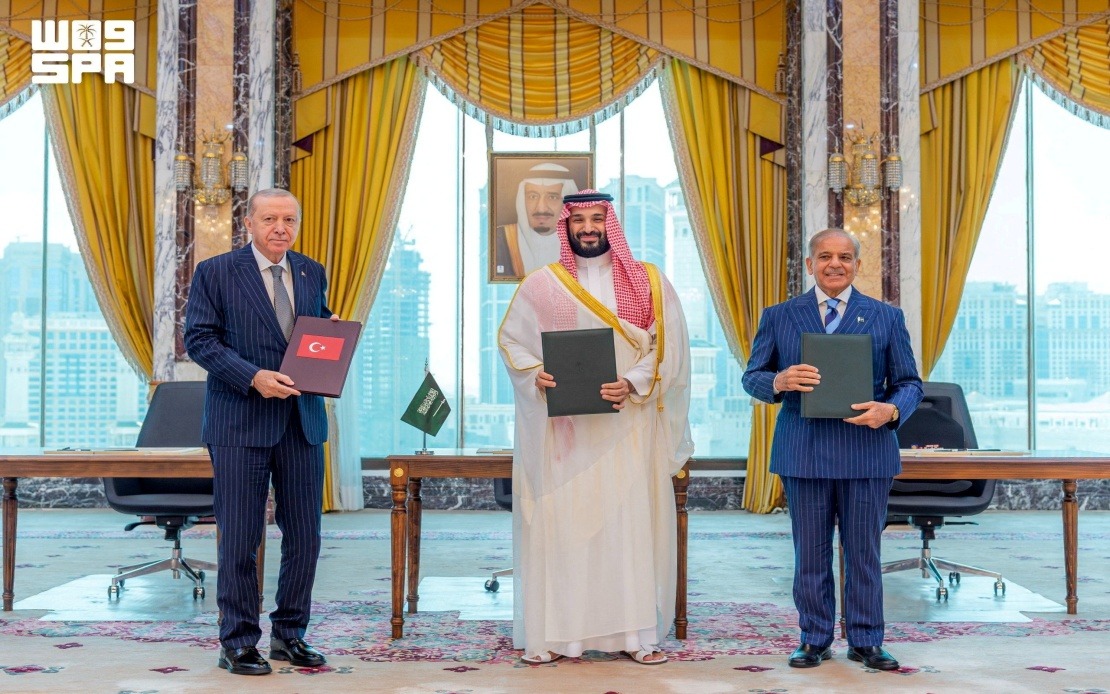
Three major regional powers have cemented a significant security alliance by signing a comprehensive defence agreement that binds them to collective protection, signalling a deepening strategic partnership in a volatile geopolitical landscape. The Joint Defence Agreement was finalised at Al Safa Palace in Makkah during a summit bringing together Saudi Crown Prince Mohammed bin Salman bin Abdulaziz Al Saud, Pakistan Prime Minister Shehbaz Sharif and Turkish President Recep Tayyip Erdogan, establishing what the parties frame as a pillar of stability for their respective regions and beyond.
The accord's central provision treats an armed attack on any signatory as an assault on all three nations, creating a binding mutual defence obligation that mirrors classical NATO-style alliance structures. This architecture signals that Pakistan, Türkiye and Saudi Arabia intend to present themselves as a united front against external threats, while simultaneously serving as a deterrent mechanism that could discourage hostile actors from targeting any individual member. The commitment extends beyond reactive defence to encompass proactive cooperation, with the agreement explicitly mandating enhanced coordination across all dimensions of defence capability and military planning.
For Pakistan, the pact represents a formalisation of longstanding relationships with both regional partners. As one of nine nations globally possessing nuclear weapons, Pakistan brings significant military weight to the alliance, potentially amplifying the deterrent effect of the broader arrangement. The country has historically maintained robust defence ties with Türkiye through NATO-adjacent security structures and deep partnerships with Saudi Arabia rooted in religious, cultural and economic commonalities. This trilateral framework consolidates those bilateral relationships into a more structured institutional format.
Saudi Arabia's role in orchestrating the accord reflects its evolving regional security posture. The kingdom has increasingly sought to strengthen partnerships with capable military actors to counterbalance rival powers and stabilise the Middle Eastern theatre following years of proxy conflicts and sectarian tensions. By anchoring itself to Pakistan's nuclear deterrent and Türkiye's NATO credentials, Riyadh fortifies its strategic depth while projecting commitment to multilateral security arrangements.
Türkiye's participation completes a geographically expansive alliance linking the Eastern Mediterranean, Middle East and South Asia. As a NATO member with significant independent military capabilities, Ankara brings advanced defence infrastructure and a bridge between Western and Islamic-majority security frameworks. The agreement allows Türkiye to deepen engagement with strategically important partners in the broader region while reinforcing its own position as an indispensable security actor.
The joint statement emphasises that this arrangement pursues shared objectives of promoting regional peace, security and stability while advancing prosperity for all three nations and their neighbours. Saudi Arabia's deputy public diplomacy minister Rayed Krimly characterised the pact as enabling collaborative development of joint defence capabilities and enhanced strategic deterrence through integrated readiness measures. Critically, official messaging framed the accord as non-threatening to other regional actors and explicitly denied that it represents an escalation or threat to any state, suggesting the signatories anticipate potential criticism or apprehension from competing regional actors.
This agreement builds on an established trajectory of bilateral cooperation. Pakistan and Saudi Arabia previously formalised their own defence compact in September of the preceding year, which obligated mutual assistance in cases of external aggression. The new trilateral framework effectively expands that bilateral foundation into a broader alliance structure, indicating sustained momentum in consolidating security relationships among these three powers.
For Southeast Asia and Malaysia specifically, the pact carries several implications. As a Muslim-majority region with significant strategic interests, Southeast Asia must navigate shifting alliance dynamics in the broader Islamic world. Any alignment between major Muslim powers potentially influences regional balancing acts and coalition-building across various geopolitical contests. Malaysia, as a non-aligned nation balancing relationships with competing powers, must carefully assess how this trilateral deepening affects regional organisations and bilateral partnerships.
The alliance also reflects broader trends toward regional security self-sufficiency and reduced dependence on distant powers. Rather than relying exclusively on Cold War-era partnerships or Western security guarantees, Pakistan, Saudi Arabia and Türkiye are constructing their own institutional frameworks for addressing security challenges. This model of South-South and East-South cooperation through defence integration may influence how other developing nations approach security architecture in their own regions.
Longer-term significance hinges on how vigorously the parties operationalise the agreement beyond ceremonial signing. Joint exercises, integrated command structures, shared intelligence protocols and coordinated procurement decisions would demonstrate genuine commitment. The absence of such concrete implementation mechanisms could render the pact primarily symbolic rather than transformative of actual military capabilities and readiness.
The timing of the accord, announced amid complex regional tensions involving various state and non-state actors, underscores these powers' determination to strengthen mutual deterrence through institutionalised cooperation. By articulating their alliance publicly and investing diplomatic capital in formalising the relationship, they signal resolve to potential adversaries while reassuring their respective populations of enhanced security provisions.

