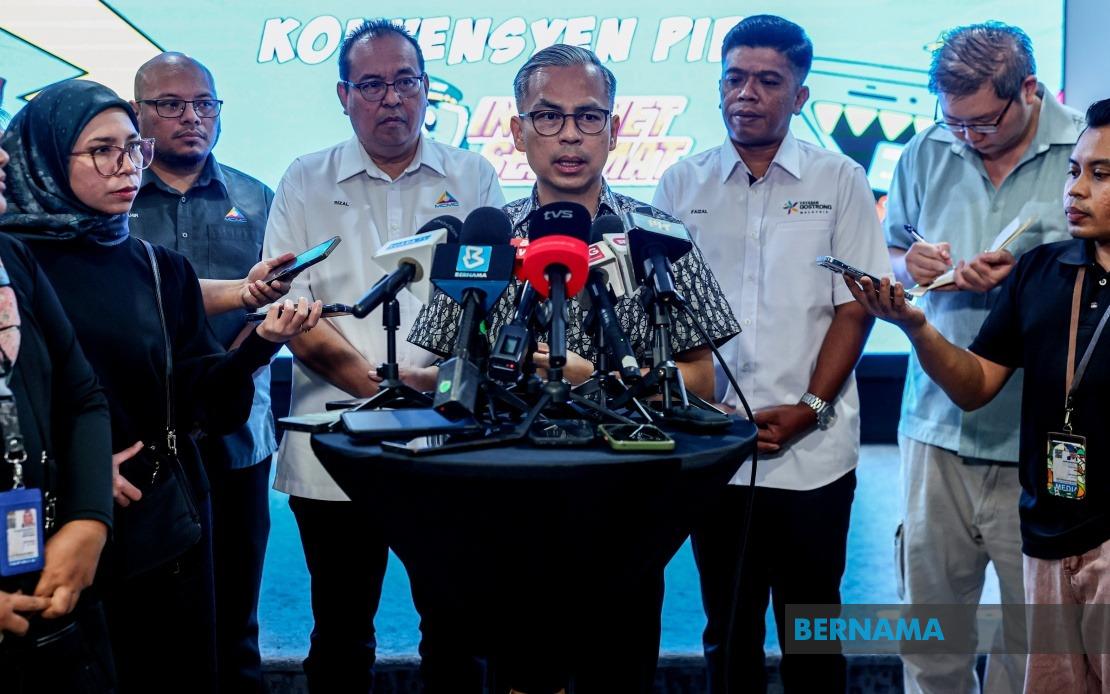
Communications Minister Datuk Seri Fahmi Fadzil has sounded a warning to Malaysian parents about the growing trend of children developing AI chatbot relationships, urging families to maintain vigilant oversight as artificial intelligence becomes increasingly sophisticated and conversational. Speaking at the Kuala Lumpur Federal Territory Safe Internet PTA Convention 2026, Fahmi stressed that while AI technology offers legitimate educational and informational benefits, it should never be regarded as a genuine friend, romantic partner, or emotional confidant.
The concern outlined by Fahmi centres on the deceptive nature of conversational AI systems, which are engineered to simulate human-like interaction so convincingly that young users may develop unhealthy emotional attachments. He explained that despite the lifelike responses these systems generate, they remain fundamentally artificial constructs trained on human-generated data rather than autonomous entities capable of genuine understanding or care. This distinction matters considerably for child development, as relationships with AI lack the reciprocal emotional investment, boundary-setting, and social growth that characterise human connections.
One of the most pressing dangers Fahmi highlighted involves the prevalence of misinformation and "hallucination" in AI outputs—technical terms describing instances where systems generate plausible-sounding but entirely fabricated information. Parents must understand that the information their children receive through AI conversations may be outdated, inaccurate, or deliberately misleading, particularly since many AI systems operate with training data that has temporal limitations. This knowledge gap becomes especially concerning when adolescents rely on AI for guidance on health, relationships, or academic matters where factual accuracy is paramount.
Rather than implementing blanket prohibitions on internet and technology use, which Fahmi acknowledged would be impractical in today's digital society, he advocated for a balanced approach combining active parental engagement with appropriate technological controls. Schools should become partners in this effort, with parents encouraged to seek intervention and support from educational institutions when they observe problematic AI usage patterns in their children. This collaborative model recognises that digital literacy and online safety represent shared responsibilities spanning home, school, and community environments.
Fahmi also drew attention to concerning patterns of cyberbullying within Malaysia's Tamil-speaking communities on platforms such as TikTok, where live-streaming sessions have extended into early morning hours with content targeting vulnerable individuals. He raised the critical observation that content moderation systems powered by AI frequently fail to grasp linguistic nuance, cultural context, and language-specific bullying tactics, particularly in Indian languages where metaphor, idiom, and coded language create layers of meaning that automated systems struggle to interpret correctly. This limitation reveals a fundamental flaw in over-reliance on algorithmic content policing without human oversight.
The minister's engagement with TikTok specifically addressed the inadequacy of AI-driven moderation for protecting Tamil-language users, emphasising that cultural and linguistic sensitivity cannot be entirely outsourced to machine learning models. Content that appears innocuous in English or Malay translation may carry deeply offensive connotations when understood within cultural and linguistic contexts. This challenge extends across Southeast Asia's diverse linguistic landscape, where automated systems trained predominantly on English-language data prove particularly inadequate.
Fahmi outlined Malaysia's regulatory framework for digital platform accountability, highlighting the implementation of the Child Protection Code and Risk Mitigation Code as benchmarks for acceptable platform conduct. Social media operators have received extended transition periods to redesign their systems in compliance with these standards, though the minister made clear that tolerance for non-compliance is finite. The Malaysian Communications and Multimedia Commission is currently conducting regional consultations in Singapore with major platforms including YouTube to ensure comprehensive implementation of both codes.
Non-compliance carries substantial consequences. Once these regulatory frameworks achieve full implementation, platforms that fail to meet required standards face potential court proceedings with penalties described as "very high fines." This enforcement mechanism represents a shift toward treating digital platforms as legally accountable entities rather than passive channels, particularly regarding their responsibility to prevent fraud, online gambling, cyberbullying, and exploitation targeting minors and vulnerable groups.
The convention itself attracted nearly five hundred participants representing a broad cross-section of Malaysian society—parents, educators, school administrators, Parent-Teacher Association leadership, government agency representatives, and community advocates. This inclusive gathering reflected recognition that safe internet practices require coordinated action across multiple stakeholder groups rather than isolated efforts by individual families or institutions. The GoStrong Malaysia Foundation and Malaysian Communications and Multimedia Commission jointly organised the event, signalling government commitment to positioning digital safety as a mainstream policy priority.
The timing of these warnings proves significant for Malaysian parents navigating an evolving technological landscape where AI chatbots have transitioned from novelty applications to everyday communication tools accessible through smartphones and personal devices. As these systems become more integrated into daily life, the distinction between helpful tool and unhealthy substitute for human connection becomes increasingly blurred in young users' perception. Fahmi's intervention aims to sharpen that distinction before problematic usage patterns become entrenched, particularly among children and adolescents whose social and emotional development depends on authentic human relationships.
Looking forward, Malaysia's approach to AI safety in youth contexts will likely influence neighbouring Southeast Asian nations grappling with similar challenges. The regulatory frameworks outlined—the Child Protection Code and Risk Mitigation Code—establish precedent for holding digital platforms accountable for content moderation quality and youth protection measures. As AI technology continues advancing in sophistication and accessibility, the conversation between government authorities, technology companies, educators, and families will prove essential to ensuring that technological progress does not come at the expense of child wellbeing and social cohesion.

