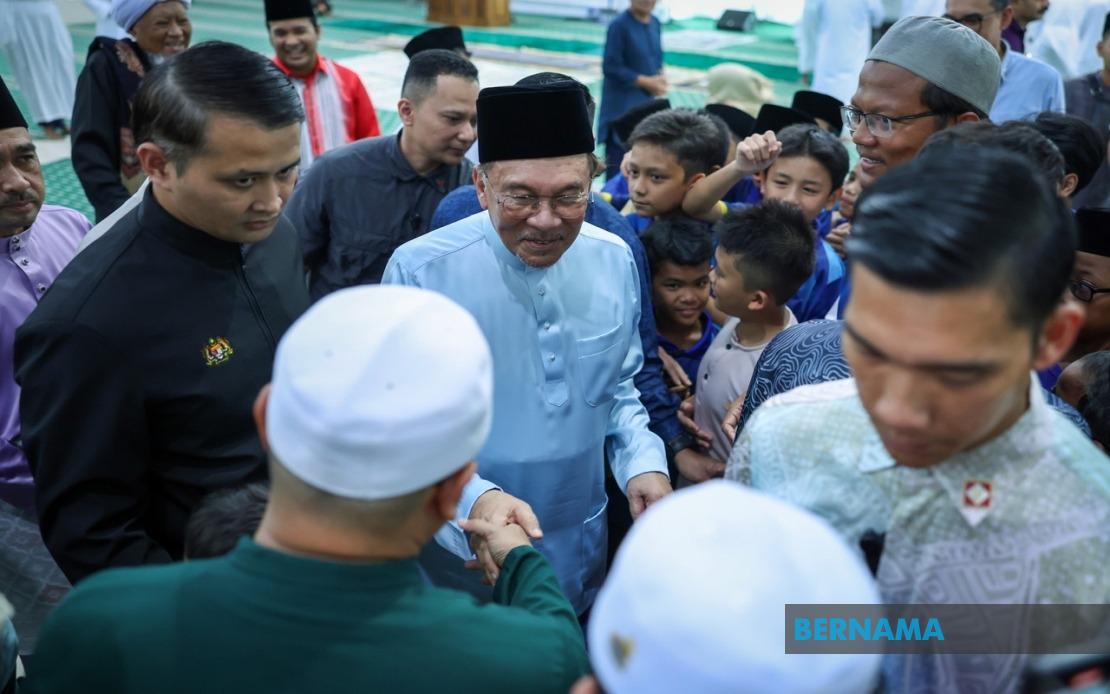
Prime Minister Datuk Seri Anwar Ibrahim has drawn a clear distinction between constituency funding and political office, declaring that allocations channelled to parliamentary seats belong to the people who reside there, not to their elected representatives. Speaking after performing Friday prayers at Masjid Ar-Rasyidin in Alor Gajah on August 7, the Prime Minister stressed that such funds must be directed towards tangible community benefits and infrastructure improvements that meaningfully enhance residents' quality of life.
Anwar's comments come as several opposition lawmakers have alleged that the government has deliberately reduced or suspended their constituency allocations in retaliation for their political stance. The Prime Minister's clarification addresses these grievances by reframing the fundamental purpose of parliamentary funding within Malaysia's governance structure. He emphasised that irrespective of whether an MP belongs to the ruling coalition or sits on the opposition benches, the principle remains constant: these monies exist to serve the electorate's immediate needs rather than function as patronage directed through individual political figures.
The practical application of this policy is significant for Malaysia's evolving political landscape. Anwar provided concrete examples of legitimate expenditure categories, noting that a two million ringgit allocation should support essential community infrastructure such as educational institutions, religious schools, mosques, drainage system repairs, and other infrastructure addressing local concerns. This specificity underscores the government's commitment to ensuring funds reach their intended beneficiaries rather than accumulating as discretionary political resources. By establishing these benchmarks publicly, the Prime Minister appears intent on institutionalising a more transparent allocation mechanism that separates governance resources from partisan political advantage.
The backdrop to these remarks involves the complex dynamics of Malaysia's multi-party political environment following recent electoral shifts. Opposition MPs, particularly those representing constituencies within the ruling coalition's traditional strongholds, have complained that their reduced allocation reflects punishment for electoral outcomes. Anwar's assertion that the government will channel funds directly to constituents regardless of their representative's political affiliation represents a countervailing perspective, one that prioritises administrative consistency over political calculation. This approach, if genuinely implemented, could establish a precedent for more professionalised resource distribution in Malaysian governance.
Anwar indicated that this allocation philosophy is not novel but rather reflects longstanding institutional understanding. He noted that MPs who previously served in government positions would be familiar with these operational principles, suggesting the framework has existed across multiple administrations. This historical continuity, he implied, should render current disputes unnecessary, as opposition representatives should understand that allocation mechanisms function independently of their parliamentary alignment. The assertion that this is established policy, not a new initiative, frames the government's position as maintaining consistency rather than introducing controversial reforms.
The timing of Anwar's statement reflects broader tensions within Malaysia's political ecosystem, where coalition governments have historically used resource allocation as an instrument of political management. By publicly reiterating that funds serve constituents rather than political gatekeepers, the Prime Minister addresses perceptions of vindictive governance while simultaneously attempting to establish administrative credibility. For opposition MPs and their constituents, this clarification offers assurance that essential services and infrastructure development need not depend on maintaining government favour. However, the effectiveness of this commitment ultimately rests on implementation consistency across government agencies responsible for fund disbursement.
For Malaysian voters and civil society observers, this distinction carries implications beyond immediate constituency politics. Clear separation between development funding and political patronage represents a step toward more merit-based governance where resource allocation decisions follow transparent criteria rather than factional calculations. In a context where Malaysian governance has historically struggled with perceptions of political interference in administrative decisions, establishing and maintaining such boundaries strengthens institutional integrity. The challenge lies in ensuring that lower-level government officials implementing these policies adhere to the stated principle rather than prioritising political considerations in practice.
The comments also reflect the Prime Minister's broader governance philosophy following his coalition's return to power. By emphasising that constituency development transcends political divisions, Anwar appears positioning his administration as invested in national welfare beyond factional calculation. This framing carries particular resonance in Malaysian politics, where regional disparities and perceptions of unequal development distribution have historically fuelled political grievances. Establishing that opposition constituencies receive equivalent development resources could serve as a confidence-building measure in an increasingly fractious political environment.
Separately, Anwar addressed personnel matters within his political party, acknowledging that PKR deputy president Nurul Izzah has temporarily stepped back from her formal responsibilities. The Prime Minister characterised this as a temporary arrangement responding to unspecified alternative commitments requiring her focus, while assuring party members that she remains actively engaged in party matters. He presented the decision as a straightforward accommodation rather than a disciplinary action or response to internal party tensions. Though he did not elaborate on the nature of these alternative engagements, his measured framing suggests an effort to normalise the arrangement and prevent speculation regarding internal party dynamics.
Moving forward, the test of Anwar's commitment to depoliticising constituency allocations will manifest in implementation across Malaysia's various constituencies. Government ministries, local authorities, and development agencies must demonstrate that opposition-held constituencies receive funding proportionate to their needs and populations. Sustained allegations of withheld allocations would undermine the Prime Minister's assurances and potentially reinforce perceptions that Malaysia's governance remains subordinate to partisan considerations. Conversely, demonstrating that development resources flow equitably regardless of political affiliation would represent meaningful institutional progress in Malaysian democracy.

