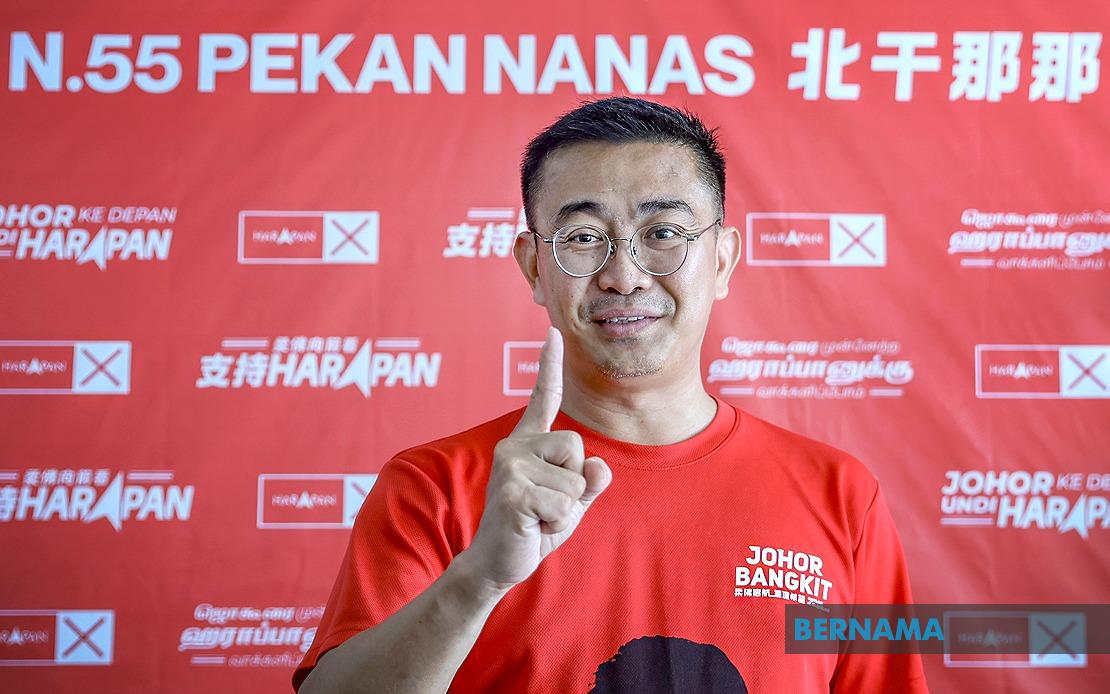
Yeo Tung Siong, the Pakatan Harapan contender for Pekan Nanas in the ongoing Johor state election, is mounting a bid to reclaim the seat he held through two consecutive terms between 2013 and 2022. Speaking in Pontian, the former assemblyman expressed confidence that his previous tenure and the groundwork he has undertaken during the campaign period position him favourably to win back the constituency from the incumbent Barisan Nasional representative.
The ex-educator, who previously served as a vice-principal and discipline teacher, has emphasised his accessibility and constituent-focused approach as key strengths distinguishing his candidacy. Rather than relying solely on incumbency advantage, he is staking his campaign on direct engagement with voters and a demonstrated willingness to respond to community concerns without bureaucratic formality. His team claims to have connected with approximately 60 per cent of the electoral base through a comprehensive outreach strategy spanning community talks, residential visits, market engagements, and grassroots meetings across the constituency.
Yeo has presented his constituent service record as evidence of his effectiveness as a representative. During his previous tenure, he secured RM500,000 in allocations to address the Pulai River's flooding issues through channel realignment works—a longstanding infrastructure problem affecting the area. Additionally, he collaborated with private sector partners to execute drainage projects adjacent to Kampung Melayu Raya, tackling water management challenges that had affected residents' quality of life for years. These initiatives underscore his emphasis on translating political office into tangible development outcomes rather than symbolic gestures.
The candidate's campaign messaging reflects a sharp focus on mobility and economic opportunity, two issues consistently raised by voters throughout the campaigning period. Traffic congestion has emerged as a critical concern for residents, particularly given Pekan Nanas's geographic position and its connectivity challenges between Pontian and Johor Bahru. If elected, Yeo has committed to prioritising two infrastructure projects aimed at creating alternative route corridors: one connecting Ulu Pulai to Pekan Nanas and another linking Pulai to the Sri Bunian junction. These shortcuts, he contends, would substantially reduce commute times and improve traffic flow across the region, addressing a persistent frustration among the working population.
Employment opportunity gaps have equally animated voter discussions throughout the campaign trail. Yeo has pledged to revitalise the career carnival programme, which he previously organised in partnership with major corporate entities operating in and around the Pekan Nanas area. This initiative aims to bridge the disconnect between job seekers and employers, creating pathways for local residents to access employment without migration. The focus on local job creation reflects broader economic concerns in Johor, where smaller constituencies often struggle with youth unemployment and limited career prospects relative to larger urban centres like Johor Bahru.
Beyond infrastructure and economic initiatives, Yeo has signalled his commitment to expanding social support mechanisms for vulnerable populations. He has indicated that a renewed mandate would enable him to strengthen coordination with government welfare agencies including the Social Welfare Department (JKM) and the Social Security Organisation (SOCSO), ensuring that residents facing hardship receive appropriate assistance and access to available support schemes. This dimension of his platform speaks to the social safety net concerns that persist across Malaysian constituencies, particularly in smaller towns where awareness of government assistance programmes may be limited.
Yeo's campaign strategy also emphasises personal accountability and accessibility. Unlike candidates who maintain formal distance from constituents, he has positioned himself as perpetually available and willing to conduct home visits to address individual grievances. This hands-on approach harks back to traditional community-level representation, though its effectiveness ultimately depends on whether voters perceive it as genuine service or mere electoral tactics. His assertion that he is "not one to be concerned with protocol" signals an attempt to differentiate himself from establishment political figures, appealing to voters fatigued by hierarchical governance styles.
The race itself represents a direct contest between Yeo and Tan Eng Meng, the incumbent Barisan Nasional assemblyman, with no apparent third-party candidacy fragmenting the contest. This one-on-one dynamic simplifies voter choice but also heightens the stakes for both campaigns. In a tightly contested electoral landscape within Johor, where state and federal political dynamics intersect, the Pekan Nanas contest carries significance beyond its individual constituency. A Pakatan Harapan victory would signal voter receptiveness to the opposition coalition's governance narrative, while a Barisan Nasional hold would reinforce the ruling coalition's continued strength in the state.
Yeo's reliance on his service record rather than adversarial attacks reflects a calculated strategic choice. Rather than emphasising what his opponent has failed to deliver, he is positioning himself as the proven alternative with documented accomplishments and constituent relationships. This messaging approach requires voters to actively recall or learn about his previous tenure, making campaign ground operations—the walkabouts, community meetings, and direct voter contact—critical to refreshing his political brand among first-time voters and those whose memories of his prior tenure may have faded.
The Johor state election itself occurs in a broader political context where state-level outcomes increasingly diverge from federal results, as demonstrated by recent Malaysian electoral patterns. Pekan Nanas voters will be making distinct calculations about which coalition best serves their specific interests in state governance, independent of national political preferences. Yeo's focus on localised grievances—flooding, traffic, employment—reflects this reality, grounding his campaign in tangible territorial concerns rather than high-level national political discourse.
For Pakatan Harapan's broader prospects in Johor, seats such as Pekan Nanas represent opportunities to expand its footprint beyond urban strongholds into smaller, semi-urban constituencies where infrastructure deficiencies and economic marginality create voter receptiveness to alternative governance models. The coalition's ability to field experienced candidates with prior constituency tenure, such as Yeo, potentially strengthens its competitive positioning in such areas where voter preferences may prove decisive to final seat tallies.

