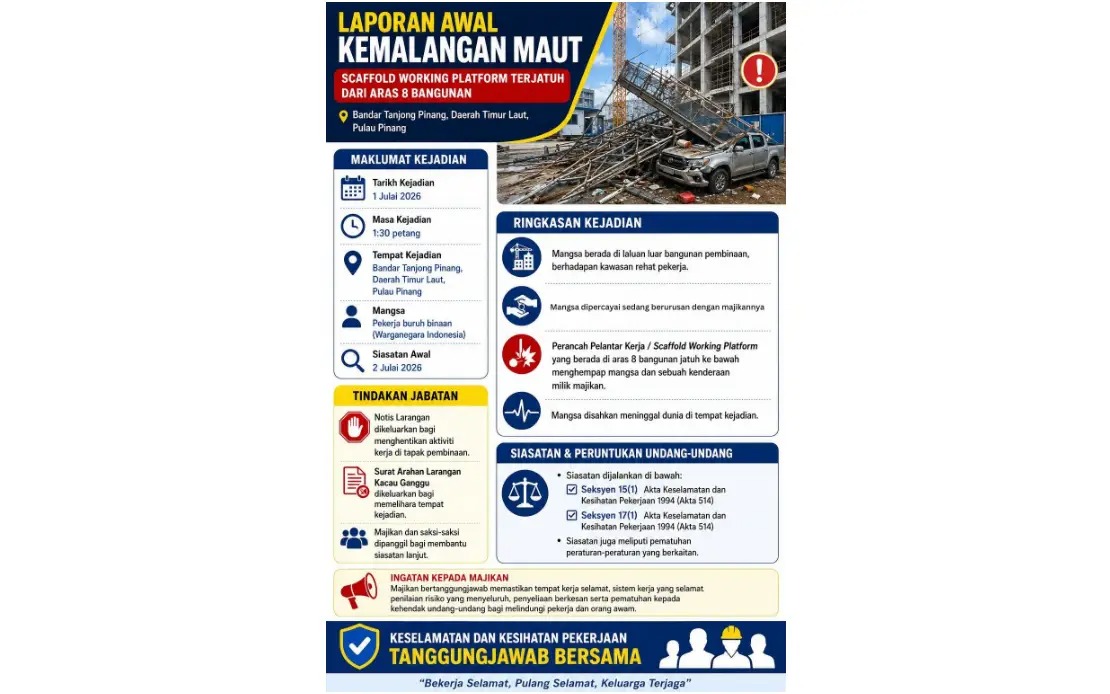
The Department of Occupational Safety and Health (DOSH) in Penang has moved swiftly to impose a complete work stoppage at a Bandar Tanjong Pinang construction site following the death of an Indonesian worker in a scaffolding collapse on July 1. The regulatory body issued a formal prohibition notice immediately after the incident, which occurred at 1.30 pm, effectively halting all related activities at the location while investigations proceed into the circumstances surrounding the tragedy.
According to DOSH's statement, the fatality involved a scaffolding working platform that detached from the eighth floor of the building under construction and fell to lower levels, striking the victim who was positioned on an external walkway adjacent to a workers' rest area. The falling platform also damaged a vehicle belonging to the employer. The worker was conducting discussions with his employer at the time of the accident, placing him directly in the path of the falling structure.
The regulatory intervention extends beyond the simple cessation of work. DOSH has additionally implemented a non-disturbance order to preserve the accident scene in its original state, a critical step that allows investigators to examine the physical evidence and reconstruct the sequence of events. This forensic approach is essential for determining the root causes of the platform's failure and identifying any systemic deficiencies in site management or equipment maintenance.
The investigation currently focuses on potential breaches of the Occupational Safety and Health Act 1994 (Act 514), specifically examining whether employers met their obligations under Sections 15(1) and 17(1) of this legislation. These provisions typically mandate that employers provide and maintain safe working environments, ensure proper training and supervision, and implement appropriate safety measures to protect workers from foreseeable hazards. DOSH is calling in both employers and witnesses to provide comprehensive accounts of the incident.
For Malaysia and the broader Southeast Asian region, this incident underscores persistent vulnerabilities in construction site safety management, particularly concerning the protection of migrant workers who constitute a substantial proportion of the construction workforce across the region. Many migrant workers, including those from Indonesia, may lack full familiarity with local safety protocols or may face pressure to work in suboptimal conditions due to employment contract vulnerabilities. The reliance on scaffolding and elevated work platforms in high-rise construction creates inherent risks that demand rigorous engineering oversight and regular safety inspections.
The incident raises important questions about equipment inspection regimes and maintenance standards at Malaysian construction sites. Scaffolding systems, whether temporary or permanent, must be engineered correctly, installed according to specifications, and subjected to regular competency checks to ensure structural integrity. The collapse of a platform from the eighth floor suggests either inadequate initial installation, insufficient maintenance, or failure to comply with load-bearing specifications and safety certifications.
DOSH's firm stance signals a commitment to accountability within the construction sector, though critics argue that Malaysian regulators historically have faced resource constraints that limit their capacity for comprehensive site inspections and enforcement across the rapidly expanding construction landscape. The issuance of a prohibition notice represents the strongest immediate enforcement action available to DOSH and indicates the seriousness with which the department views this fatality.
Penang's construction industry, which has experienced substantial growth through major infrastructure projects and urban development initiatives, will likely face increased scrutiny in the coming months. Developers, main contractors, and subcontractors operating across the state should anticipate potential enhanced inspection protocols and more rigorous documentation requirements for safety compliance. The statement from DOSH explicitly reminded all construction stakeholders that adequate planning and safety implementation are non-negotiable obligations.
Enforcement action will be determined once the investigation concludes and DOSH determines whether specific legal provisions were violated. Penalties under the Occupational Safety and Health Act 1994 can include substantial fines and, in cases of gross negligence, potential imprisonment of responsible officers. Such consequences create meaningful incentives for adherence to safety standards across the construction industry.
The broader significance of this incident extends to highlighting the vulnerability of migrant construction workers in Malaysia and throughout Southeast Asia. Without strong regulatory enforcement and genuine commitment to workplace safety culture, workers from lower-income countries remain susceptible to accidents that could be prevented through proper planning and investment in safety infrastructure. This tragedy serves as a reminder that construction safety is not merely a compliance exercise but a fundamental obligation to protect human life.
Moving forward, the construction sector should view this incident as a catalyst for comprehensive safety culture reform rather than an isolated regulatory action. Industry bodies, professional associations, and large contractors have opportunities to establish collaborative safety improvement initiatives, share best practices, and invest in worker training programs that encompass both local employees and migrant workers. Such proactive measures would ultimately benefit both workers and industry stakeholders by reducing accident rates and associated liabilities.

