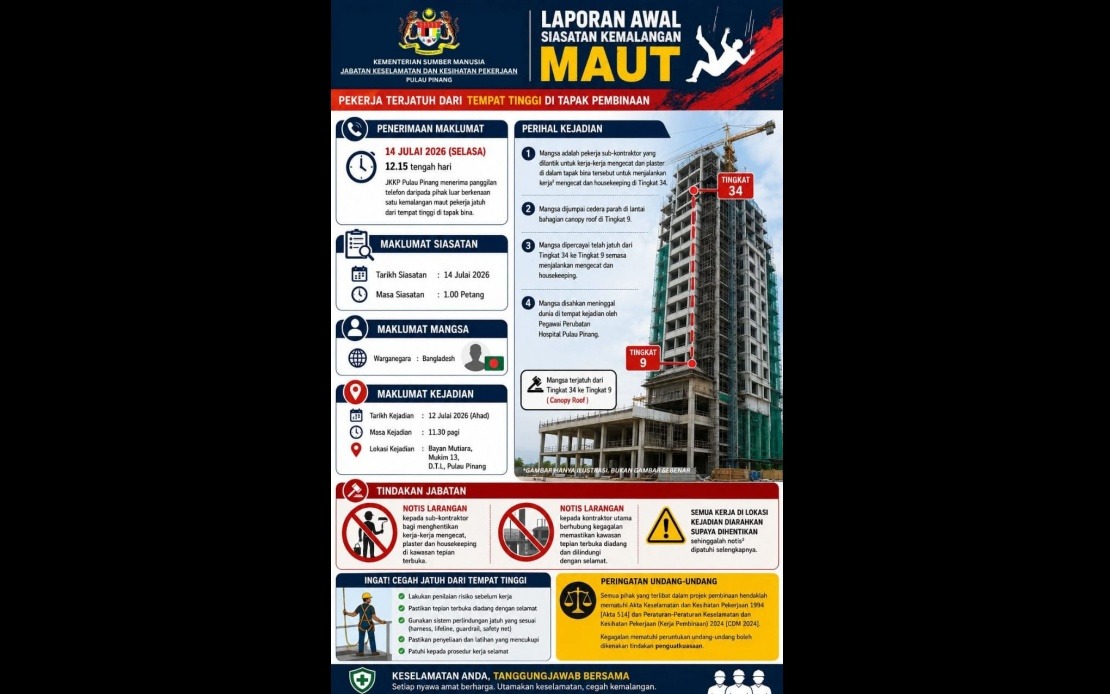
The Penang Department of Occupational Safety and Health (DOSH) has launched a formal investigation into the fatal fall of a Bangladeshi worker at a construction site in Bayan Mutiara, following the incident reported on July 15. The worker, employed by a subcontracting firm, fell from a significant height and was later pronounced dead at the scene by medical staff from Penang Hospital.
According to Penang DOSH director Hairozie Asri, the department became aware of the accident at 12.15 pm when external parties notified authorities of the tragedy. A team of investigating officers was immediately deployed to the Bayan Mutiara location to gather evidence and assess the circumstances surrounding the death. The rapid response underscores the severity with which occupational safety breaches are treated by the regulatory body.
Preliminary findings indicate that the deceased was contracted to perform painting, plastering, and housekeeping duties at the construction site. The worker was reportedly stationed on the 34th floor when the incident occurred, but was subsequently discovered with severe injuries on the canopy roof at Level 9—a fall spanning approximately 25 storeys. The significant vertical distance and the nature of the injuries suggest a catastrophic breach of safety protocols.
The subcontracting arrangement adds another layer of complexity to workplace safety accountability. In Malaysia's construction industry, subcontractors often bear direct responsibility for worker safety on specific tasks, yet coordination between main contractors and subcontractors can sometimes blur liability lines. This structural arrangement frequently presents challenges in enforcement, as multiple entities may claim limited oversight of particular work areas or practices.
In response to the tragedy, Penang DOSH issued prohibition notices against both the subcontractor and the main contractor. The subcontractor has been specifically barred from conducting any painting, plastering, or housekeeping operations in open-edge areas—a direct response to how the worker may have accessed the dangerous zone. Such restrictions acknowledge that inadequate safeguards for edge protection and fall prevention were in place during open-air work at height.
Comprehensive work suspension orders have also been implemented at the accident site. All activities connected to the incident location must cease immediately, and operations cannot resume until both contractors fully satisfy the requirements outlined in the prohibition notices. This precautionary measure prevents further potential incidents while investigations proceed and safety measures are reassessed and strengthened.
For Malaysian readers and Southeast Asian workers, this incident reflects broader occupational health challenges facing the region's rapidly expanding construction sectors. Migrant workers from Bangladesh, Nepal, Indonesia, and Myanmar comprise a significant proportion of construction workforces across Malaysia and neighbouring countries, yet language barriers, unfamiliarity with local safety regulations, and vulnerability to pressure to meet deadlines can heighten their accident risk. Educational campaigns and enforcement mechanisms targeting subcontractors—often smaller entities with fewer resources for safety training—remain critical.
The 34th-floor fall also highlights the particular hazards associated with high-rise construction in dense urban developments like Penang's expanding skyline. As buildings climb higher and construction timelines compress, the pressure on workers to complete tasks efficiently can inadvertently compromise safety culture. Falls from height remain the leading cause of construction fatalities in Southeast Asia, yet many sites continue to operate with inadequate harnesses, guardrails, and safety protocols.
Penang DOSH's investigative response sets expectations for how such incidents should be handled—swift intervention, transparent preliminary findings, and decisive enforcement action. However, critics argue that prohibition notices alone do little to deter future violations without meaningful financial penalties and criminal accountability for managers and supervisors responsible for safety standards. The investigation's outcome and any subsequent legal proceedings will signal whether Malaysian authorities intend to escalate enforcement beyond work stoppages.
The incident also raises questions about worker representation and accident reporting mechanisms. Whether this worker's death was immediately reported by the contractor or only discovered by external observers suggests possible delays in incident notification—a common problem when workers lack confidence in grievance channels or fear retaliation. Strengthening worker voice and independent safety auditing could prevent incidents from going unreported or unaddressed.
As Penang continues its position as a major construction hub with substantial foreign worker populations, this tragedy underscores the human cost of inadequate safety oversight. The investigation must establish not only how the fall occurred, but why safeguards failed—whether through design failure, inadequate training, worker negligence, or systemic management failures. Only comprehensive findings can drive meaningful reform across the industry and protect other vulnerable workers on high-rise projects throughout the region.

