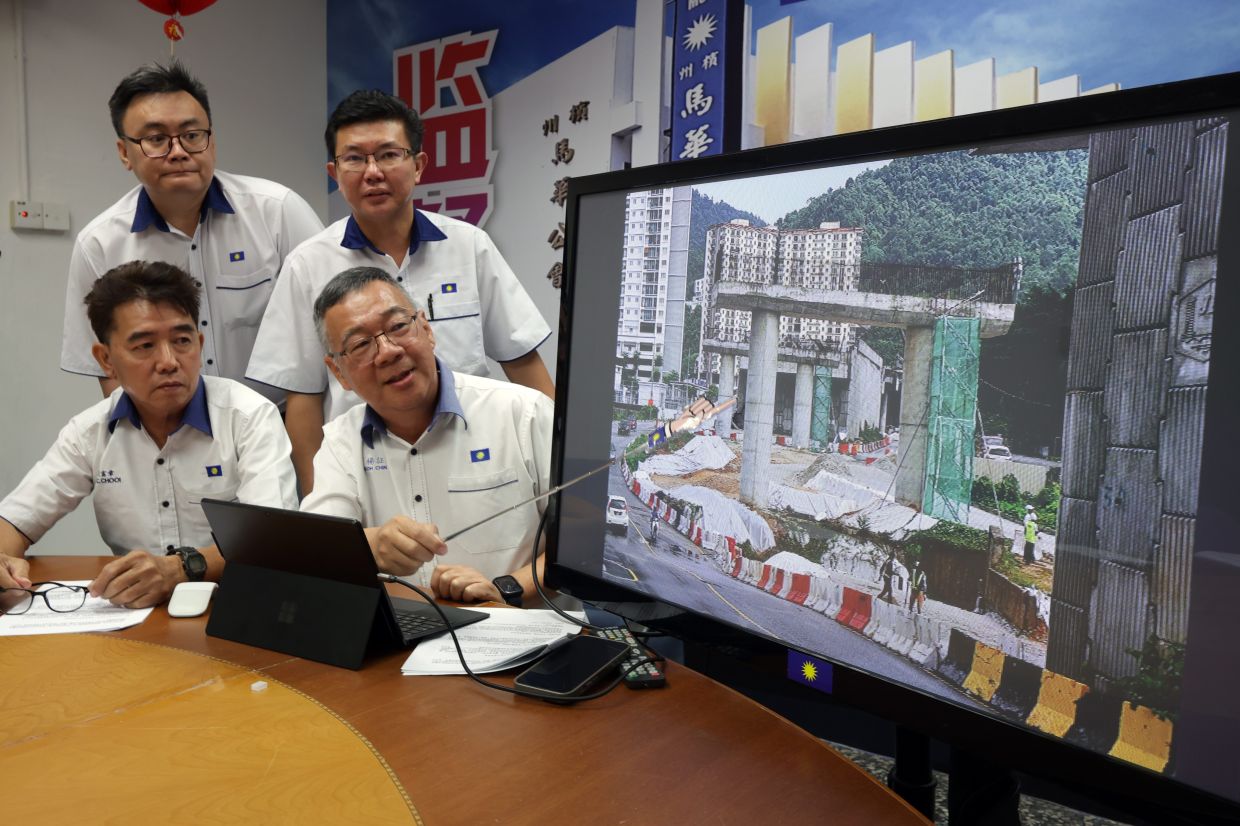
The Penang MCA has turned up the pressure on the state government over the Air Itam-Tun Dr Lim Chong Eu Expressway bypass project, shifting the debate away from simple project delays to fundamental questions about governmental accountability and transparency. Rather than accepting official progress updates at face value, the opposition coalition partner is demanding the release of payment records, consultant certification reports and comprehensive project assessment documentation — a move that signals deepening concern about the discrepancies between reported completion percentages and ground-level conditions.
Secretary Yeoh Chin Kah framed the dispute in notably unambiguous terms, asserting that the real issue transcends the familiar territory of construction delays that plague infrastructure projects throughout Malaysia. He emphasised that the challenge centres on restoring public confidence in state institutions, a particularly sensitive consideration given that residents in the affected areas have already endured multiple extensions to the original 2024 completion timeline. The distinction Yeoh drew matters: it moves discussion from technical explanations about labour shortages or supply chain disruptions to the broader question of whether the public can trust official progress assessments.
The crux of the MCA's complaint rests on a mathematical inconsistency that raises legitimate questions about how completion percentages are being calculated. Yeoh pointed out that the project allegedly accelerated from 80 per cent completion in May to 89 per cent in December of the previous year — a nine-percentage-point jump in seven months. Yet during an inspection conducted on July 1, MCA representatives observed sections along Valley Road, Changkat Tembaga and Jalan Thean Teik that appeared nowhere near completion in practical terms. They documented the presence of bridge piers but the absence of bridge beams and decking, incomplete road surfacing throughout multiple stretches, and numerous uncompleted mechanical, electrical and connectivity works across the entire corridor.
This gap between statistical claims and observable reality is the core of the dispute. When an inspection team can photograph sections where fundamental structural elements remain absent, it becomes difficult to reconcile those conditions with an 89 per cent completion designation. Different stakeholders may calculate completion percentages using different methodologies — accounting for design completion, foundation work, structural elements and finishing separately — but the public reasonably expects these figures to align with substantive progress visitors can see on site. The MCA's complaint essentially argues that either the completion calculation is methodologically questionable or the reported figures do not accurately reflect true progress.
Yeoh issued a seven-day ultimatum for the state government to produce the requested documentation, with escalation plans already prepared should officials decline. The MCA threatened to lodge formal complaints with the National Audit Department and the Malaysian Anti-Corruption Commission, sending a clear signal that this dispute involves more than routine partisan disagreement. The party also announced plans to establish a special monitoring committee dedicated specifically to tracking the project's progress and ensuring payment compliance, essentially positioning the opposition to independently verify all future official claims about advancement.
The expressway project itself represents a significant infrastructure investment for the state. The six-kilometre toll-free bypass, formally designated as Package Two of the broader Penang undersea tunnel and three paired roads initiative, connects Lebuhraya Thean Teik in Bandar Baru Air Itam to the Tun Dr Lim Chong Eu Expressway through an intricate combination of elevated viaducts, tunnels and surface-level roadways. The original completion target of 2024 has already slipped twice, with the current scheduled opening set for April 12, 2027 — a delay that has stretched beyond three years from the original estimate and has presumably added considerable costs beyond initial projections.
Once operational, the bypass is intended to provide meaningful relief for approximately 300,000 residents distributed across Air Itam, Bandar Baru Air Itam and Paya Terubong. For these communities, the project represents a long-awaited solution to chronic congestion that has plagued daily commutes and economic activity in these densely populated neighbourhoods. The extended delay therefore carries tangible consequences beyond mere inconvenience, potentially affecting property values, business competitiveness and quality of life for hundreds of thousands of people who have already adjusted their expectations multiple times.
The Paya Terubong assemblyman Wong Hon Wai offered a counternarrative to the MCA's criticism, asserting that the project has actually reached 91 per cent completion and remains aligned with the April 2027 target date. Wong reported attending a construction team meeting on June 30 where updated progress figures were presented, and stated that contractors have provided personal assurances regarding the schedule adherence. He provided specific construction milestones to support his claim: twelve bridge beams on the Gelugor side are scheduled for installation between the current month and August, with the remaining six beams projected for the fourth quarter of the year.
Wong acknowledged that bridge beams on the Bandar Baru Air Itam side have already been deployed, but noted that immediate road opening will not follow construction completion. Instead, several procedural steps remain: deck slab and parapet works are currently underway, and once these finish, the relevant government safety agency will conduct a Road Safety Audit. The Public Works Department will subsequently determine the actual opening date based on that audit's findings, introducing an additional variable that could extend the timeline between construction completion and public access. This staged approach, while standard for major infrastructure projects, adds another layer of complexity to public expectations about when residents will actually benefit from completed works.
The disagreement between the MCA and state government representatives reflects broader tensions in Malaysian governance around infrastructure transparency and accountability mechanisms. Large-scale construction projects regularly encounter delays, cost overruns and scope adjustments, yet mechanisms for independent verification of official progress claims remain limited. The MCA's demand for documentary evidence and certification reports represents a legitimate governance question: in complex infrastructure projects where the public bears financial and opportunity costs through years of disruption, what documentation standards should officials maintain to substantiate progress claims? The answer to that question has implications extending well beyond this single Penang expressway, potentially establishing precedents for infrastructure accountability across the country.
The standoff also illuminates how construction progress is measured and communicated in Malaysian infrastructure development. Percentage-based completion metrics, while convenient for public communication, can mask uneven advancement where early phases progress rapidly while final stages extend over disproportionate timeframes. The compressed timeline suggested by the May-to-December jump in figures — from 80 to 89 per cent — deserves examination, particularly when ground observations suggest substantial work remains on critical elements. Resolving this dispute requires either transparent methodological explanation of how percentages are calculated or acknowledgement that initially optimistic figures require revision, neither of which currently appears to have occurred.
The implications for Penang and Southeast Asian readers centre on how regional governments balance infrastructure development with public accountability. Large-scale projects like this expressway bypass exemplify the tension between wanting rapid development and insisting on transparent governance. The MCA's escalation to potential audit and anti-corruption complaints suggests this issue transcends routine coalition disagreements and touches on fundamental questions about institutional credibility. How the state government responds to the transparency demands will likely influence public perception of governance quality extending well beyond this single project, affecting confidence in future infrastructure announcements and state competence generally.

