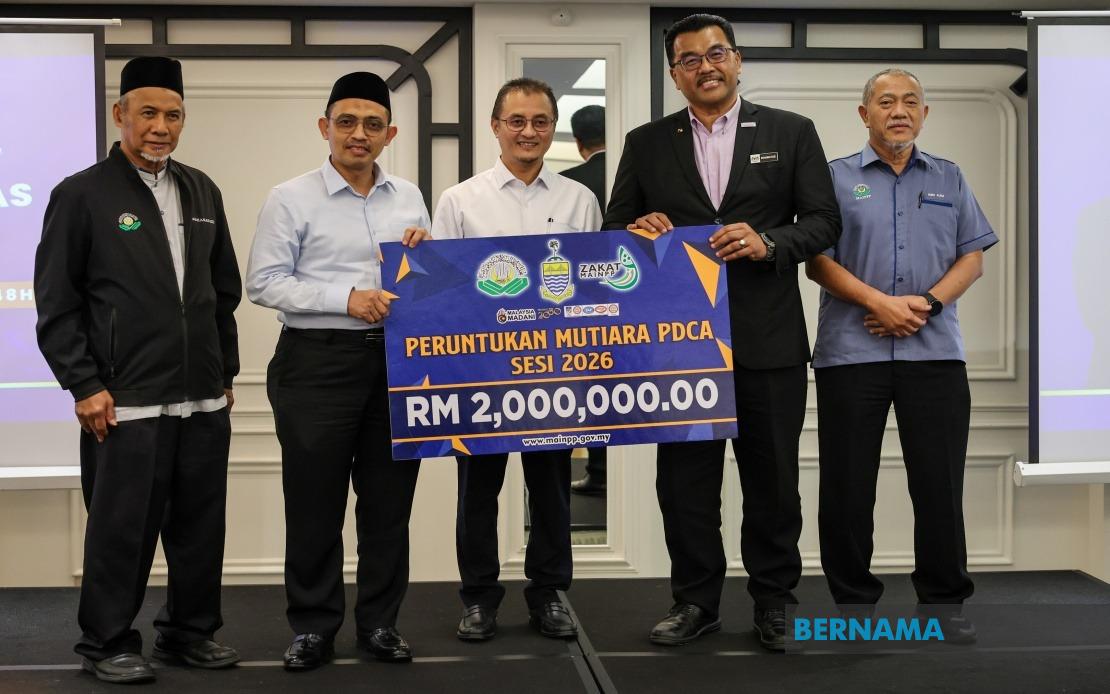
The Penang State Islamic Religious Council (MAINPP) has earmarked RM2 million to strengthen educational support for Bumiputera learners in 2026, with the Mutiara Didik Cemerlang Akademik (MPDCA) programme reaching a combined 7,403 pupils and students throughout the state. The initiative represents a sustained effort to narrow achievement gaps and ensure equitable access to quality tuition for students regardless of family economic circumstances. Deputy Chief Minister I Datuk Dr Mohamad Abdul Hamid, who also leads MAINPP, unveiled the allocation at a coordinating teachers' briefing in Kepala Batas, framing the investment as part of a broader commitment to developing Bumiputera human capital.
Since its establishment two decades ago, the MPDCA programme has operated as a collaborative venture involving multiple state agencies and federal coordination bodies. The partnership brings together MAINPP, the Penang State Education Department (JPNPP), the Penang Bumiputera Participation Coordination Division under the Prime Minister's Department Implementation Coordination Unit, and the Penang Regional Development Authority (PERDA). This multi-stakeholder approach signals government recognition that educational advancement requires coordinated effort across administrative divisions, a model that may hold relevance for other states seeking to strengthen outcomes among Bumiputera cohorts.
The scale of this year's rollout demonstrates programme expansion. A total of 698 coordinating teachers from 71 primary schools and 38 secondary schools will administer the scheme across the state. For Year Six pupils, tuition focuses on four foundational subjects—Bahasa Melayu, English, Mathematics and Science—targeting competency in core competencies essential for progression to secondary education. The breadth expands significantly at upper secondary level, where students preparing for Sijil Pelajaran Malaysia (SPM) examinations access instruction across thirteen subjects spanning languages, humanities, sciences and additional mathematics.
The programme's curriculum scope extends beyond secular subjects to encompass Islamic studies where relevant. At government-aided religious schools, three Integrated Dini Curriculum subjects are offered: Dini-Lughatul Arabiyyah Mu'asirah (LAM), Dini-As Syariah and Dini-Usuluddin. This inclusion acknowledges the dual educational priorities of religious and academic development within specific school systems, ensuring students in these institutions receive cohesive support aligned with their institutional missions.
Datapoints from JPNPP indicate the programme has delivered measurable academic improvements since 2006. Students who engage with MPDCA tuition show enhanced performance relative to comparable cohorts, suggesting the standardised, resource-intensive support model generates positive outcomes. The availability of centrally developed learning modules, examination technique workshops and academic seminars appears to address specific skill deficits that limit achievement among lower-income learners who lack access to private tutoring alternatives. Such data underscores why state governments continue allocating funds to such schemes despite budgetary constraints.
Frontline educators identify the programme's relevance for students from economically disadvantaged backgrounds. Hartina Arjan, a Bahasa Melayu teacher at Sekolah Kebangsaan Permai Indah in Bukit Minyak, emphasises how systematically structured learning modules build language competency across speaking, reading and writing dimensions. The materials explicitly prepare students for Classroom-Based Assessment (PBD) and final examinations, moving beyond generic tutoring toward examination-aligned instruction. Sadiah Roslan, teaching at Sekolah Rendah Islam Al-Masriyah Halimatun in Bukit Mertajam, observes that free access proves transformative for children whose families cannot afford private tuition, removing a significant barrier to academic support.
The pedagogical innovations embedded within MPDCA appear responsive to contemporary learning preferences. Updated modules incorporating quiz-based activities and interactive methodologies generate greater student engagement compared to traditional lecture formats. Teachers report increased classroom participation and improved subject mastery when materials employ gamified assessment and contemporary instructional design, suggesting that programme evolution keeps pace with evolving educational best practices rather than remaining static over its two-decade existence.
The RM2 million allocation for MPDCA exists within a substantially larger educational investment portfolio that MAINPP coordinates. Beyond this specific programme, the council channels RM22.36 million toward higher education bursaries, RM6.3 million for the Permulaan IPT (Initial Tertiary Education) Scheme, RM3 million for early schooling assistance and RM3 million for school uniform support. Combined, these initiatives total over RM36 million directed toward removing financial barriers across the educational pipeline, from primary schooling through to tertiary completion. This comprehensive approach reflects recognition that sustainable socio-economic advancement requires continuous investment across multiple stages rather than point interventions.
For Malaysian policy observers, the Penang model demonstrates how state-level institutions can mobilise substantial resources for targeted demographic support within existing constitutional frameworks. The MPDCA framework combines centralised curriculum design with local implementation, achieving standardisation while permitting contextual adaptation. The involvement of religious councils in secular academic advancement illustrates pragmatic institutional cooperation that transcends sectarian boundaries toward shared developmental outcomes. As states compete for talent and economic dynamism, programmes that measurably improve foundational competencies among previously underserved populations represent strategic investments in inclusive growth.

