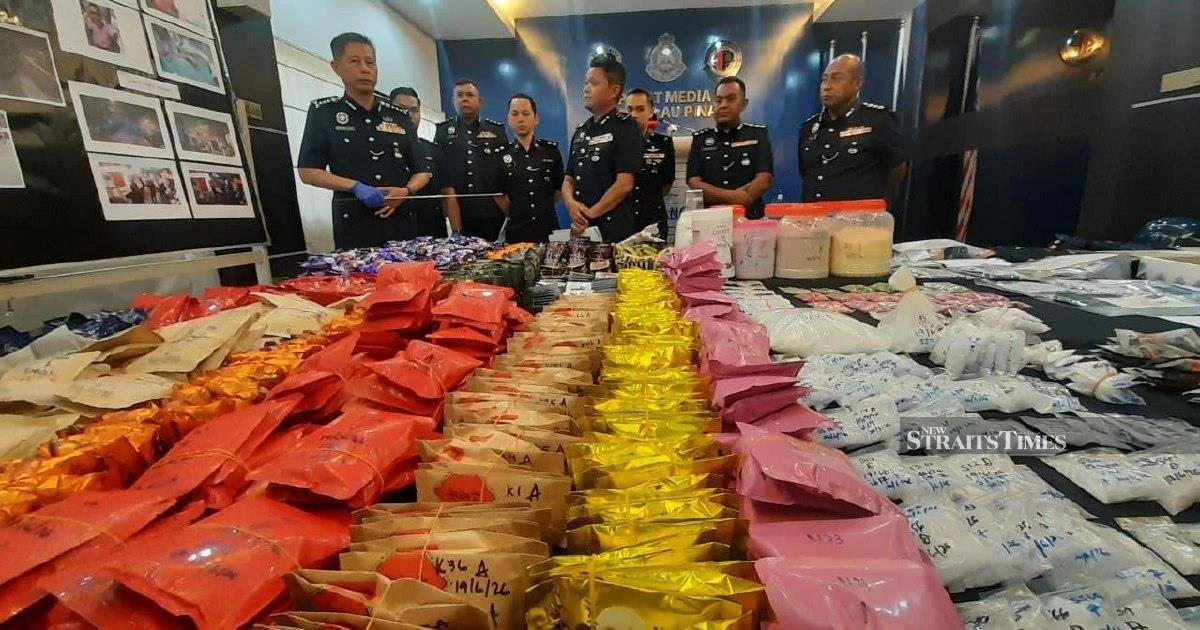
Law enforcement authorities in Penang have successfully disrupted what appears to be a substantial clandestine drug operation following a raid on a residential unit in Butterworth. The coordinated police action resulted in the apprehension of a couple believed to be operating the scheme and the confiscation of controlled substances estimated at RM9.7 million in street value. The discovery represents a notable success in the state's ongoing efforts to combat organised drug trafficking networks.
The operation came to light following an intelligence-led investigation that pointed authorities toward the condominium complex in Butterworth, a key commercial and residential hub in the northern corridor of Penang. Officers executing the search warrant discovered evidence suggesting the premises served as both a drug-processing facility and a distribution centre for narcotics destined for wider circulation across the region. The scale of the operation and quantity of drugs recovered indicate a level of sophistication beyond opportunistic dealing, pointing instead to an organised enterprise with established supply chains and market networks.
The arrested couple remains in police custody as investigators piece together the broader architecture of the syndicate. Initial findings suggest their roles within the operation, whether as operators, financiers, or facilitators, though authorities have not yet publicly detailed the specific charges or nature of their alleged involvement. The arrest of both individuals simultaneously disrupts not only the immediate operation but also removes key personnel who likely maintained critical relationships with upstream suppliers and downstream distributors.
The range and composition of the seized narcotics have not been fully disclosed, though such large-scale operations typically involve multiple drug types to maximise market reach and revenue generation. The RM9.7 million valuation suggests considerable quantities, possibly encompassing methamphetamine, heroin, or synthetic drugs commonly trafficked throughout Southeast Asia. Understanding the specific drug profiles helps authorities identify connections to known trafficking networks and international smuggling routes that feed these operations.
This bust arrives amid heightened concern about drug manufacturing operations establishing themselves in Malaysia's urban centres. Residential units in apartment complexes offer distinct advantages for criminal syndicates: they provide anonymity amid high resident turnover, multiple entry and exit routes, and the cover of legitimate domestic activity. Butterworth's strategic location near the Penang Bridge and its position as a transit point between northern and southern Peninsular Malaysia make it particularly attractive for traffickers seeking to establish hidden processing operations.
The discovery underscores the continued vitality of drug trafficking networks in Penang despite previous enforcement successes. The state has long grappled with its role in regional drug transit, serving as both a significant market and a transshipment point for substances destined for other parts of Malaysia and neighbouring jurisdictions. The persistence of such operations suggests that disrupting individual syndicates, while important, must be complemented by deeper investigation into supply sources and distributive patterns to achieve lasting impact.
For Malaysian law enforcement more broadly, the seizure demonstrates the value of intelligence-gathering and targeted raids over reactive policing. The capacity to identify specific premises and execute focused operations relies on systematic intelligence networks, informant development, and inter-agency coordination. The Penang operation appears to reflect the application of these techniques, though questions remain about how long the operation had functioned before detection and what market disruption the seizure actually causes.
The implications for regional drug control extend beyond Penang's borders. Malaysia sits within a critical trafficking corridor spanning Southeast Asia, with organised syndicates moving substances across multiple jurisdictions. Operations in Penang influence supply patterns and pricing throughout the region. Dismantling manufacturing capacity, even temporarily, can disrupt distribution to consumer markets in Kuala Lumpur, other states, and neighbouring countries. The success of this operation may consequently ripple beyond immediate geographic boundaries.
Investigators will now focus on the secondary dimensions of the case: identifying the customer base, upstream suppliers, financial networks, and any broader organisational structure linking the apprehended couple to larger trafficking enterprises. Such analysis often proves more valuable than the immediate seizure itself, as it reveals systemic vulnerabilities in trafficking networks and identifies additional targets for enforcement. The condominium operation may represent merely one node within a more extensive criminal architecture waiting to be mapped.
The arrest and seizure also highlight the need for property owners and management to maintain vigilance against their premises being exploited for illicit purposes. Condominium complexes face particular vulnerability given their transient resident populations and relative anonymity. Management education programs and partnership with law enforcement can help identify suspicious patterns of activity—unusual visitors, reinforced doors, chemical smells, or irregular maintenance—that might signal criminal misuse of units.
As investigations continue, police will be examining financial records, communication devices, and transaction patterns to establish the operation's scope and duration. These deeper forensic enquiries often take weeks or months to complete and frequently yield evidence implicating additional individuals beyond the initial arrests. The broader syndicate structure, if substantial, may involve suppliers, mid-level distributors, and street-level dealers across multiple locations.

