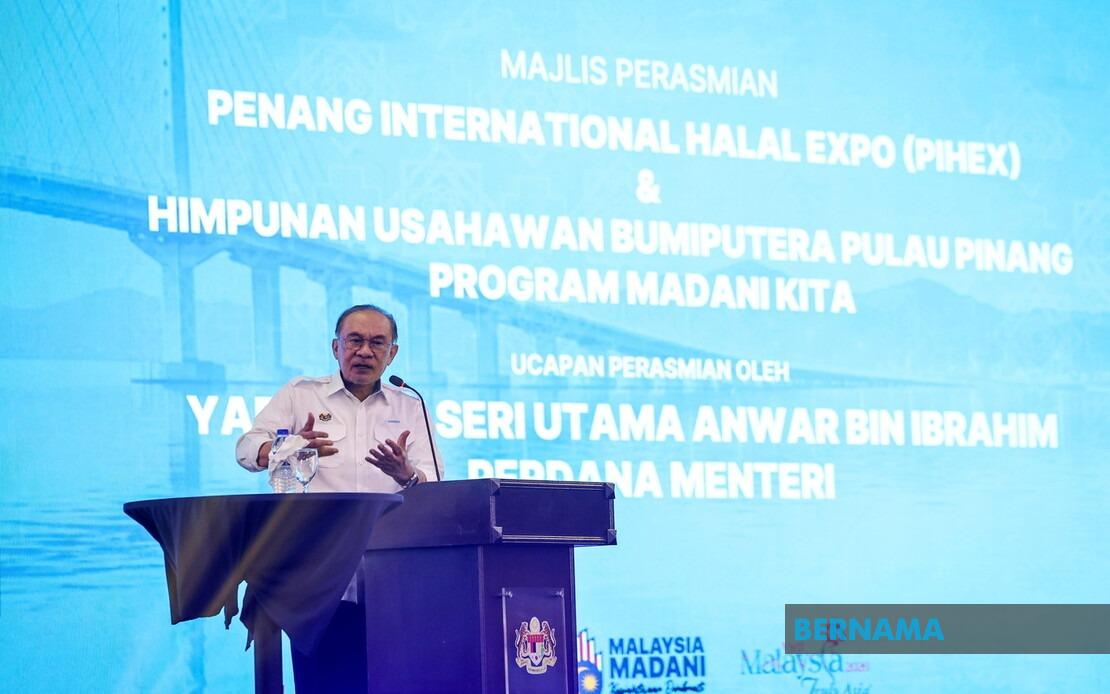
Prime Minister Datuk Seri Anwar Ibrahim is positioning Penang as a potential flagship state for Bumiputera economic participation, arguing that existing perceptions about the community's economic weakness in the state contradict measurable evidence. Speaking at the opening of the Penang International Halal Trade Exhibition 2026 and Penang Bumiputera Entrepreneurs Gathering at Seberang Perai Polytechnic in Permatang Pauh on July 25, Anwar contended that Bumiputera economic performance in Penang actually outperforms most Malay-majority states across Peninsular Malaysia, contrary to popular narratives suggesting otherwise.
The prime minister's assertion represents a deliberate reframing of perceptions around Bumiputera economic participation in what is predominantly a non-Malay state. Penang, governed by a multiethnic administration and widely recognised as an economic powerhouse driven by its manufacturing and technology sectors, has historically been viewed by some as less focused on Bumiputera-specific economic initiatives compared to Malay-majority states. By emphasising data-driven evidence, Anwar seeks to challenge this assumption and unlock greater confidence among Bumiputera entrepreneurs operating within the state's dynamic business environment. This narrative shift carries implications for how economic development strategies are framed across Southeast Asia's multicultural economies, where indigenous participation programmes often intersect with competitive, market-driven growth.
To translate vision into action, Anwar has instructed all Bumiputera development agencies operating across federal and state jurisdictions to align under a unified strategic framework. Currently, these organisations function independently, potentially duplicating efforts or leaving coordination gaps. Penang Bumiputera Development Council chairman Tan Sri Khalid Ramli has been tasked with consolidating these agencies under the Bumiputera Economic Development Council, ensuring implementation is streamlined rather than fragmented across multiple administrative silos. The prime minister indicated he would assess progress within weeks, establishing clear accountability for this institutional restructuring effort.
The semiconductor industry emerges as the primary vehicle for expanding Bumiputera economic opportunities in Penang. As Finance Minister, Anwar recognises that Penang's established position as the nation's semiconductor hub creates a natural platform for indigenous companies to integrate into technology-intensive supply chains. Rather than seeking to displace existing operators, the strategy focuses on enabling Bumiputera firms to develop competitive capabilities and secure positions within this high-value sector. This approach balances inclusive economic participation with operational efficiency, acknowledging that Bumiputera advancement need not come at the expense of established industry players.
To catalyse this expansion, the government has allocated RM5 million specifically for a Bumiputera Semiconductor Action Plan. This dedicated funding signals serious commitment beyond rhetorical endorsement, providing tangible resources for capability-building, workforce training, and supply chain integration. The allocation reflects understanding that entry into semiconductor manufacturing and services requires specialised investment in human capital and technological infrastructure. For Malaysian readers, this initiative underscores how indigenous economic policy is evolving toward high-technology sectors, moving beyond traditional commerce and small-scale enterprise toward knowledge-intensive industries where margin and growth potential exceed conventional business domains.
The halal industry component of these coordinated efforts demonstrates parallel momentum. According to Penang Deputy Chief Minister I and Penang Halal Industry Development Council chairman Datuk Dr Mohamad Abd Hamid, the state has expanded its network of Malaysian Halal Certification holders substantially. The count increased from 1,098 in 2024 to 1,191 in 2025, with 853 additional certificates processed through mid-July 2025. This expansion suggests robust growth in halal-certified businesses, extending beyond food into cosmetics, pharmaceuticals, and services. For Bumiputera entrepreneurs, this certification pathway offers accessible entry points into markets spanning Southeast Asia, the Middle East, and beyond, where halal standards command premium positioning and expanding consumer demand.
The Penang International Halal Trade Exhibition 2026 serves as both practical marketplace and symbolic platform for these initiatives. By hosting regional halal industry players and potential Bumiputera participants, the event facilitates direct commercial connections while reinforcing Penang's ambitions to become a halal sector hub. The exhibition format allows emerging Bumiputera enterprises to showcase capabilities, establish partnerships, and access international buyer networks. For the broader region, Penang's involvement in halal trade infrastructure positions Malaysia as a credible standard-setter and market leader within one of the world's fastest-growing ethical consumer segments.
The presence of Communications Minister Datuk Seri Fahmi Fadzil and Malaysian Communications and Multimedia Commission chairman Tan Sri Mohamad Salim Fateh Din at these events signals that digital transformation intersects with Bumiputera economic initiatives. Digital connectivity increasingly underpins supply chain participation, e-commerce scaling, and market access. Malaysian policy is recognising that Bumiputera advancement requires not only traditional business support but integration into digital infrastructure, telecommunications networks, and digital commerce platforms. This multisectoral approach reflects evolved understanding of how indigenous economic participation functions within contemporary global economies.
Penang's geographical position as a major manufacturing and logistics hub within Southeast Asia amplifies the significance of its Bumiputera economic positioning. The state connects to ASEAN markets, particularly Thailand and Vietnam through land routes, and maintains strategic port access. Bumiputera companies strengthening their presence in Penang gain proximity to cross-border supply chains, multinational investment corridors, and regional trade networks. This locational advantage means that success in Penang translates into broader Southeast Asian market access, positioning indigenous Malaysian enterprises competitively against regional peers.
The coordination imperative articulated by Anwar addresses a systemic challenge across Malaysian economic policy: fragmentation of development support across multiple agencies often dilutes impact. By consolidating Bumiputera development efforts under unified command, Penang positions itself to apply lessons more rapidly, reallocate resources flexibly, and demonstrate measurable outcomes. Success in Penang could establish a replicable model for other states, suggesting that institutional coherence itself drives economic results independent of sector or geography.
For Malaysian and Southeast Asian business observers, these announcements represent calibrated recalibration of indigenous economic policy toward integration with competitive, technology-intensive sectors rather than protection within parallel markets. The semiconductor and halal industry focuses demonstrate confidence that Bumiputera entrepreneurs can compete in open markets when provided strategic support, capability development, and supply chain integration pathways. This approach potentially offers instructive lessons for other ASEAN nations managing indigenous economic participation within market-driven frameworks.
The implicit challenge embedded in Anwar's Penang vision addresses scepticism about whether Bumiputera participation can meaningfully expand beyond small-scale enterprise and government-reserved contracts. By targeting semiconductor and halal sectors—both globally competitive, technologically advanced, and aligned with international consumer demands—the strategy asserts that indigenous economic advancement depends less on preferential protection and more on competitive capability development. Whether Penang delivers measurable performance improvements within the timeframe Anwar has indicated will determine whether this approach gains traction as a broader policy model, particularly across other states and sectors where similar institutional consolidation could unlock economic participation.

