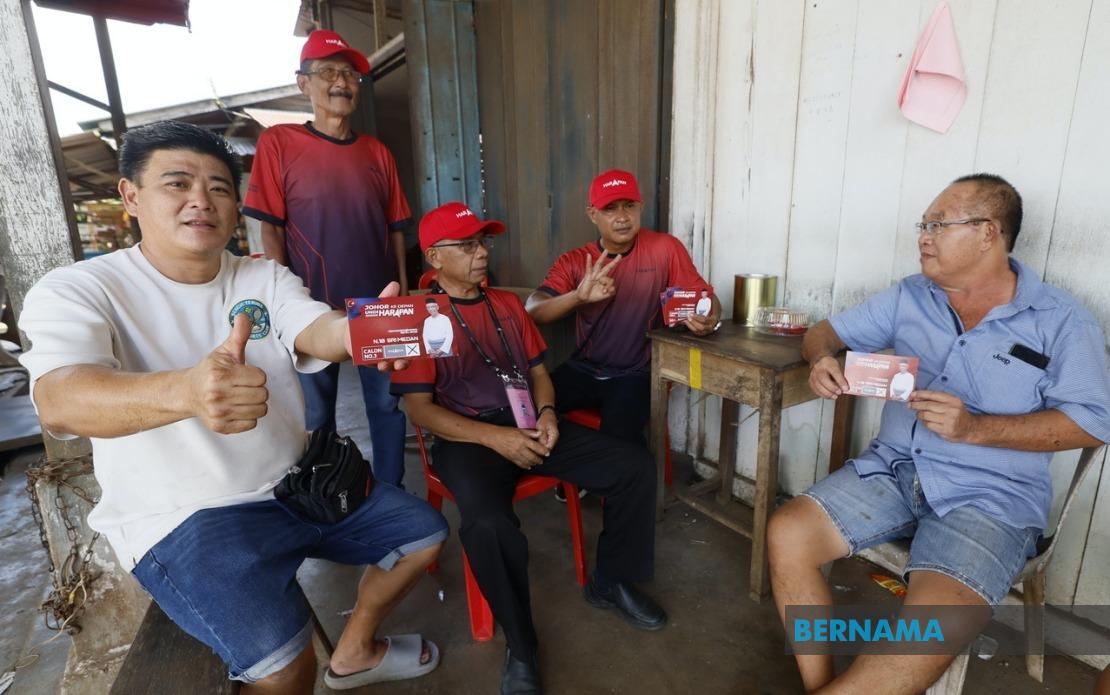
Pakatan Harapan is mounting a determined campaign in the traditionally Barisan Nasional-controlled Sri Medan seat, betting on grassroots engagement and local problem-solving to chip away at the ruling coalition's dominance ahead of the July 11 Johor state election. The coalition's candidate, Hishamudin @ Misrin Ishak, a former mathematics educator and village leader, is staking his candidacy on a philosophy of direct constituent service and addressing long-neglected infrastructure concerns that have frustrated residents for years.
The campaign approach, observable during recent walkabouts across Pekan Kangkar Senangar and surrounding areas in Batu Pahat, reflects a deliberate strategy to position Hishamudin as an attentive listener willing to engage with household-level grievances rather than offering grand political rhetoric. His emphasis on a "work first, talk later" principle suggests an attempt to differentiate from rival candidates by foregrounding demonstrated commitment over campaigning promises. Observers of Johor electoral dynamics note that such ground-level engagement strategies have gained traction in recent state contests, particularly where BN's traditional organisational machinery faces challenges from motivated challengers.
Water management and flood mitigation emerge as central planks in Hishamudin's platform, reflecting genuine concerns within Sri Medan's residential areas. The recurring inundations that have affected the constituency represent both a material hardship for families and a symbol of perceived government neglect, making their resolution a politically potent issue. By elevating this issue in his early campaign messaging, Hishamudin signals responsiveness to immediate quality-of-life concerns rather than abstract policy frameworks, an approach that aligns with voter sentiment in peri-urban and semi-rural constituencies across Malaysia.
Beyond flood prevention, Hishamudin's manifesto encompasses balanced spatial development—ensuring that infrastructure investment reaches not only urban commercial zones but also semi-urban and rural peripheries. This geography-aware approach acknowledges economic disparities within the constituency and implicitly critiques uneven development patterns that may have characterised prior administrations. Such messaging typically resonates in constituencies where rural and agricultural communities feel economically sidelined by urban-focused planning.
Skills development and youth engagement feature prominently in his platform, with specific mention of Technical and Vocational Education and Training (TVET) initiatives. This emphasis reflects broader Southeast Asian trends acknowledging the gap between secondary education pathways and labour market demands. By committing to organise training programmes and digital education exposure, Hishamudin addresses employer-side labour shortages while offering young constituents alternatives to conventional university pathways. Such initiatives, if implemented, could position the constituency as a regional hub for skills development, generating economic activity beyond traditional sectors.
Small and medium enterprise development, framed as market-access expansion beyond local demand, reflects understanding of SME constraints common across Malaysia. Many enterprise owners struggle to scale beyond community markets due to distribution, regulatory, and financial barriers. A constituency representative championing export-market connections and supply-chain integration could facilitate business growth, tangibly improving household incomes in ways constituents can directly experience. This positioning appeals to entrepreneurial cohorts and informal-sector workers often overlooked in mainstream political messaging.
Hishamudin's track record as a village administrator provides grounding for these promises, offering credible demonstration of community-engagement skills and problem-resolution experience. Village-level governance, while modest in scope, involves managing multiple stakeholder interests, resolving resource conflicts, and implementing development initiatives—experiences directly transferable to state-level constituency management. This background also signals accessibility; unlike candidates with purely urban or elite networks, Hishamudin maintains institutional familiarity with rural administrative mechanisms.
The competitive landscape within Sri Medan presents substantial obstacles for a PH candidate challenging an incumbent Barisan Nasional representative, Datuk Zulkurnain Kamisan, while simultaneously contending with a Perikatan Nasional challenger, Ahmad Rosdi Bahari. The three-way contest fragments opposition support and potentially advantages the incumbent if PH and PN voters divide roughly equally. Historical voting patterns in Sri Medan suggest BN has maintained consistent electoral margins, making this race an uphill struggle. However, Johor's political volatility—demonstrated in recent elections—means BN dominance is no longer assured, particularly if incumbent performance on local issues proves vulnerable to credible criticism.
Hishamudin's framing as a "fresh face" carrying no baggage from prior state or federal government failures represents strategic positioning in a context where governing parties across Malaysia face voter fatigue and accountability questions. New candidates, particularly those with demonstrable local credentials, can partly escape blame for systemic failures attributed to established party hierarchies. This asset becomes particularly valuable if the campaign successfully connects voter grievances—flooding, economic stagnation, limited youth opportunities—to specific government inaction rather than broader abstract ideological critique.
The early-campaign emphasis on non-partisan service resonates with evolving Malaysian voter preferences, particularly among younger cohorts and floating voters in suburban constituencies. Explicit commitments to serve all constituents "regardless of political affiliation" acknowledge that electoral legitimacy depends on governing for entire communities, not merely party supporters. This language, increasingly common in competitive constituencies, reflects normative shifts in voter expectations about representative accountability.
PH's strategic focus on Sri Medan reflects broader state-level calculations in Johor, where the coalition seeks to expand representation following mixed recent performances. Johor remains politically significant as Malaysia's fourth-largest state by population and a traditional BN stronghold; any gains would demonstrate PH viability in conservative constituencies. Conversely, BN will vigorously defend Sri Medan as a litmus test of ruling-coalition resilience in its core regions.
With early voting scheduled for July 7 and polling on July 11, the campaign timeline is compressed, limiting opportunity for extended issue development or mistake-recovery. Hishamudin's effectiveness will ultimately depend on whether his constituent-engagement approach translates into persuasive local narrative about government responsiveness and whether flood mitigation, SME support, and youth development messaging resonates sufficiently to overcome BN incumbency advantages.
The Sri Medan contest ultimately exemplifies contemporary Malaysian electoral dynamics: established ruling parties facing motivated challengers armed with local credibility and specific issue platforms, competing in constituencies where voter loyalty is increasingly conditional on demonstrated performance. Whether Hishamudin's people-first approach proves sufficient to crack BN's Johor fortress remains uncertain, but his candidacy reflects meaningful competitive pressure that suggests Malaysian electoral politics continues to evolve toward greater incumbent accountability and constituent expectations.

