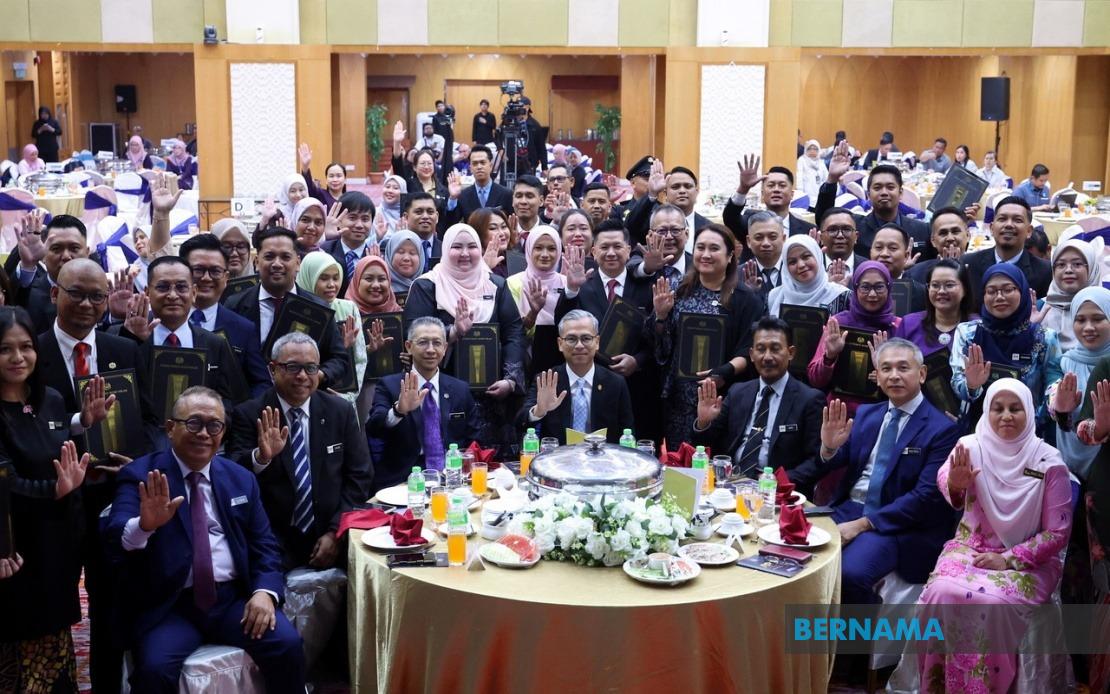
The MADANI Government views the prosperity of ordinary Malaysians as central to its economic mission, according to Communications Minister Datuk Seri Fahmi Fadzil, who drew a distinction between headline economic figures and their real-world impact on households. Speaking at the Communications Ministry's Sabah and Labuan Zone Excellent Service Awards ceremony in Kota Kinabalu, Fahmi articulated a philosophy that positions "people's economy" — the economic experiences of individual citizens — as a measure of governmental success that supersedes traditional macroeconomic metrics.
While national and state-level indicators present an encouraging picture, with growth evident across investment, government revenue, foreign reserves, gross domestic product, and bilateral trade volumes, Fahmi stressed that these statistical achievements mean little if they fail to materialise as improvements in household finances and living standards. The minister's remarks underscore an emerging priority within the Cabinet to bridge the gap between aggregate economic performance and the experiences of ordinary citizens navigating daily expenses and economic pressures.
To illustrate his point, Fahmi referenced the government's targeted subsidy programme, known as BUDI MADANI, which reflects a more nuanced approach to economic policy than broad subsidies. The programme attempts to direct benefits to those most in need while phasing out universal support that benefits wealthier households. However, the minister highlighted that implementation requires careful attention to geographical realities, particularly in East Malaysian states where distances between settlements and districts are substantial. This geographical consideration is especially relevant in Sabah and Sarawak, where residents often must travel considerable distances for essential services, meaning subsidy decisions carry different weight depending on local circumstances.
Fahmi noted that Prime Minister Datuk Seri Anwar Ibrahim and the Cabinet have given this matter serious consideration, recognising that policies formulated in Kuala Lumpur require calibration at the implementation stage to account for regional differences. The acknowledgment suggests a shift away from one-size-fits-all economic policies toward frameworks that recognise Malaysia's diverse geography and demographic spread. This approach potentially addresses long-standing grievances in East Malaysia, where residents have historically felt that federal policies inadequately account for their unique circumstances.
The concept of "people's economy" that Fahmi articulated goes beyond subsidy policy. It encompasses a broader philosophy in which government success is ultimately measured by whether citizens observe tangible improvements in their wallets and pockets — whether through increased wages, reduced living costs, improved access to services, or enhanced economic opportunities. This framing represents a departure from developmental metrics that focus primarily on GDP growth, foreign direct investment inflows, and trade expansion, metrics that may not always correlate with household welfare improvements, particularly for lower and middle-income earners.
For Malaysia and the Southeast Asian region more broadly, this rhetorical shift has implications. The country's economic trajectory has historically relied on attracting foreign investment and maintaining macroeconomic stability, with the assumption that such growth would eventually benefit all segments of society through job creation and wage growth. However, stagnating real wages in many sectors, widening income inequality, and rising living costs have created a political imperative to demonstrate more direct, immediate connections between government policy and household prosperity. Fahmi's remarks suggest the MADANI administration intends to address this disconnect more explicitly.
The minister also emphasised that government ministries and agencies bear responsibility for clear communication about policies and programmes to prevent public misunderstanding or confusion. This responsibility extends beyond simply announcing policies; it requires comprehensive explanation of rationales and implementation details. The emphasis on communication is particularly relevant given past controversies surrounding subsidy changes and economic restructuring initiatives, which sometimes sparked public backlash when citizens felt inadequately informed about changes affecting their finances. By positioning communication as a governmental responsibility, Fahmi suggests the Cabinet recognises that policy success depends not only on sound design but on public understanding and acceptance.
The Sabah platform for Fahmi's remarks carries symbolic importance. As an East Malaysian state, Sabah has frequently expressed concerns that federal economic policies insufficiently account for regional peculiarities. By delivering these remarks in Kota Kinabalu rather than the federal capital, the minister signalled that the government takes East Malaysian economic concerns seriously and recognises that a genuinely inclusive people's economy must address both peninsular and East Malaysian contexts. This geographical emphasis may reflect broader efforts by the MADANI Government to strengthen ties with Sabah and Sarawak, where political support remains competitive.
Implementing a people-centric economic agenda presents practical challenges. Policymakers must balance multiple sometimes-conflicting objectives: maintaining fiscal discipline, supporting businesses, ensuring social protection, and managing inflation. Targeted subsidies, while more efficient than universal ones, require robust administrative capacity to identify beneficiaries and prevent gaming. East Malaysia's geographical challenges compound these complexities. Nevertheless, Fahmi's articulation of the government's priorities signals a determination to pursue this path, even if execution proves complicated.
The emphasis on people's economy also reflects evolving global thinking about development and governance. International organisations increasingly acknowledge that GDP growth alone proves insufficient as a measure of societal progress, advocating instead for metrics capturing wellbeing, opportunity, and equity. By adopting this language and prioritising it explicitly, the MADANI Government positions itself as attuned to contemporary development thinking while simultaneously addressing domestic political pressures to improve living standards.
Looking ahead, Fahmi's remarks suggest Malaysians should anticipate continued emphasis on policies aimed at improving household finances and living costs. This might include refined subsidy targeting, wage enhancement initiatives, affordable housing programmes, and improved public service delivery in underserved regions. The government's success in the coming years will likely be judged less by GDP growth rates or foreign investment figures than by whether ordinary Malaysians perceive genuine improvements in their economic circumstances — a metric that proves more personally meaningful to voters than abstract macroeconomic statistics.

