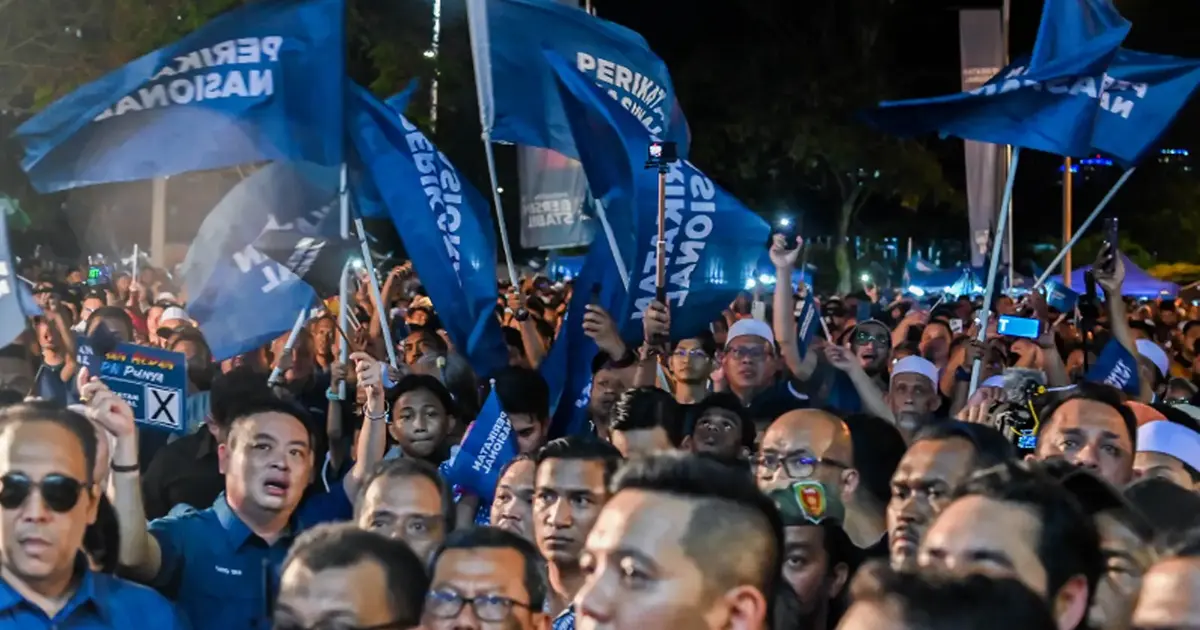
The stability of Perikatan Nasional, one of Malaysia's major political coalitions, appears increasingly precarious as friction between its two dominant components—PAS and Bersatu—deepens into what observers characterize as open, sustained conflict. According to Yusri Ibrahim, chief researcher at the Ilham Centre, the deterioration has moved beyond the realm of typical political disagreement into what he describes as a 'guerrilla war' phase, suggesting the dispute has become entrenched, unpredictable, and increasingly difficult to resolve through conventional means.
The PN coalition, which comprises PAS, Bersatu, and several smaller parties, has served as a significant political force in Malaysian politics in recent years. However, the relationship between PAS and Bersatu has never been entirely smooth, reflecting deep differences in ideology, strategy, and organizational culture. PAS, the Parti Islam Se-Malaysia, draws its strength from religious conservatism and a substantial grassroots presence in predominantly Muslim Malay heartlands. Bersatu, led by former Prime Minister Mahathir Mohamad and later Muhyiddin Yassin, represents a more centrist approach to coalition politics and has sought to position itself as a bridge between various political constituencies.
The characterization of current tensions as a 'guerrilla war' implies that the dispute has transcended formal public disagreements and entered into a more tactical, subterranean phase of maneuvering. Rather than clear, declarative positions taken in parliament or at party congresses, the conflict now appears to involve behind-the-scenes positioning, strategic positioning of cadres, and efforts to outmaneuver the other party across various political terrains. This form of political competition within a coalition can be particularly corrosive because it erodes trust and creates an atmosphere of uncertainty among party members and supporters.
For Malaysian politics more broadly, the potential unravelling of PN would have substantial ramifications. The coalition currently holds significant parliamentary representation and has served as a counterweight to other political blocs. A fracture within PN could reshape the entire political landscape, potentially opening new possibilities for realignment or creating periods of instability as different factions seek new partnerships. Given Malaysia's history of coalition politics, the defection of members from one bloc to another has often preceded major political shifts.
The tensions have been fuelled by competing visions for the coalition's future direction. PAS has sought to assert stronger control over Islamic policy matters and to position itself as the primary voice on religious affairs within the coalition. Bersatu, meanwhile, has advocated for a more inclusive political approach that appeals beyond the traditional Malay-Muslim demographic. These fundamentally different strategic outlooks have created friction on key decisions regarding policy priorities, candidate selection, and the distribution of ministerial positions and other political spoils.
Yusri Ibrahim's assessment carries particular weight given the Ilham Centre's reputation for nonpartisan political analysis. When such observers describe a situation as having entered a new, more dangerous phase, it signals that the situation has qualitatively changed and may be approaching a tipping point. The 'guerrilla war' metaphor suggests that standard conflict resolution mechanisms may prove ineffective, as the dispute has become fragmented into multiple localized confrontations rather than a single, unified disagreement.
The practical implications of this deterioration could manifest in various ways. Within parliament, coalition discipline might weaken, reducing the bloc's ability to act as a unified force on legislative matters. At the state and local levels, where both parties compete for influence, the friction could translate into open competition that undermines coordination. Party members faced with internal conflict may become demoralized, potentially affecting organizational effectiveness and campaign energy during electoral cycles.
Historically, Malaysian political coalitions have proven surprisingly durable despite internal tensions, but they have also collapsed when fundamental differences became irreconcilable. The critical question for PN's future is whether the current feud between PAS and Bersatu represents a temporary spat that can be managed through negotiation and power-sharing arrangements, or whether it reflects deeper structural incompatibilities that make continued partnership untenable. The shift to 'guerrilla warfare' suggests the latter may increasingly be the case.
For smaller parties within PN, the escalating tensions present both danger and opportunity. These components depend on the coalition's stability for their own political survival and relevance. However, should the coalition fracture, they might gain leverage as potential partners for whoever emerges as the leading force from the breakdown. This dynamic creates incentives for smaller parties to maintain a certain neutrality while positioning themselves advantageously.
The timing of this deterioration matters significantly for Malaysian politics. With general elections required within the next few years, sustained internal conflict within a major coalition could prove disadvantageous when voters go to the polls. Coalitions with visible internal strains typically underperform compared to more unified blocs. For PN's potential rivals, particularly the Pakatan Harapan coalition, the spectacle of PN's internal struggles may offer opportunities to present themselves as a more coherent and stable alternative.
Moving forward, the trajectory of PN will depend on whether senior leaders from PAS and Bersatu can negotiate a modus vivendi that addresses their core differences while maintaining coalition structure. Without such arrangements, the 'guerrilla war' characterization may prove prophetic, with the coalition gradually deteriorating rather than suffering a sudden, dramatic collapse. This incremental unravelling could ultimately prove more destabilizing to Malaysian politics than a clear, definitive split would be.