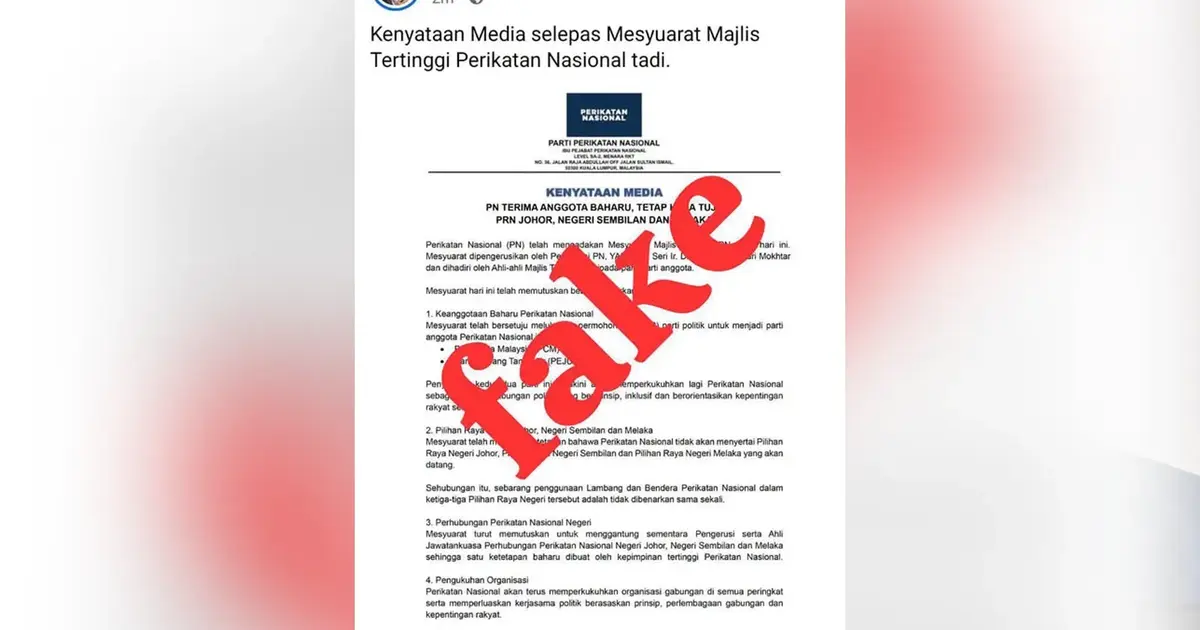
Perikatan Nasional moved quickly to dispel what it describes as misleading claims circulating online regarding its electoral strategy, issuing a categorical denial that the coalition plans to withdraw from three state contests. The opposition coalition characterised the statement making these allegations as entirely false and inaccurate, emphasising that no such decision has been taken by party leadership or the broader PN membership.
The emergence of this spurious document underscores a persistent challenge facing Malaysian politics: the rapid dissemination of fabricated claims through digital channels, particularly social media platforms where verification remains difficult and misinformation can gain traction before corrective statements reach wider audiences. In an environment where political messaging shapes voter behaviour and public perception of coalition viability, such deception carries meaningful consequences for how citizens understand coalition positions and intentions.
The timing of the false statement warrants attention, as Malaysia approaches various electoral cycles and state politics continues to experience significant flux. Perikatan Nasional, which has positioned itself as a major political force at both federal and state levels following its emergence as a prominent player in recent national politics, maintains ambitions to expand its influence across multiple state administrations. Any suggestion that the coalition would strategically retreat from electoral contests contradicts its stated trajectory of political consolidation and expansion.
For observers tracking Malaysian political developments, the incident illustrates how deliberate disinformation campaigns can serve competing interests within the broader political landscape. Such tactics may originate from rival coalitions seeking to sow doubt about PN's commitment to electoral contests, from internal party factions attempting to create friction, or from actors seeking to test information ecosystem vulnerabilities. Regardless of source, the effect remains the same: public confusion and diminished trust in formal political communications.
Perikatan Nasional's swift response reflects contemporary political necessity. In an era where false narratives can metastasise across platforms before conventional media corrections reach audiences, coalitions and parties must maintain rapid-response capabilities to counter misinformation. The coalition's explicit labelling of the statement as fraudulent serves both defensive and communicative purposes—protecting its credibility while signalling to supporters that the coalition remains in control of its own messaging and strategic direction.
The implications extend beyond PN's immediate interests. Malaysian voters increasingly navigate an information landscape cluttered with competing claims, requiring heightened critical engagement with political statements regardless of source. The prevalence of forged documents and fake attributions creates ambient uncertainty about what political leaders have actually said versus what circulates under their names. This broader erosion of information reliability affects democratic functioning by complicating voter decision-making and reducing the clarity necessary for informed electoral choices.
State elections assume particular significance in Malaysian federalism, as these contests determine which coalition controls resource distribution, administrative appointments, and policy implementation at sub-national levels. The notion that Perikatan Nasional would voluntarily skip electoral opportunities in three states would represent a stunning strategic reversal inconsistent with the coalition's recent trajectory of competitive engagement across multiple arenas. The falsity of such claims becomes apparent when examined against PN's demonstrated willingness to contest elections at federal and state levels.
For Southeast Asian observers more broadly, this incident reflects a region-wide challenge: managing political discourse in contexts where digital literacy remains uneven, partisan polarisation runs high, and organised disinformation becomes an increasingly sophisticated tool in political competition. Malaysia's experience with fabricated statements and false attributions mirrors problems evident across the region, where emerging democracies and stable systems alike struggle with information integrity in digital environments.
The broader question emerging from this episode concerns institutional responses to systematic misinformation. While individual coalition denials address specific false claims, Malaysia continues to develop mechanisms—whether through regulatory frameworks, platform policies, or civil society initiatives—designed to reduce the impact and prevalence of disinformation on political discourse. The absence of widespread consensus on how governments should intervene while respecting speech freedoms remains a point of ongoing tension.
Moving forward, Perikatan Nasional's handling of this incident may influence how other political actors respond to similar fraudulent statements. Coalition leaders must balance between over-reacting to every false claim, which risks amplifying misinformation, and under-responding, which leaves false narratives unchallenged in the public sphere. The coalition's measured but firm denial suggests confidence in its position while signalling vigilance against attempts to misrepresent its intentions.
Ultimately, this episode serves as reminder of Malaysian politics' continued vulnerability to narrative manipulation. As the nation approaches various electoral contests and state-level power dynamics continue shifting, maintaining clarity about what political leaders have genuinely said—rather than what forged documents falsely attribute to them—becomes essential for democratic health. Perikatan Nasional's denial, while addressing an immediate crisis, points toward larger questions about how Malaysian political institutions and society will collectively manage information integrity in coming years.

