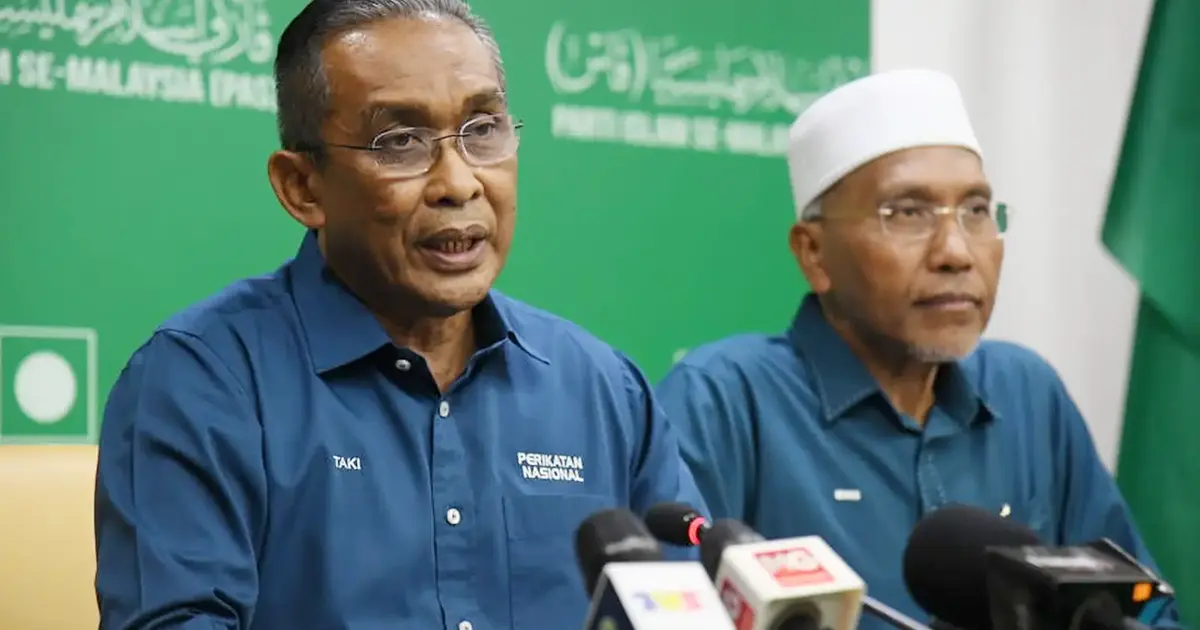
Perikatan Nasional has introduced stricter internal governance controls, with the coalition's secretary-general Takiyuddin Hassan announcing that no meetings or events can be convened without the explicit authorization of the chairman. The announcement comes at a sensitive moment for the opposition alliance, as reports emerged that Bersatu president Muhyiddin Yassin had sought to schedule a PN Supreme Council meeting without following the newly established approval procedures.
The timing of Takiyuddin's statement reveals underlying tensions within the three-party coalition, which comprises Bersatu, PAS, and the Malaysian United Indigenous Party. While the secretary-general framed the new requirement as a procedural clarification, observers interpret it as a mechanism to consolidate control over the coalition's organizational apparatus. The distinction between formal protocol and actual power dynamics within PN remains contested, particularly given the high-profile nature of the Supreme Council, which typically convenes to discuss coalition direction and strategic decisions.
This development underscores the complexity of managing a multi-party coalition where individual parties maintain their own leadership hierarchies while operating within a broader united structure. Bersatu, as the largest component of PN by parliamentary representation, carries significant influence, yet the coalition framework requires consensus-building among leadership figures spanning multiple organizations. The requirement for chairman approval before convening meetings effectively centralizes decision-making authority and may constrain the ability of individual party presidents to initiate discussions independently.
The incident involving Muhyiddin's attempt to call a Supreme Council meeting without prior authorization suggests friction over procedural matters and possibly substantive policy disagreements. As Bersatu president, Muhyiddin maintains considerable sway within his own party and historically has played a central role in PN's formation and direction. However, the secretary-general's assertion that formal approval is mandatory indicates that the chairman's office now exercises gatekeeping authority over the coalition's most important deliberative body.
For Malaysian political observers, this represents a significant development in how opposition coalitions manage internal governance during periods when they are not in federal power. The ability to maintain party discipline and coherent messaging relies heavily on controlling when and how leadership bodies meet. By restricting access to Supreme Council meetings, the chairman's office can potentially manage which topics receive coalition-wide attention and in what sequence different parties address contentious issues.
The new protocol also carries implications for how decisions are made within PN on critical matters ranging from policy positions on religious and constitutional affairs to electoral strategy. PAS, which holds considerable ideological influence within the coalition, depends on regular inter-party consultation to advance its agenda. If the Supreme Council cannot convene without chairman authorization, this creates potential bottlenecks that could frustrate any party seeking to urgently raise matters of concern to its membership.
Takiyuddin's role as secretary-general places him in a position to enforce this requirement, yet the relationship between the chairman and secretary-general in multi-party coalitions can be complex. If the chairman and secretary-general operate in alignment, this creates a powerful enforcing mechanism for coalition discipline. However, if divisions emerge between these offices, the administrative authority to approve or deny meetings could become a flashpoint for broader leadership disputes.
The incident highlights how opposition coalitions in Malaysia must balance the democratic aspirations of their constituent parties with the operational necessity of presenting a unified front. Individual party leaders elected by their own membership may feel constrained if they cannot easily convene coalition-wide discussions on matters they deem urgent. This tension between coalition cohesion and intra-party autonomy has historically been a source of instability in Malaysian opposition alliances.
Regional observers watching PN's trajectory note that similar governance challenges have affected other Southeast Asian opposition coalitions. Thailand's Democratic Alliance Against Dictatorship and Indonesia's various opposition blocs have grappled with similar coordination problems. The mechanisms PN adopts to manage internal disputes could offer lessons for how regional opposition movements maintain unity under pressure.
For federal politics in Malaysia, the durability of PN remains a significant factor in the balance of power between the ruling coalition and opposition. If internal governance tightness leads to mutual satisfaction among the three parties' leaderships, it could strengthen PN's coherence and electoral appeal. Conversely, if rank-and-file members perceive themselves as excluded from deliberation, it could generate friction that public procedural disputes might eventually expose.
The requirement for chairman approval before convening meetings may also reflect broader concerns about unauthorized communications or attempts by party elements to circumvent established decision-making structures. In highly competitive political environments, coalition partners often worry about leaks, unauthorized negotiations, or attempts by rival factions to shape narratives before official positions are formulated. Administrative controls over meeting access represent one mechanism to mitigate these risks.
Takiyuddin's clarification of this requirement signals that PN's administration intends to enforce it rigorously, at least for high-profile bodies like the Supreme Council. Whether this extends to other committee structures or affects informal consultations among party leaders remains to be seen. The secretary-general's public statement likely aims both to establish clear expectations and to deter future attempts to convene meetings that bypass the approval process.

