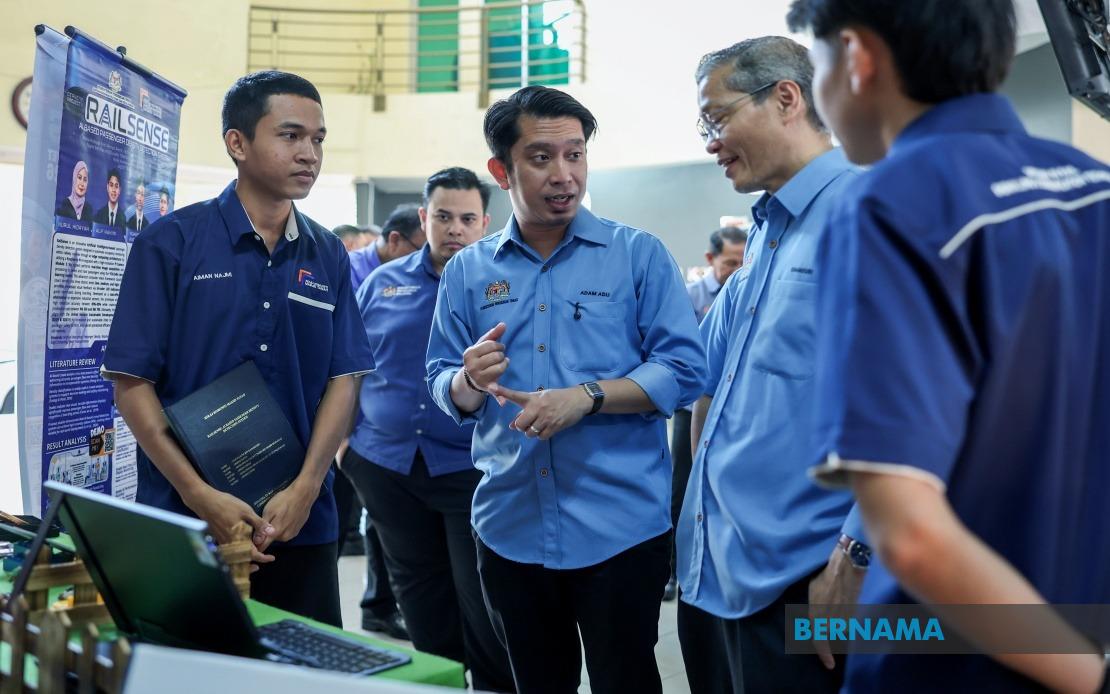
The National TVET Innovation Competition, known as PERISA '26, wrapped up its three-day run at Masjid Tanah Community College in Alor Gajah with a critical message: innovators must move swiftly to protect their creations through formal intellectual property registration. Deputy Higher Education Minister Adam Adli Abd Halim delivered this guidance during the closing ceremony, stressing that the safeguarding of inventions represents a fundamental step toward ensuring local innovations gain competitive advantage in an increasingly crowded marketplace where intellectual assets determine commercial viability.
The emphasis on patent protection reflects a broader strategic shift within Malaysia's technical and vocational education system toward creating a pipeline of market-ready innovations. Adam Adli articulated this vision clearly, noting that registering intellectual property does not restrict an innovation's potential but rather preserves its inherent value and competitive edge. This framing addresses a common misconception among emerging innovators and TVET students who may fear that patenting their work limits its applications or utility. In reality, formal registration provides the legal foundation necessary for licensing agreements, joint ventures, and industry partnerships—pathways through which inventions reach broader markets and generate economic returns for their creators.
The competition itself, themed "Agentic AI in Innovation," attracted 118 innovation projects spanning five distinct categories: Engineering Technology, Information Technology, Social Sciences, Commerce and Hospitality, and Students. This diversity of participation underscores Malaysia's commitment to fostering innovation across multiple sectors rather than concentrating efforts solely on advanced manufacturing or digital industries. The broad thematic scope also reflects the government's recognition that technological solutions to real-world challenges emerge from interdisciplinary thinking and that vocational education institutions serve as crucial incubators for practical problem-solving approaches that university research laboratories sometimes overlook.
Among the standout innovations showcased during PERISA '26 was a rail passenger density monitoring system developed using artificial intelligence. This project exemplifies the competition's objective of channeling technological advancement toward addressing tangible infrastructure and public service challenges. Such innovations demonstrate that TVET institutions and their students are capable of contributing meaningfully to national development priorities, a reality that often remains underappreciated in discourse dominated by university research achievements. The rail monitoring system also illustrates the intersection between government infrastructure priorities and technology development, suggesting pathways for future commercialisation through collaboration with relevant agencies and private sector transport operators.
Deputy Higher Education Minister Adam Adli positioned intellectual property registration as integral to unlocking commercialisation opportunities through industry collaboration. This sequential thinking—develop, patent, commercialise—reflects international best practices in innovation management and technology transfer. For Malaysian TVET graduates and institutions, this framework offers a concrete roadmap: innovations emerging from colleges and polytechnics should not languish as academic exercises but should transition into industry partnerships where established companies provide capital, distribution networks, and market access. The minister's emphasis on this progression suggests that the ministry views TVET institutions not merely as training providers but as innovation-generating entities with economic potential.
The presence of multiple government stakeholders at the competition's closing—including Polytechnic and Community College Education Department director-general Dr Shamsuri Abdullah and deputy director-general Ulaimi Yahya—signifies institutional commitment to transforming TVET education through innovation prioritization. This top-level attention signals that vocational education reform in Malaysia increasingly incorporates entrepreneurship, technology commercialisation, and intellectual property literacy as core competencies alongside traditional skills training. Such institutional backing matters considerably because it can influence resource allocation, curriculum development, and the prestige accorded to innovation activities within polytechnic and community college environments.
Crucially, the competition served broader strategic purposes beyond identifying individual winning projects. As an official platform driving TVET transformation, PERISA '26 cultivates innovation culture, encourages creative problem-solving aligned with industry demands, and generates solutions addressing national development imperatives. This intentional architecture—coupling a competition with explicit innovation objectives—represents a deliberate policy approach to channel institutional energy and student talent toward outputs with measurable economic and social relevance rather than relegating innovation to peripheral status within TVET curricula.
The strategic collaborations announced during the event—a memorandum of understanding between Masjid Tanah Community College and Prasarana Malaysia Berhad, and a letter of intent with ERL E-MAS—demonstrate the tangible mechanisms through which competition outcomes translate into industry partnerships. These agreements focus on competency development, expertise sharing, and industry networking within technology and skills domains, creating pathways for students and educators to engage with major infrastructure and transportation sector operators. Such linkages prove invaluable because they expose TVET participants to industry-standard practices, connect innovations with potential commercial partners, and create employment pathways for graduating students.
For Malaysian policymakers, PERISA '26 exemplifies how well-structured innovation competitions can simultaneously serve multiple objectives: identifying promising technologies, building awareness around intellectual property protection, fostering industry partnerships, and strengthening TVET sector reputation and relevance. The competition's emphasis on artificial intelligence applications aligns Malaysia's vocational education trajectory with the technology sector's evolving demands, ensuring that TVET graduates develop capabilities valued by forward-looking employers.
The broader implication for Southeast Asian economies lies in recognizing TVET institutions' underutilized potential as innovation sources. While universities dominate regional research rankings and international attention, polytechnics and community colleges often possess more direct industry connections, pragmatic problem-solving orientations, and student populations motivated by employment prospects. Competitions like PERISA '26 systematically mobilize these strengths, transforming vocational education from a stigmatized alternative pathway into a driver of technological advancement and commercialisable innovation.

