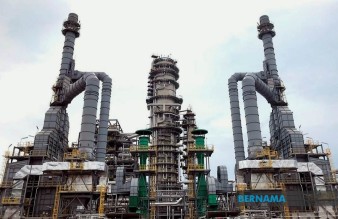
Malaysia should view a proposed national petroleum reserve not as a standalone energy policy but as part of an integrated economic security framework that addresses vulnerabilities across multiple critical sectors, according to Mohd Sedek Jantan, director of investment strategy and country economist at IPPFA Sdn Bhd. His assessment comes in response to Prime Minister Datuk Seri Anwar Ibrahim's proposal to establish a petroleum reserve stock designed to shield the nation from international supply disruptions and geopolitical instability. However, the economist cautions that fixating solely on energy reserves risks overlooking equally consequential threats to economic stability that could emerge from food supply chains, access to critical minerals, semiconductor production or digital infrastructure vulnerabilities.
Mohd Sedek's perspective reflects a fundamental shift in how nations conceptualise economic resilience in an increasingly interconnected and fragmented global system. He emphasises that stockpiling barrels of crude oil, while valuable, does not by itself create durable resilience. Instead, reserves function most effectively when positioned within a coordinated national strategy addressing multiple points of potential economic rupture. The success of any petroleum reserve should consequently be measured not by volumetric benchmarks but by whether it genuinely strengthens Malaysia's capacity to absorb and recover from future geoeconomic shocks. This distinction matters significantly for policymakers determining resource allocation and strategic priorities in the coming years.
The economist highlights food security as deserving equal policy priority alongside energy reserves, particularly given Malaysia's substantial reliance on imported foodstuffs for domestic consumption. Disruptions to global food supply chains carry immediate and visible consequences for ordinary Malaysians, directly influencing inflation rates, household purchasing power and ultimately social cohesion. A sudden spike in food prices or sustained shortages would create economic instability as severe as any petroleum crisis, yet this vulnerability often receives less strategic attention in long-term planning discussions. By contrast, reliable energy supply chains, whilst essential for manufacturing, transportation and industrial competitiveness, represent only one dimension of comprehensive economic security.
Critical minerals and semiconductors constitute additional strategic sectors meriting serious consideration in Malaysia's economic resilience planning. The global semiconductor industry's concentration in a handful of jurisdictions creates potential bottlenecks that could cripple advanced manufacturing and technology sectors throughout the region. Similarly, access to rare earth elements and other critical minerals remains essential for battery production, renewable energy infrastructure and defence capabilities. Malaysia's own position within semiconductor supply chains, combined with its resource wealth in certain strategic minerals, makes this dimension particularly relevant for national economic strategy development.
Mohd Sedek underscores that energy security, whilst increasingly important to Malaysia's economic future, should not be viewed in isolation from these complementary vulnerabilities. Policymakers must recognise that the next significant economic crisis may originate from entirely different sources than petroleum supply disruptions. Food systems, mineral supply chains, technological dependencies or digital infrastructure could each trigger widespread economic damage if adequate resilience mechanisms remain absent. This forward-looking perspective demands a more sophisticated and diversified approach to national economic security than historical frameworks provide.
The economist proposes three essential elements should guide any petroleum reserve initiative. First, policymakers must articulate the reserve's precise purpose with clarity, distinguishing between legitimate economic security objectives and potential misuse for short-term market manipulation. A strategic petroleum reserve should activate only during genuine supply disruptions threatening economic functioning, not operate as a tool for price management or commercial speculation. This distinction carries important implications for governance structures and decision-making protocols governing reserve deployment.
Second, the governing framework must retain sufficient flexibility to adapt as strategic threats evolve. Today petroleum may rank among Malaysia's most pressing vulnerabilities, yet tomorrow's challenge could involve entirely different sectors. A truly resilient approach establishes methodological capacity to identify emerging vulnerabilities, assess their economic impact and develop responsive strategies without requiring structural overhauls each time the threat landscape shifts. This adaptive capability proves more valuable than any single reserve's static contents.
Third, implementation must satisfy both commercial and fiscal sustainability criteria. Decisions regarding reserve size, financing mechanisms, physical storage infrastructure and administrative governance should rest upon rigorous cost-benefit analysis ensuring public resources generate genuine long-term value. Poorly designed or oversized reserves become fiscal drains without meaningfully enhancing actual economic resilience, potentially crowding out investments in alternative security measures that might yield superior outcomes.
Mohd Sedek points toward Japan as a instructive international example, where strategic reserves operate not in isolation but as components of integrated frameworks encompassing diversified supplier networks, resilient logistics systems and robust public-private coordination mechanisms. Japanese policymakers recognised decades ago that reserves alone prove insufficient; genuine resilience emerges from interlocking systems designed to maintain supply continuity through multiple pathways even when primary channels experience disruption. Malaysia could adapt elements of this integrated approach to its own geographic position, economic structure and strategic vulnerabilities.
The broader implication of this analysis suggests that Malaysia's approach to the petroleum reserve proposal should extend beyond narrow energy considerations to encompass comprehensive national economic security planning. Rather than treating the reserve initiative as a discrete policy intervention, relevant government agencies might leverage it as a catalyst for developing a coherent multi-sectoral resilience strategy. Such an approach would position Malaysia more effectively to navigate increasingly unpredictable global economic conditions while ensuring that substantial public investments generate proportionate security benefits across multiple vulnerability dimensions.
Implementing this integrated framework would require coordination across multiple government departments, private sector partners and potentially regional neighbours through ASEAN mechanisms. Malaysia's position as both a significant oil producer and an import-dependent economy for numerous critical commodities places it at particular intersection of global supply chain vulnerabilities. A comprehensive economic security strategy developed thoughtfully over the coming years could substantially enhance Malaysia's ability to maintain prosperity and social stability regardless which sector faces disruption.

