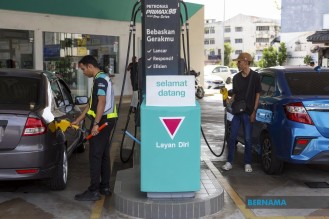
Malaysia's fuel supply position has been bolstered by a confirmation from Petronas that its petrol station network can maintain adequate fuel stocks through August, according to Datuk Seri Azalina Othman Said, Minister in the Prime Minister's Department (Law and Institutional Reform). The reassurance came during deliberations at the National Economic Action Council, addressing concerns about prolonged energy shortages stemming from international tensions.
The Petronas Dagangan Bhd network, which is the publicly listed subsidiary of the national oil corporation, represents approximately half of the country's total domestic fuel demand. This substantial market share means that stability at Petronas pumps directly translates into national energy security. The extension of supply guarantees from the end of June into August signals that immediate fuel rationing or widespread disruptions are not anticipated in the near term, providing relief to businesses and consumers dependent on stable energy access.
The government's response to the global energy crisis reflects growing awareness that Malaysia's fuel security cannot be taken for granted. In response to geopolitical tensions in West Asia that have disrupted international energy markets, authorities established the Crisis Management Task Force under MTEN to provide coordinated oversight of petroleum flows. This body operates with a mandate to continuously assess fuel, petroleum, and energy supply dynamics across the nation while simultaneously addressing price stability concerns that accompany commodity volatility.
The task force's portfolio extends beyond simple supply monitoring. Its mandate encompasses efforts to prevent fuel smuggling and irregular market activities that tend to proliferate when supply uncertainty creates price differentials with neighbouring countries. For Malaysia, this has long been a concern given geographical proximity to lower-cost fuel sources in Brunei and Indonesia. The establishment of this formal institutional arrangement signals that the government recognises fuel security as requiring sustained, systematic attention rather than ad-hoc crisis response.
Diversification of crude oil sourcing represents a strategic pillar of Malaysia's energy resilience approach. Rather than relying predominantly on Middle Eastern crude, the government is pursuing supply arrangements with producers in West Africa and the Americas. Such geographical diversification reduces vulnerability to regional disruptions while also introducing competitive dynamics that can influence pricing. However, these sourcing alternatives require careful evaluation given the technical specifications of crude oil grades and their compatibility with Malaysia's refining infrastructure, alongside commercial considerations around pricing and payment terms.
The parliamentary question that prompted this clarification reveals ongoing public and political scrutiny of energy security. Khairil Nizam Khirudin's inquiry about Petronas' earlier statement regarding supply guarantees only through June 2026 indicates that lawmakers are pressing for extended visibility and contingency planning. This dynamic reflects the reality that in Malaysia's parliamentary system, energy security—being fundamental to economic stability—remains subject to regular legislative oversight.
For Malaysian businesses and consumers, the extended supply outlook through August provides a planning horizon for managing energy-dependent operations. Manufacturing sectors reliant on fuel-intensive production, the logistics and transportation industry, and commerce dependent on reliable fuel access can proceed with greater confidence in near-term continuity. However, the framing of stability only through August leaves open the question of what happens thereafter, implying that longer-term energy policy adjustments may be necessary to address structural challenges beyond the immediate crisis period.
The geopolitical backdrop to this statement cannot be overlooked. Ongoing West Asian tensions have repeatedly sent shockwaves through global energy markets, typically pushing crude prices upward and creating supply chain uncertainties. Malaysia, as an oil-producing nation itself with substantial reserves, enjoys greater insulation than purely oil-importing regional neighbours. Yet even producer nations benefit from stable international markets, and Malaysia's own crude production has been declining, necessitating continued reliance on imports to meet domestic demand.
The government's emphasis on price control mechanisms within the crisis management framework addresses a critical anxiety beyond simple physical supply. Energy affordability directly impacts household and business costs, with ripple effects throughout the economy. By emphasising the task force's role in monitoring and controlling prices, the administration is signalling commitment to preventing speculative price spikes that could undermine economic stability even when physical fuel remains available. This reflects lessons learned from previous energy crises where psychological factors and hoarding behaviour sometimes exacerbated supply disruptions.
Looking forward, Malaysia's energy security will likely depend on the government's success in executing the diversification strategy outlined. Securing crude supplies from African and American producers requires building diplomatic and commercial relationships beyond traditional partnerships. These sourcing alternatives may command different pricing premiums and involve extended shipping times, introducing new logistical considerations. The technical compatibility issues mentioned underscore that energy security is not purely a commercial or diplomatic matter but also an operational challenge for Malaysia's refining sector.
The August timeline also serves as a natural checkpoint for reviewing policy effectiveness and adjusting strategies as needed. Whether global energy markets stabilise sufficiently by late summer to reduce crisis management pressures, or whether renewed disruptions require further government intervention, remains to be seen. For now, Malaysia has moved from a posture of uncertainty about fuel availability into a more structured, planned approach to energy security—a meaningful shift in how the nation manages one of its most critical economic resources.

