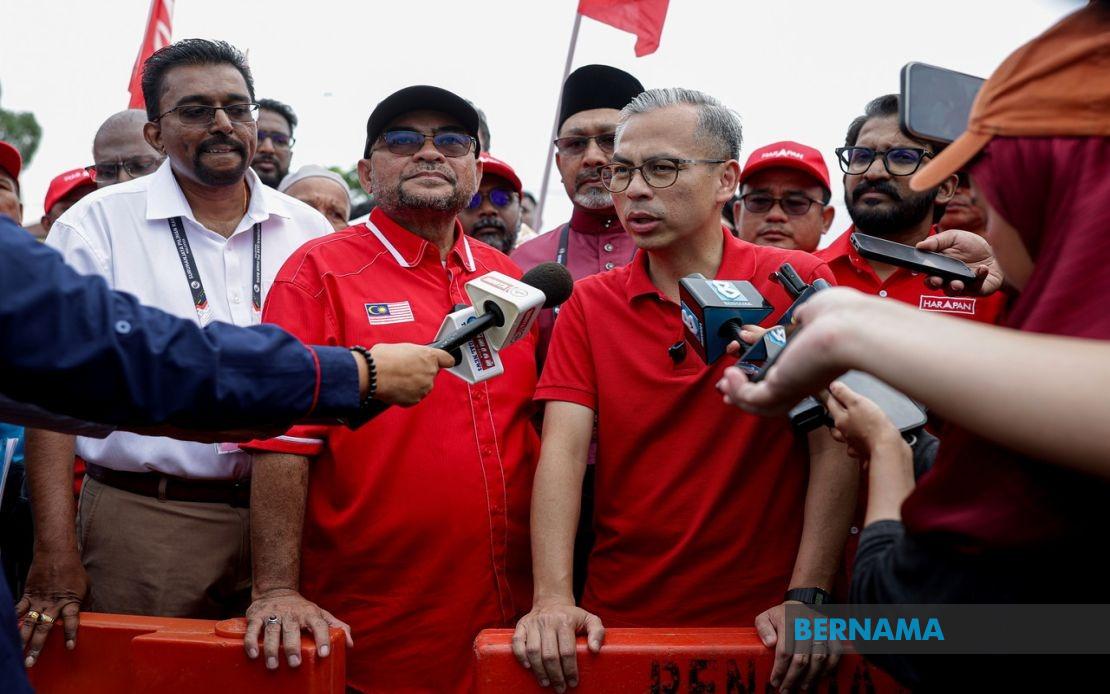
Pakatan Harapan will contest the upcoming Negeri Sembilan state election by emphasizing the administrative continuity under incumbent Menteri Besar Datuk Seri Aminuddin Harun and the coalition's track record of economic performance since assuming office six years ago. Communications Minister Datuk Seri Fahmi Fadzil outlined this strategy at the nomination ceremony for four constituencies under the Jempol parliamentary district, signalling that PH intends to campaign primarily on the strength of the current administration's accomplishments rather than on alternative policy proposals.
The coalition's central argument rests on a series of measurable outcomes that party officials contend demonstrate competent governance. These achievements include expanded zakat collections across the state, improved revenue generation for the state government coffers, and a sustained trajectory of foreign direct investment inflows into Negeri Sembilan. Among the high-profile development markers PH plans to highlight is the construction of a new port facility, which the party views as emblematic of its commitment to infrastructure modernization and economic diversification. By framing these developments as evidence of sound administration, PH hopes to persuade voters that maintaining the current leadership structure offers the best prospect for preserving economic stability and extending the prosperity that residents have experienced during Aminuddin's tenure.
This electoral strategy reflects a broader positioning common to incumbents seeking re-election: the argument that established governance should continue rather than be disrupted by political change. For Negeri Sembilan, where Aminuddin's administration has operated within the Pakatan Harapan framework across a period of relative political stability at the state level, the continuity message carries particular weight. The administration's ability to attract foreign investors and maintain steady revenue streams becomes, in PH's framing, a reason for voter confidence in the status quo. This approach implicitly concedes that electoral contests are often decided on the basis of comparative performance metrics rather than ideological positioning, a calculation that appears especially pertinent in a state where economic considerations rank high among voter priorities.
Within the four constituencies involved in Tuesday's nomination process, PH has calibrated distinct messaging to address localized voter concerns. In Jeram Padang, where the party fields G. Manivannan, a lawyer and political secretary to Prime Minister Datuk Seri Anwar Ibrahim, the campaign will emphasize employment opportunities and economic advancement for younger constituents. This represents a deliberate segmentation strategy, with PH recognizing that different demographic groups within the state respond to different policy appeals. The Jeram Padang contest involves a four-way competition, with Manivannan facing Barisan Nasional incumbent Datuk Mohd Zaidy Abdul Kadir, Perikatan Nasional-affiliated candidate R. Sri Sanjeevan from Bersatu, and Dayana Dal, the sole Orang Asli candidate fielded as an independent. This crowded field underscores the complexity of multi-ethnic coalition politics in Malaysian state elections.
The competitive landscape across the four constituencies reveals significant variation in contest structures. While Jeram Padang and Serting will feature four-way battles, the Bahau seat will see a direct bilateral contest between PH's incumbent Teo Kok Seong, a DAP member, and BN's Chong Fui Ming representing the MCA. In Serting, PH's Yaacob Mahmood will confront Perikatan Nasional's incumbent Mohd Fairuz Mohd Isa alongside Bersatu's Muhammad Noraffendy Mohd Salleh. The Palong division presents another three-cornered fight, with BN's incumbent Datuk Mustapha Nagoor defending against PH's Muhammad Zahin Zinal Abidin and Bersatu's Rebin Birham. These varied configurations require PH to tailor campaign resources and messaging to the specific dynamics of each locality, a resource-intensive undertaking that demands coordinated effort across multiple organizational levels.
Fahmi's remarks also signalled the broader communications environment within which the campaign will unfold. As Communications Minister, he articulated expectations that all participants—candidates, party machinery, media representatives, and online commentators—would conduct themselves responsibly during the two-week campaign period. He explicitly urged stakeholders to refrain from politicizing sensitive matters encompassed by the so-called 3Rs framework, which traditionally designates religion, race, and the institution of rulers as domains requiring cautious handling in public discourse. Additionally, Fahmi cautioned against the dissemination of false information and defamatory material, a particular concern in an era when digital platforms enable rapid viral spread of unverified claims. His emphasis on these guardrails reflects government awareness that electoral cycles can generate heightened social tensions if campaigns veer into inflammatory territory, particularly in a multi-communal state like Negeri Sembilan.
The explicit commitment to monitor the welfare of media practitioners throughout the campaign indicates official recognition of journalism's role in covering elections fairly and comprehensively. This undertaking carries significance for the broader health of electoral processes, as independent media scrutiny serves as a counterweight to partisan propaganda and helps citizens make informed voting decisions. By pledging to attend to media practitioners' safety and working conditions, Fahmi's statement implicitly acknowledges that journalists performing their professional duties during contentious electoral periods require institutional support and protection from potential harassment or intimidation.
The Election Commission's schedule establishes early voting on July 28 and main polling day on August 1, creating a fourteen-day window for campaign activities. This compressed timeframe requires political organizations to deploy resources with considerable efficiency and concentration, as voters will make their decisions based on messaging and engagement occurring during this relatively brief interval. The nomination process, completed without incident according to official reports, proceeded smoothly across all four constituencies, suggesting organizational competence on the part of both the electoral authorities and participating political organizations.
For Malaysian observers and stakeholders with broader regional interests, the Negeri Sembilan election offers a barometer for voter sentiment regarding Pakatan Harapan's stewardship at the state level. While national political dynamics significantly influence state-level contests, voters in Negeri Sembilan can assess PH's administrative record through direct experience with public services, infrastructure projects, and economic opportunities. The party's decision to campaign primarily on this tangible record, rather than on abstract policy promises or criticisms of opposition parties, suggests confidence in the government's performance metrics. Whether this strategy will prove persuasive to a majority of voters will become apparent on August 1, when Negeri Sembilan residents cast their ballots and determine the composition of the state assembly for the coming years.

