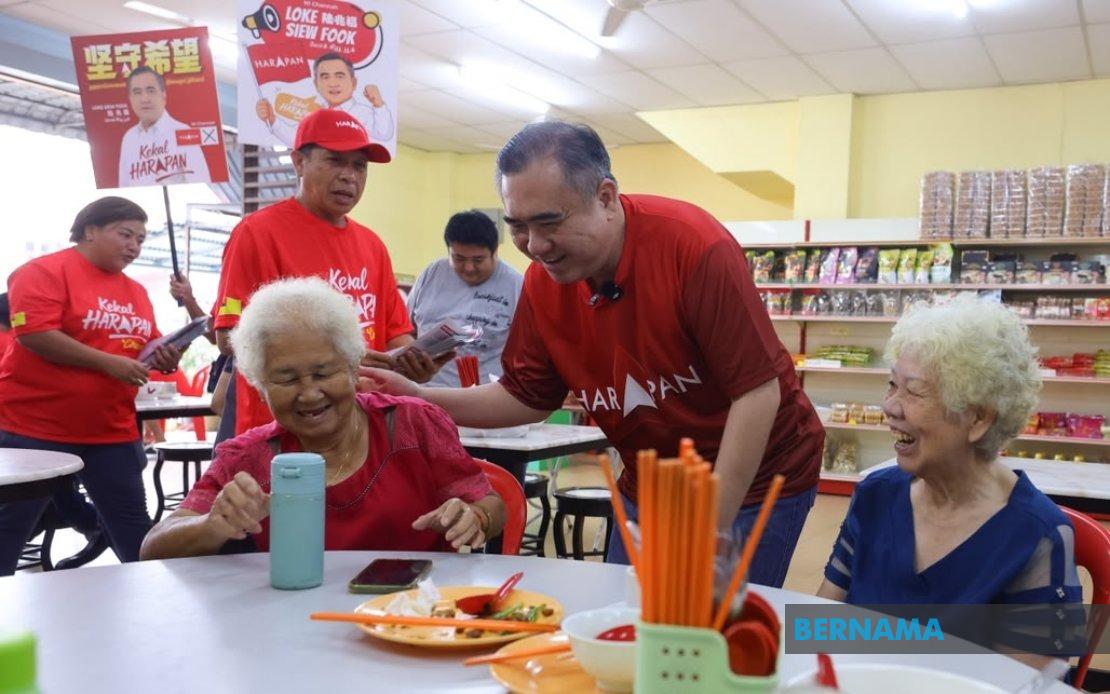
Pakatan Harapan is taking a granular approach to its campaign machinery ahead of the Negeri Sembilan state election, with party leadership emphasising that successful electoral outreach demands careful attention to the particular economic, social, and demographic realities of individual constituencies. DAP secretary-general Anthony Loke, who is mounting a defence of his Chennah state seat, outlined this strategy during a community walkabout in Pekan Titi on July 20, signalling that the opposition coalition recognises the futility of applying a one-size-fits-all electoral message across a diverse state.
The principle underpinning PH's approach reflects a sophisticated understanding of Malaysian electoral politics. Negeri Sembilan, though relatively compact, encompasses communities with markedly different concerns—rural farming villages, small-town commercial centres, and suburban housing developments all coexist within the state's boundaries. Loke's observation that each village requires distinct engagement strategies suggests that PH intends to move beyond generic policy announcements and instead position its candidates as responsive to hyperlocal preoccupations, whether these involve agricultural support, infrastructure development, or business regulation.
In the Chennah constituency specifically, PH has structured its campaign machinery to reflect geographical and demographic variation. Rather than a uniform canvassing operation, the party has segmented its voter contact efforts to align with the particular composition of different areas. This tactical flexibility offers several advantages: it enables candidates to address specific grievances that might carry outsized importance in particular villages, allows volunteers to develop deeper familiarity with local opinion leaders and community networks, and creates space for candidates to position themselves as intimately acquainted with neighbourhood-level concerns rather than distant political figures distributing standardised speeches.
Loke, who serves as Transport Minister and has represented Chennah since 2013, underscored that all PH candidates have already begun intensive ground operations during the opening days of the official campaign period. This early mobilisation suggests the coalition views the three-week window before the August 1 polling day as insufficient to establish genuine voter contact and therefore commenced relationship-building activity immediately upon announcement of the election date. The emphasis on candidates meeting voters directly and listening to their perspectives indicates that PH views this election partly as an information-gathering exercise—using campaign interactions to identify emerging concerns that should inform policy positioning in a future state government.
The party's insistence on granular campaign tailoring also reflects lessons from recent Malaysian electoral contests. When opposition parties apply undifferentiated national narratives to state or local races, they frequently discover that voters prioritise immediate, tangible issues over abstract ideological commitments. A voter in a rural Negeri Sembilan village may care far more about pothole repair or veterinary services than about broader governance frameworks, and PH's acknowledgment of this reality demonstrates organisational maturity. The strategy also acknowledges that BN candidates, drawing on years of state government experience, already possess detailed knowledge of local conditions, so PH cannot afford to appear generic or disconnected by comparison.
Loke also addressed the party's manifesto, which was scheduled for unveiling on the evening of July 20. He characterised the document as the product of dedicated committee work involving extensive internal consultation and discussion prior to finalisation. The manifesto will presumably contain a range of initiatives framed as beneficial to voters, though Loke declined to preview specific content, instead inviting public attention to the official launch. This measured approach—withholding premature disclosure of policy proposals—allows PH to control the narrative environment around the manifesto's introduction and potentially coordinate its public release with media and campaign events designed to maximise coverage and voter attention.
Contests for state assemblies in Malaysia typically hinge on a combination of national political trends and intensely local considerations. The Negeri Sembilan election occurs amid broader political dynamics that have shaped Malaysian politics since the 2022 federal election, but state-level outcomes depend substantially on the performance and credibility of individual candidates in their respective constituencies. Loke's Chennah contest pits him against Barisan Nasional candidate Siow Kong Choon in what the source describes as a straight fight, signifying that neither contest features more than two serious contenders. This binary contest structure simplifies the electoral arithmetic but intensifies pressure on both campaigns to mobilise their respective partisan bases while convincing persuadable voters in the centre.
The Election Commission's scheduling of early voting for July 28 and polling day for August 1 provides a compressed campaign period compared to some previous state elections. Early voting arrangements traditionally favour parties with superior organisational capacity to identify and transport older voters, disabled voters, and those unable to vote on the main polling day. Both PH and BN will therefore prioritise identification of early voting candidates and ensure reliable transport is arranged. This logistical dimension of campaigning often receives insufficient attention in media coverage but substantially influences electoral outcomes, particularly in constituencies where margin of victory is expected to be narrow.
Loke's presentation of PH's campaign strategy also implicitly addresses concerns that opposition parties sometimes struggle to maintain campaign energy and volunteer enthusiasm across long electoral cycles. By emphasising that candidates are already engaged in direct voter contact and that campaign machinery has begun implementation of locally-tailored strategies, he signals that the party possesses the organisational infrastructure and volunteer depth necessary for sustained ground operations throughout the campaign period. This matters because volunteer fatigue and declining campaign momentum frequently benefit incumbents, who can maintain campaign visibility through government announcement and media coverage independent of campaign activity.
Negeri Sembilan's political complexion has shifted notably over recent electoral cycles, with constituencies swinging between opposition and ruling coalition control. The state represents genuinely competitive electoral terrain rather than a PH stronghold or a BN bastion, meaning that individual constituency outcomes can differ significantly from statewide trends. Loke's acknowledgment that PH must customise its approach to local conditions reflects realistic assessment of this competitive environment—there are no automatic victories to be claimed through national brand appeal alone, and success requires methodical, disciplined engagement with the particular concerns of specific voter populations.
The Transport Minister's emphasis on listening to voter perspectives during campaign interactions also suggests that PH intends to use the campaign period as a diagnostic tool, identifying policy gaps and emerging community concerns that should inform governance priorities if the coalition achieves victory. Malaysian voters increasingly expect their elected representatives to demonstrate specific, detailed knowledge of constituency conditions and to articulate concrete responses to identified problems rather than merely reciting party platforms. By framing its campaign as a listening exercise, PH positions itself as responsive and accountable to constituent input, a positioning that can prove decisive in competitive electoral environments where voters harbour considerable skepticism toward all political parties.

