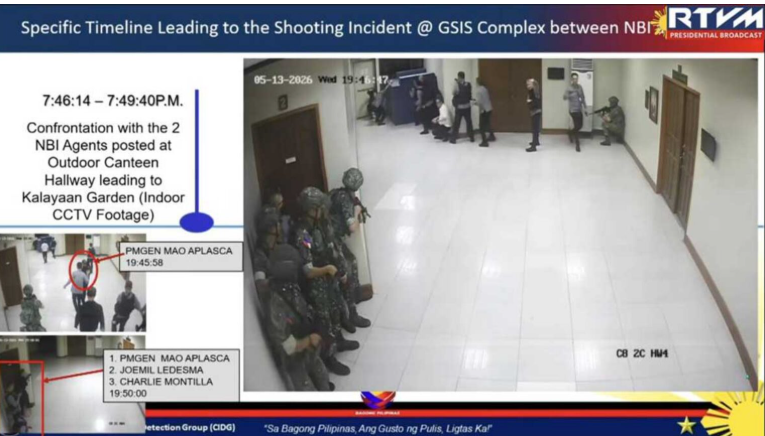
The Philippine Department of Justice has opened a formal investigation into potential criminal charges against public officials in connection with a dramatic shooting incident at the Senate on May 13 and the subsequent escape of Senator Ronald dela Rosa from police protection early the following morning. Justice Secretary Fredderick Vida confirmed that prosecutors are actively examining the circumstances surrounding both events and exploring possible links between them, signalling that the inquiry has expanded beyond a simple examination of the shooting incident itself to encompass the broader chain of events that unfolded over those two crucial days.
According to Vida's account, the investigation panel has compiled substantial evidence from multiple sources. The National Bureau of Investigation has provided testimonies and documentation, while security camera recordings from the Senate complex offer visual confirmation of critical moments. Media accounts and witness statements have also been incorporated into the evidentiary record. Crucially, investigators have identified sniper fire that originated from the fifth floor of the Senate building, with ballistic evidence suggesting the shots were deliberately directed at an NBI vehicle positioned at the nearby GSIS premises—indicating a targeted operation rather than random violence.
The targeting of a specific NBI vehicle raises significant questions about advance knowledge and coordination. The precision of the shooting and the apparent coordination between the Senate location and the intended target suggest a level of planning that extends beyond a spontaneous act. For observers in Southeast Asia watching Philippine governance, the incident underscores vulnerabilities within law enforcement and protective services that parallel concerns in other regional democracies about institutional integrity and the concentration of security apparatus control.
While Vida has not yet identified specific individuals under investigation, he made clear that preliminary findings point toward multiple public officials as persons of interest. This distinction is legally significant: the department is gathering information before determining whether sufficient evidence exists to formally charge anyone. The focus on public officials rather than private actors adds a constitutional dimension to the inquiry, as it potentially involves questions about the misuse of state institutions and resources for purposes that may violate the public trust.
The escape of Dela Rosa from protective custody presents a separate but possibly interconnected layer of investigation. His removal from secure protection just hours after the Senate shooting raises questions about whether protective arrangements were deliberately compromised or whether negligence in security protocols allowed his departure. As a former Philippine National Police chief with security clearances and insider knowledge of law enforcement operations, Dela Rosa's movements and the circumstances permitting them have drawn intense scrutiny from investigators seeking to understand the full scope of what transpired.
Vida's commitment to conducting the investigation "professionally, objectively, and without fear or favor" carries particular weight in a Philippine context where allegations of selective justice and political manipulation of the legal system surface regularly. His explicit acknowledgment that "no individual is above the law" addresses longstanding public concerns about elite impunity, while his counterstatement that "no person should be judged before the evidence has been fully examined" signals an awareness of the need for due process protections—a balance that will be tested as the inquiry advances.
For Malaysian and regional observers, the case illustrates how political instability and questions about institutional loyalties can rapidly escalate domestic security concerns. The incident demonstrates that even in democracies with established security institutions, breaches can occur that suggest competing power centers within government apparatus. The involvement of the NBI as a victim rather than merely an investigator adds complexity, as it suggests internal tensions within law enforcement may be relevant to understanding what occurred.
The gathering of CCTV evidence and NBI testimony indicates investigators are building a forensic record that will be difficult for subjects to dispute through political rhetoric alone. Physical evidence of where shots originated, combined with communications records and personnel movements, can establish facts independent of conflicting narratives. This forensic approach will likely prove decisive if the investigation advances to the charging stage, though securing access to all relevant evidence and witnesses may present political obstacles.
The phrase "at this stage" in Vida's statement is telling—it acknowledges that the investigation remains preliminary and that conclusions remain fluid. This openness to evolving findings contrasts with rushed determinations that sometimes characterize Philippine official statements, though whether this measured approach will be sustained if political pressure mounts remains uncertain. The Justice Department faces pressure to both pursue the investigation thoroughly and avoid appearance of partisan targeting, a tension that characterizes justice system work globally.
For the broader Philippine political context, the investigation signals that institutions retain capacity to examine high-level conduct even when powerful figures are implicated. Yet the outcome will reveal much about the current balance of power between different government institutions and the extent to which law enforcement remains genuinely independent. Regional governments watching the Philippines will note whether the investigation achieves credible conclusions or whether it stalls amid institutional obstruction.