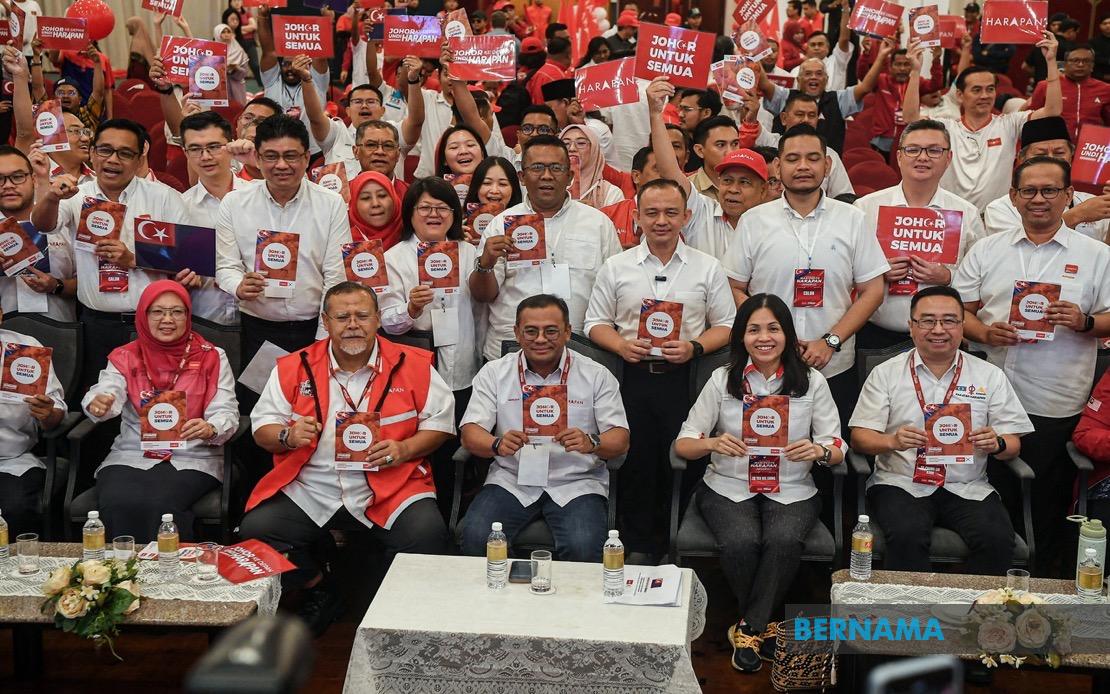
Pakatan Harapan unveiled its manifesto for Johor's upcoming state election on Wednesday, with senior party figures insisting the platform represents a pragmatic response to voter concerns rather than mere campaign rhetoric. Unveiled in Johor Bahru, the 'Johor Untuk Semua' (Johor For All) initiative sets out a structured agenda intended to address the daily challenges confronting the state's diverse population. DAP chairman Teo Nie Ching, who doubles as Deputy Communications Minister, framed the document as a carefully calibrated response to both immediate community needs and the broader economic landscape shaping the southern state's future trajectory.
The manifesto rests on ten pillars designed to span the full demographic spectrum. Young professionals and parents figure prominently in the campaign's targeting, reflecting PH's determination to broaden its appeal beyond traditional support bases. The package encompasses the proposed Johor Health Scheme, which would extend subsidised medical coverage to state residents; a first-time homebuyer assistance programme to ease entry into property ownership; a RM500 million youth development fund aimed at skills training and entrepreneurship; and a comprehensive education improvement strategy. Teo characterised the overall framework as balanced and inclusive, avoiding the tendency toward narrow political positioning that sometimes undermines campaign promises.
Border management has emerged as a critical vote-winning issue for Johor, where congestion at crossings to Singapore imposes genuine costs on commuters, businesses, and the broader economy. The manifesto commits PH to a 50 per cent reduction in waiting times at frontier checkpoints, a target that strikes many observers as ambitious but not impossible given sufficient political will. Teo expressed confidence that coordination with the federal Home Ministry could unlock the necessary administrative reforms and infrastructure investments. The pledge reflects recognition that cross-border efficiency directly affects quality of life for thousands of daily travellers and commercial operators who depend on smooth passage between Malaysia and its wealthier neighbour.
Teo's invocation of Selangor's parallel health initiative demonstrates PH's wider strategy of leveraging successful governance models across multiple states. Selangor's healthcare subsidy scheme has developed operational credibility through several years of implementation, establishing both institutional knowledge and a track record that the party believes can reassure sceptical Johor voters. By pointing to another PH-administered state's proven capability, the party attempts to transform manifesto promises from abstract commitments into tangible, evidence-based propositions. This comparative approach addresses a persistent vulnerability for opposition parties: voter concern that pledges, however well-intentioned, cannot survive contact with the complexities of actual governance.
The timing of the manifesto launch precedes the 16th Johor state election, scheduled for July 11, with early voting set for July 7. The compressed campaign window concentrates voter attention and forces all parties to crystallise their messaging quickly. PH's emphasis on specific, quantifiable targets distinguishes this approach from broader ideological appeals. Education quality, economic opportunity for youth, healthcare access, housing affordability, and infrastructure efficiency represent concerns that cross ethnic and class boundaries. The diversity of offerings suggests the coalition recognised that no single policy domain dominates voter priorities in contemporary Johor, and that competitive advantage derives from presenting a coherent response across multiple fronts simultaneously.
Teo's role as Deputy Communications Minister lends additional institutional weight to PH's assertions. Her position within the federal administration ostensibly positions her to broker cooperation between state-level initiatives and national-level resources, though such coordination frequently encounters bureaucratic friction and budgetary constraints in practice. Her public confidence that promised outcomes are achievable rests partly on her access to federal channels, yet also carries implicit risk: failure to deliver on high-profile commitments becomes more damaging when senior figures have personally championed specific targets. The 50 per cent border reduction goal, in particular, represents the kind of quantified pledge that invites subsequent scrutiny against actual performance metrics.
The manifesto's construction reflects broader shifts in Malaysian electoral politics, where voters increasingly demand specificity regarding how parties will deploy state resources and power. Generic commitments to fighting corruption or improving service quality no longer satisfy electorates exposed to successive campaign promises over multiple electoral cycles. The 'Johor Untuk Semua' package's inclusion of concrete figures—the RM500 million youth fund, the targeted border congestion reduction, references to Selangor's healthcare model—represents an attempt to ground campaign discourse in operational reality. This shift toward measurable commitments, whether ultimately achievable or not, reflects voter sophistication and experience-based scepticism about political pledges.
For Malaysian and Southeast Asian observers, the Johor contest carries implications extending beyond state boundaries. Johor represents the PH coalition's strongest terrain in peninsular Malaysia outside the northwest, yet the party's grip remains contested. Performance in this election will shape perceptions of PH's broader viability as a governing force, influencing potential partnerships, candidate recruitment, and fundraising across the region. The manifesto's emphasis on economic competitiveness, healthcare provision, and infrastructure efficiency reflects issues dominating Southeast Asian political discourse as nations navigate post-pandemic recovery, demographic change, and intensifying regional competition.
Critiques from opposition quarters have predictably focused on financing questions: how PH would fund the health scheme, youth programmes, and border improvements without either raising taxes or reallocating resources from other essential services. Teo's confidence that these initiatives can be delivered presupposes not merely federal goodwill but also adequate budget allocation. Critics question whether a coalition government, dependent on maintaining parliamentary majorities and balancing competing coalition partners' interests, would prioritise Johor's manifesto commitments over other national priorities. The gap between campaign promises and budgetary reality frequently determines whether initiatives launch successfully or languish in implementation limbo.
The election result will test whether voters credit PH's manifesto-based approach as a meaningful advance in political communication and accountability, or dismiss it as sophisticated packaging of conventional campaign rhetoric. Success in Johor would validate the strategy of specific, cross-demographic policy platforms and reinforce PH's positioning as detail-oriented administrators rather than populist promisers. Conversely, a disappointing performance might suggest that voters remain sceptical regardless of manifesto specificity, or that PH's particular policy mix failed to resonate with Johor's electorate. The state election thus functions as both immediate political contest and broader test of contemporary Malaysian politics' trajectory toward accountability-focused governance.

