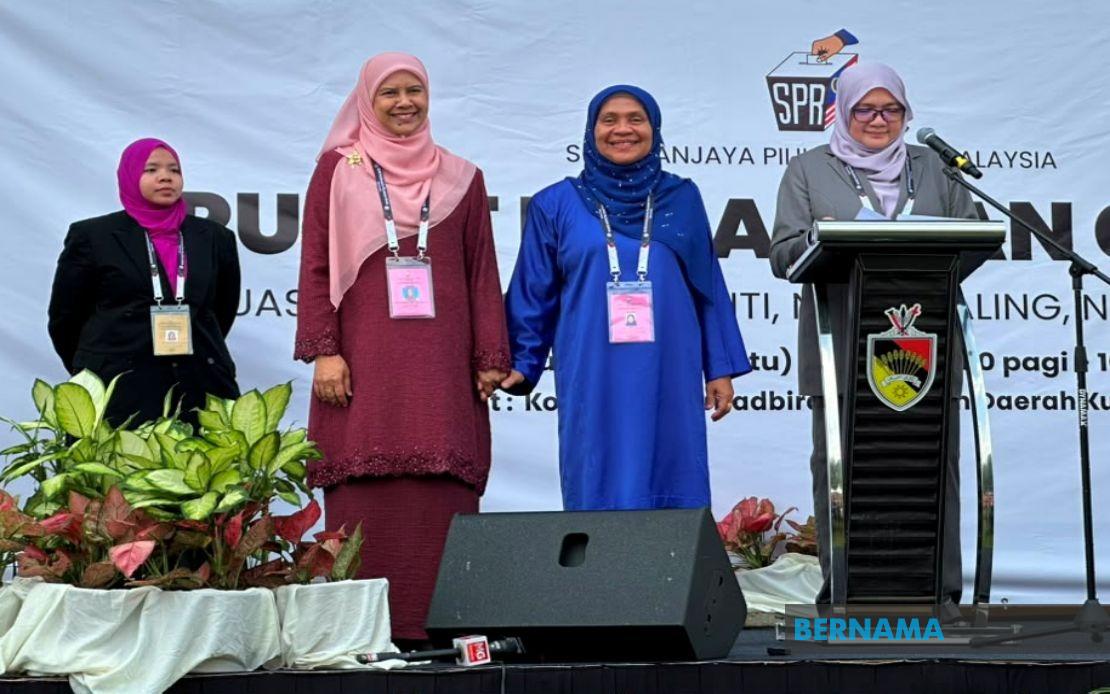
The Pilah state constituency in Negeri Sembilan will stage a rare all-women showdown in the upcoming 16th State Election, pitting incumbent Datuk Noorzunita Begum Mohd Ibrahim of Pakatan Harapan against Barisan Nasional's S. Leza Md Yasin. The nomination period closed on July 18 following formal registration of both candidates at the District and Land Office in Kuala Pilah, with returning officer Nawal Mohammed Amin confirming the two-candidate field after the morning's submission deadline.
The gender composition of the Pilah race reflects broader shifts in Malaysian electoral participation, where women have increasingly taken prominent roles in state and federal contests. Noorzunita Begum's incumbency carries the weight of her previous electoral mandate, while S. Leza's candidacy represents Barisan Nasional's attempt to recapture a seat the coalition may view as vulnerable territory. The timing of their nominations—Noorzunita Begum filing at 9:03 am and S. Leza following just six minutes later—underscored the predictability of the final lineup once candidate vetting processes concluded.
Support mobilisation for the competing sides involved senior ministerial figures, signalling the importance both coalitions attach to the Negeri Sembilan election. Education Minister and PKR Wanita chief Fadhlina Sidek accompanied Pakatan Harapan candidates during the nomination process, while Angkatan Muda Keadilan vice-chief and Youth and Sports Minister Dr Mohammed Taufiq Johari also reinforced PH's presence. Deputy Investment, Trade and Industry Minister Sim Tze Tzin from Bayan Baru further demonstrated the coalition's commitment to the contest, bringing national-level political machinery to bear on state-level races.
Barisan Nasional deployed comparable senior resources, with Deputy Home Minister Datuk Seri Dr Shamsul Anuar Nasarah and Perak Menteri Besar Datuk Seri Saarani Mohamad accompanying BN candidates. The participation of a Perak state leader underscores how closely neighbouring Perak observers are watching Negeri Sembilan's political trajectory, particularly given historical crossover effects between these adjacent states. The involvement of UMNO Supreme Working Council members highlighted the traditional coalition's determination to resist Pakatan Harapan gains in what remains a contested political arena.
Beyond the Pilah spotlight, the Negeri Sembilan contest will deliver considerable competitive variety across the state's constituencies. Three-cornered contests will dominate in Juasseh, Seri Menanti and Senaling, introducing complex vote-splitting dynamics that could prove decisive where margins narrow. The Juasseh seat will feature Pakatan Harapan's Mohd Aidil Abdullah competing against incumbent Datuk Ismail Lasim of Barisan Nasional and Bersatu's Mohd Zuhami Md Yusof, creating a triangular battle where no single party can assume comfortable victory.
Seri Menanti's contest mirrors this pattern, with PH's Mohd Kamarul Arifin Mohd Wafa seeking to dislodge incumbent Muhammad Sufian Maradzi while Bersatu's Datuk Seri Megat D. Shahriman Zaharuddin pursues an independent path. The presence of Bersatu across multiple constituencies demonstrates the party's decision to maintain ground presence in Negeri Sembilan despite national political turbulence, potentially acting as a spoiler or consolidating a specific voter base depending on local circumstances. Senaling similarly features a three-way tussle between Mohd Hanis Mohd Alimin for PH, BN's Mohamad Qayyum Abd Jalil and Bersatu's Mohd Izzafi Khan.
The Johol seat represents the only other straight contest beyond Pilah, with PH's Mohd Zailan Mohd Munawar directly challenging incumbent Datuk Saiful Yazan Sulaiman of Barisan Nasional. This bilateral competition may attract closer electoral observation than the three-cornered battles, given the cleaner lines of conflict between the two major coalitions without third-party complications. The prevalence of contests involving Bersatu candidacies across multiple seats reflects the party's continuing relevance in Negeri Sembilan politics, even as its national standing remains contested.
The Election Commission's timeline has structured voter participation with early voting scheduled for July 28 and polling day designated as August 1. This compressed electoral cycle gives candidates and parties limited time for ground campaigns, placing premium value on existing party machinery and voter familiarity with candidates. The August 1 polling date ensures minimal overlap with other electoral events, allowing Negeri Sembilan voters and observers to focus exclusively on state-level contests without distraction from concurrent national or local council races.
For Pakatan Harapan, maintaining the Pilah seat—and potentially gaining ground in three-cornered contests where opposition votes might fragment—represents a significant objective in a state where coalitional control has shifted over recent election cycles. Barisan Nasional's multi-ministerial presence signals determination to stabilise its position in Negeri Sembilan and perhaps advance into territory perceived as vulnerable. The electoral stakes extend beyond individual constituencies; they reflect broader patterns of political realignment in Malaysia's peninsular states, where voter behaviour increasingly diverges from traditional communal voting blocs.
The participation of women as leading candidates in the Pilah contest carries symbolic weight within Malaysian political discourse, though substantive policy platforms and individual candidate appeal will determine electoral outcomes. Both Noorzunita Begum and S. Leza bring their own political histories and community connections, and the contest will ultimately hinge on voter assessments of their respective governance records and future vision. The August 1 polling will test not merely party strength but voter sentiment regarding female political leadership in a state context.

