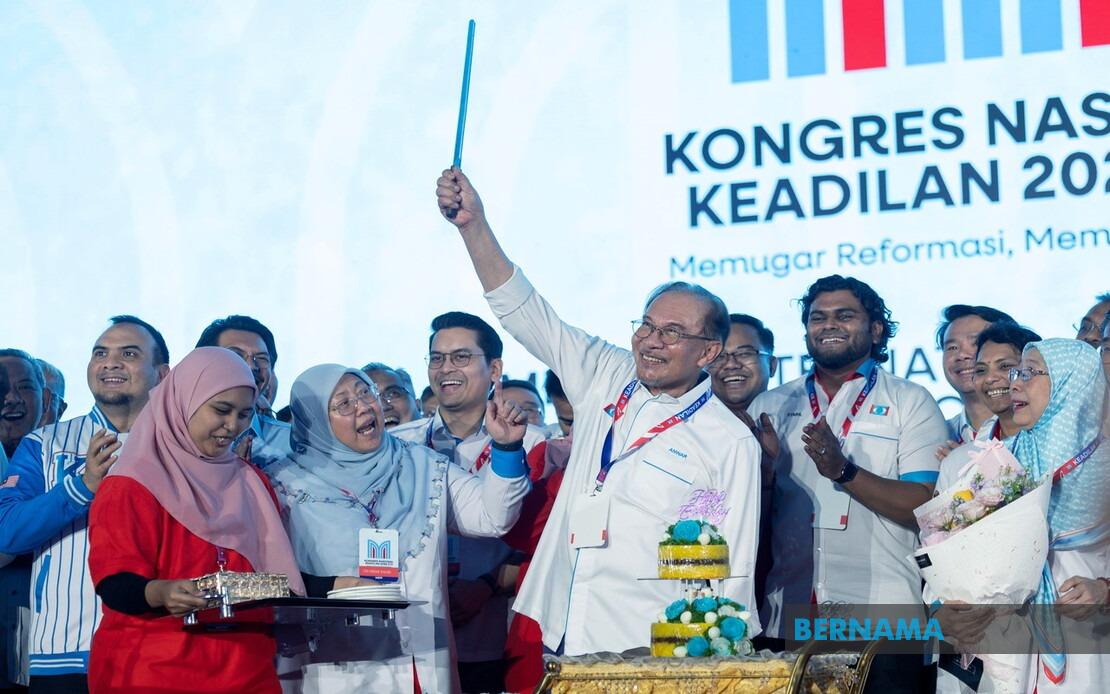
Delegates at the PKR National Congress 2026 in Melaka received a clear signal from the party's leadership this week: the commitment to Malaysia's Unity Government framework is unshakeable, but so too is PKR's foundational reform mandate. The dual messaging reflects an underlying tension within the coalition that governs Malaysia—how to maintain the political truce necessary for stability while pushing forward with the transformative agenda that brought PKR to prominence as an opposition movement.
Anwar Ibrahim, speaking in his capacity as PKR president during the congress's closing session, positioned the party's continued backing of the Unity Government as essential for safeguarding both political stability and the economic wellbeing of ordinary Malaysians. Yet this endorsement came with a crucial caveat: the future trajectory of the coalition depends significantly on decisions made by UMNO and Barisan Nasional, the dominant partners in the governing arrangement. The Prime Minister's words suggest that PKR is prepared to be a stable partner, but has not ceded its ability to reassess should circumstances change fundamentally.
Anwar's emphasis on political awareness and national interest, rather than narrow partisan calculation, deserves scrutiny in the Malaysian context. The Unity Government itself remains a relatively novel experiment in Malaysian politics—a coalition born partly from necessity after the 2022 general election produced no clear winner, and partly from genuine concern about institutional stability. For PKR, which spent decades in opposition under Anwar's leadership, this pivot to being part of the establishment represents perhaps the party's greatest test since its founding. The Congress appeared designed to reassure the party base that this transition does not represent an abandonment of core principles.
Nurul Izzah Anwar, the party's deputy president, gave voice to this concern directly. She argued that reform must continue unabated even as PKR exercises governmental power, and cited the successful repeal of the Universities and University Colleges Act 1971 as tangible evidence that being in government need not mean abandoning transformative goals. The AUKU repeal is indeed significant—the law had restricted student political activity for decades, and its removal represents a genuine reversal of authoritarian-era restrictions. That PKR could claim credit for this outcome demonstrates how coalition governance can accommodate reform priorities from constituent parties.
The student activism question, however, reveals complexities beneath the surface. While Anwar assured that no new restrictive legislation would replace AUKU, he also stressed that existing criminal laws would continue to apply to students just as they do to all citizens. This formulation—removing one restriction while relying on general legal frameworks—occupies middle ground that may not satisfy everyone. For young Malaysians concerned about political expression and student rights, the question of whether general criminal laws will be wielded more aggressively remains open.
The Congress also underscored PKR's emphasis on women in leadership, with Fadhlina Sidek, the party's Wanita chief and Education Minister, calling for expanded space for female voices in decision-making structures. She coupled this with a plea for greater openness to criticism among party and government officials—a reminder that governance improvement requires receptiveness to dissent. This positioning may reflect awareness that PKR's legitimacy partly rests on its historical association with democratic reform, an identity that risks erosion if the party becomes seen as defensive or resistant to scrutiny.
Angkatan Muda Keadilan's contributions to the congress highlighted PKR's ambitions to engage younger voters on issues beyond traditional political reform. The youth wing's focus on emerging economic sectors—artificial intelligence, semiconductors, biotechnology—coupled with advocacy around gig economy recognition and mental health support, signals an attempt to position PKR as forward-thinking on economic transformation and quality of life issues. These concerns resonate across Southeast Asia as the region grapples with rapid technological change and generational shifts in employment patterns.
Yet the Congress also touched on an underlying strategic calculation. PKR's emphasis on organisational readiness and the importance of maintaining internal strength regardless of political developments carries subtle implications. The party is signalling that it will not be caught unprepared should the political landscape shift—whether through parliamentary dissolution or other constitutional developments. For a party that spent nearly two decades building capability outside government, the message that PMR must remain institutionally robust even while in power reflects hard-earned lessons about political volatility in Malaysia.
The overall narrative from Melaka suggests PKR is attempting to navigate a narrow path. It seeks to be the stabilising force Malaysia's political system arguably needs, particularly given the fragility of coalitions in Malaysian politics. Simultaneously, it is determined not to become merely another establishment party, shedding the reform identity that distinguishes it from UMNO and other traditional partners in BN. Whether this balancing act proves sustainable through the life of the current Parliament—and beyond—will significantly shape not just PKR's trajectory but Malaysia's political development more broadly. For regional observers, PKR's experience offers lessons about how reformist movements manage the transition from opposition to power without losing their distinctive character.

