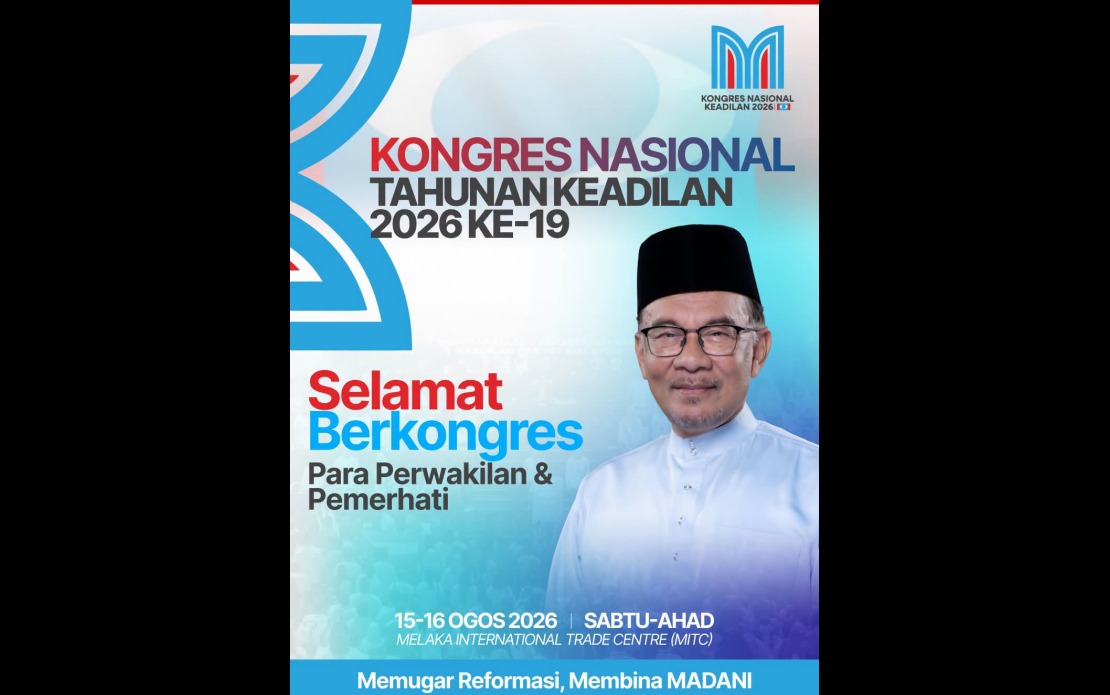
Prime Minister Datuk Seri Anwar Ibrahim has issued a pointed reminder to Parti Keadilan Rakyat that the party's continued relevance depends on its fidelity to founding principles of integrity, social justice and popular trust—values that must supersede narrow electoral calculations. Speaking through a Facebook message ahead of the PKR National Congress 2026, Anwar framed the gathering as a moment for the party to recalibrate its mission and recommit to the reformasi agenda that has animated Malaysian opposition politics for over two decades.
The gathering, scheduled for tomorrow at the Melaka International Trade Centre in Ayer Keroh under the theme "Memugar Reformasi, Membina MADANI" (Revitalising Reformasi, Building MADANI), arrives at a delicate juncture for Malaysia's ruling coalition. With PKR as a cornerstone of the Unity Government alongside Umno and other partners, internal cohesion and ideological clarity carry heightened significance. Anwar's emphasis on the party's grounding in popular mobilisation rather than state machinery reflects awareness that PKR's legitimacy ultimately rests on its perceived commitment to transformative politics rather than mere governmental incumbency.
The distinction Anwar drew carries particular weight in the Malaysian context. Opposition parties, especially those with reformist credentials, have historically maintained popular support by positioning themselves as vehicles for change and accountability. PKR, born from the Reformasi movement of the late 1990s, carries this legacy acutely. The party's transition from opposition status to junior coalition partner has raised internal questions about whether it risks co-option by the very establishment power structures it once challenged. Anwar's remarks appear calibrated to address such concerns within the party rank-and-file.
The Prime Minister characterised the congress as an opportunity for introspection and self-assessment, inviting delegates to evaluate PKR's achievements while recalibrating its strategic direction for contemporary challenges. This framing suggests recognition that mere longevity in power does not automatically secure a party's mass base. Instead, continued relevance demands periodic realignment with foundational principles and renewed engagement with grassroots constituencies. For PKR specifically, this means demonstrating tangible commitment to social equity, anti-corruption efforts and institutional reform—the pillars upon which its credibility was established.
Anwar's scheduled policy address at tomorrow's opening session will provide the platform for translating this rhetorical commitment into concrete programmatic direction. Such speeches traditionally outline a party's strategic priorities and policy agenda for coming years. Given the current political environment, where public confidence in institutions remains fragile and socioeconomic pressures weigh heavily on Malaysian households, Anwar's remarks will likely emphasise PKR's role in advancing equitable development and strengthening democratic institutions within the Unity Government framework.
The emphasis on building a "more dignified, prosperous and just Malaysia" echoes language Anwar has deployed consistently since assuming the premiership. It reflects a governing philosophy centred on inclusive development and institutional accountability. For PKR, this articulation serves dual purposes: it reinforces the party's differentiation from coalition partners and signals to its base that participation in government need not entail abandonment of reformist commitments. The underlying message—that electoral success means nothing without principled governance—addresses perennial anxieties within reform-minded political formations about organisational capture and mission drift.
South-east Asian political movements that have transitioned from opposition to power have navigated this terrain variably. Some successfully maintained grassroots mobilisation and reformist focus while governing; others progressively aligned with establishment interests. PKR's trajectory will significantly influence Malaysian politics' trajectory over the coming decade. The party's capacity to retain both governmental effectiveness and oppositional credibility—a delicate balance—depends substantially on periodic reaffirmations of principle such as Anwar's message represents.
The congress itself constitutes a significant party gathering in the five-year cycle, providing opportunity for leadership to reset narratives and reconnect with membership. Delegates will debate party direction, assess performance and potentially signal priorities for coming years. Anwar's pre-congress messaging thus represents strategic framing designed to shape internal conversation around preservation rather than abandonment of founding commitments. His invocation of the reformasi legacy explicitly connects contemporary PKR governance to historical movement that predates the party's own formation.
For Malaysian observers and regional analysts monitoring governance patterns within ASEAN, Anwar's remarks carry broader implications. Ruling coalitions in the region often struggle with internal tensions between different components' governing philosophies and constituent bases. The Unity Government's sustainability depends partly on whether member parties like PKR can maintain distinct identities while collaborating on policy implementation. Anwar's emphasis on PKR remaining grounded in popular movements and ethical governance suggests awareness that coalition stability requires space for differentiation, not homogenisation. This represents sophisticated political management navigating the inherent tensions within multi-party coalitions.
The invocation of Allah's blessing for Malaysia's future, a phrase carrying cultural resonance within the Malaysian Muslim-majority context, also positions PKR's agenda within frameworks of moral and spiritual commitment rather than mere partisan interest. This rhetorical strategy appeals to broader constituencies beyond party membership, suggesting that PKR's mission extends to the national good rather than factional advantage. Whether such messaging translates into sustained organisational practice will emerge through PKR's conduct in coming years, particularly how the party balances the demands of coalition governance with advocacy for its particular reform agenda.
Ultimately, Anwar's message reflects recognition that mass-based political movements require continuous recommitment to founding principles to maintain vitality and public trust. For PKR specifically, the congress represents occasion to renew internal covenant around the values that distinguished the party historically and justify its place within Malaysia's political landscape presently. How effectively the congress translates Anwar's rhetoric into organisational renewal and programmatic clarity will significantly influence perceptions of PKR's continued relevance as a force for principled governance.

