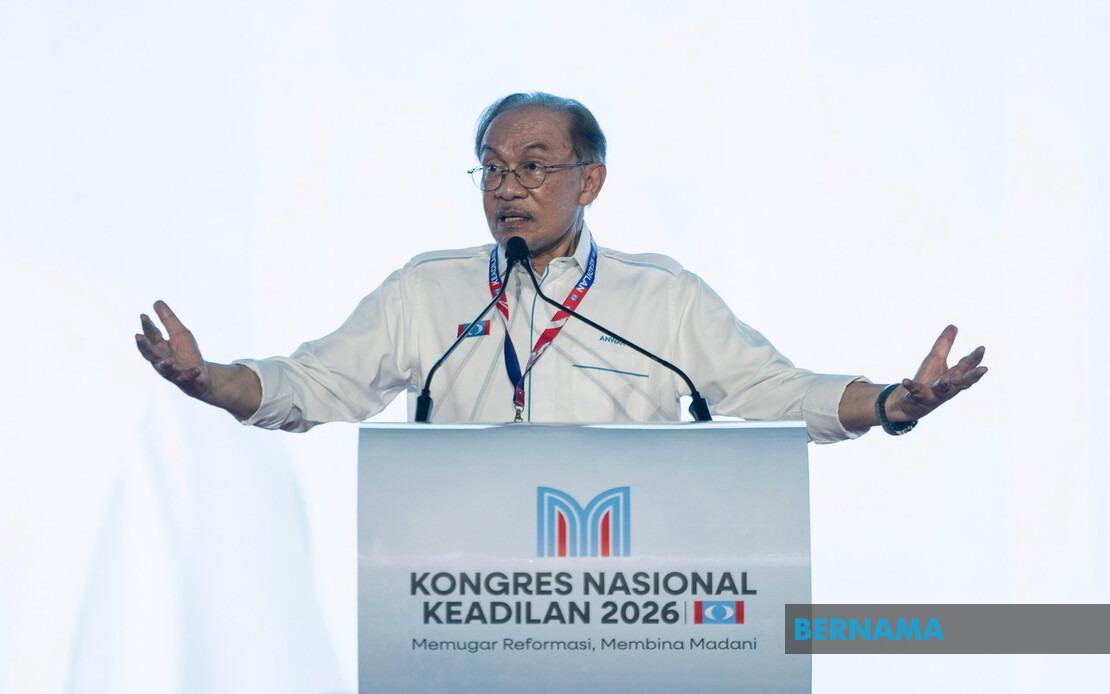
Prime Minister Datuk Seri Anwar Ibrahim has unveiled a fresh financial commitment to Malaysia's grassroots communities, announcing an additional RM1 million allocation for every parliamentary constituency nationwide. The initiative, designed to be disbursed directly to constituent areas, represents a deliberate effort to accelerate the resolution of urgent local issues without the impediment of administrative red tape that typically characterises government fund distribution.
Addressing delegates at the 2026 PKR National Congress held at the Melaka International Trade Centre here on August 16, Anwar emphasised that this supplementary funding would complement the government's existing welfare architecture. The move underscores the MADANI Government's strategic pivot towards embedding financial assistance mechanisms at the grassroots level, where local representatives can exercise greater discretion in responding to community-specific challenges. By channelling funds directly, the government aims to create a more responsive system of governance that bridges the gap between policy formation at the federal level and actual implementation in constituencies.
The announcement carries particular significance given Malaysia's ongoing efforts to combat poverty and alleviate cost-of-living pressures. Anwar highlighted that the hardcore poverty rate has declined to 0.09 per cent, a reduction that reflects targeted interventions by the administration. However, the introduction of this additional allocation suggests recognition that macro-level economic improvements have not uniformly translated into tangible benefits for all Malaysians, necessitating more granular approaches to wealth distribution and community support.
This new funding mechanism complements an expansive existing welfare portfolio. The government operates multiple assistance programmes including Sumbangan Tunai Rahmah (STR) and Sumbangan Asas Rahmah (SARA), which collectively command RM16 billion in annual allocation. By layering the parliamentary constituency allocation atop these programmes, the administration is constructing a multi-tiered safety net intended to capture various demographic segments and address diverse needs from school assistance to housing finance support and subsidised staple goods through Rahmah sales initiatives.
The stratification of assistance programmes reflects deliberate policy design aimed at inclusivity across income brackets. Rather than limiting support exclusively to the bottom 40 per cent of earners (B40), the government has extended assistance to the middle 40 per cent (M40), acknowledging that cost-of-living pressures affect broader segments of Malaysian society than traditionally conceived poverty rates might suggest. This calibrated approach addresses political economy concerns whilst maintaining fiscal sustainability.
Anwar, who doubles as Finance Minister, framed the announcement not merely as financial transfer but as evidence of committed governance philosophy. His emphasis on translating macroeconomic success into microeconomic improvements reflects recognition of a persistent challenge in developing economies—that aggregate growth statistics often mask localised hardship and uneven prosperity distribution. The parliamentary constituency allocation represents an institutionalised mechanism for converting national economic performance into local community welfare gains.
For Malaysian readers, particularly those in less-developed constituencies or rural areas, this announcement carries tangible implications. The flexibility afforded to local representatives in deploying RM1 million per constituency potentially enables customised responses to area-specific challenges. A rural constituency might prioritise agricultural infrastructure or rural broadband connectivity, whilst an urban area might address housing affordability or transport-related issues. This decentralisation of decision-making potentially enhances relevance and effectiveness compared to centrally designed, one-size-fits-all programmes.
The timing of the announcement during a party congress also reflects political calculation. By announcing major welfare initiatives at PKR's national gathering, Anwar reinforced the party's positioning as a vehicle for grassroots empowerment, potentially strengthening party machinery morale ahead of future electoral cycles. Party leaders and grassroots activists were explicitly urged to explain government initiatives comprehensively, suggesting acknowledgment that policy announcements alone insufficient—sustained communication effort required to ensure beneficiary awareness and uptake.
Regional implications warrant consideration as well. Within Southeast Asia, Malaysia's welfare approach increasingly serves as a reference point for peer economies grappling with similar middle-income challenges. The emphasis on direct allocation to constituencies, coupled with multi-programme assistance architecture, demonstrates institutional innovation in translating development gains into inclusive growth narratives—precisely the challenge confronting countries across the region seeking to maintain political stability whilst managing economic transition.
The announcement also tacitly acknowledges bureaucratic inefficiencies in traditional fund allocation mechanisms. By channelling resources directly to parliamentary constituencies, the government implicitly recognises that existing channels sometimes introduce delays or create barriers to assistance reaching intended beneficiaries. This recognition, whilst not explicitly critical of existing structures, suggests administrative reform remains an ongoing concern within government circles.
Fiscal implications bear examination. The additional allocation represents approximately RM600 million to RM700 million annually when multiplied across Malaysia's 222 parliamentary constituencies, a substantial but manageable commitment within the broader federal budget. The government's ability to absorb this expenditure without compromising macroeconomic stability reflects relatively robust revenue generation, though Malaysia's fiscal position remains constrained by existing debt servicing obligations and development spending commitments.
Moving forward, the success of this initiative will depend substantially on implementation quality at constituency level. Political patronage concerns historically plague targeted allocation programmes in Malaysia, potentially undermining stated objectives if distribution follows factional lines rather than genuine need assessment. Transparency mechanisms and community oversight will prove critical to ensuring the allocation meaningfully addresses grassroots welfare rather than becoming another lever of political advantage.
Ultimately, Anwar's announcement reflects broader MADANI Government philosophy prioritising tangible welfare outcomes over abstract economic metrics. Whether the parliamentary constituency allocation delivers anticipated benefits will substantially influence public perception of government effectiveness and contribute to shaping Malaysia's political economy trajectory in coming years.

