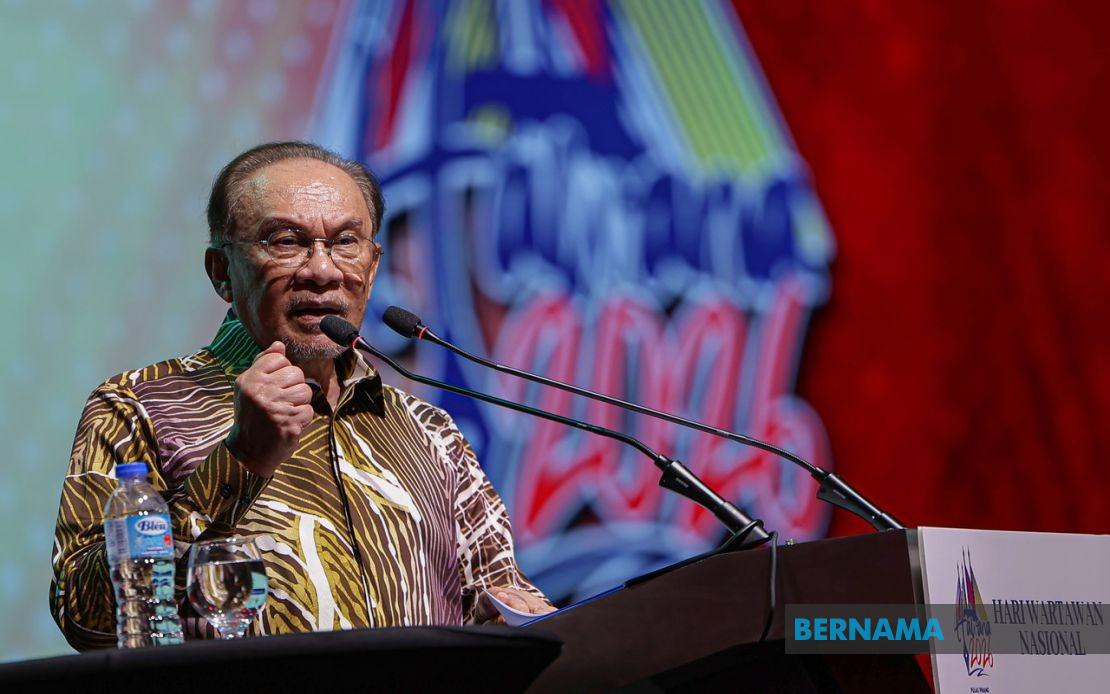
Prime Minister Datuk Seri Anwar Ibrahim has thrown his weight behind the appointment of former Federal Court judge Tan Sri Nallini Pathmanathan as chairman of the Malaysian Media Council (MMC), viewing the move as instrumental in rehabilitating the body's standing among the public. Speaking at the National Journalists' Day (HAWANA) 2026 celebration in Butterworth on June 20, Anwar underscored that Nallini's distinguished judicial background and personal integrity position her to restore the council's tarnished image and rebuild the confidence that stakeholders place in its work. The Prime Minister's public endorsement signals the government's commitment to elevating media governance at a time when press freedom and regulatory credibility remain contested issues across Southeast Asia.
Nallini's elevation to the MMC chair followed a unanimous board decision made on May 26, reflecting broad consensus among council members regarding her suitability for the post. The appointment itself represents a notable shift in leadership, bringing to the role someone with decades of experience in the judiciary rather than a career administrator or political appointee. Anwar highlighted that the careful vetting process had weighed Nallini's demonstrated track record alongside her spotless reputation, suggesting that the leadership transition was deliberately designed to signal reform and renewed commitment to institutional standards. The timing of the announcement, made during a high-profile media industry event attended by senior government figures, amplified the symbolic importance attached to her leadership.
The Malaysian Media Council itself was formally constituted under the Malaysian Media Council Act 2025, establishing it as an independent self-regulatory body with a mandate that extends across multiple domains. The institution is tasked with raising and maintaining journalistic standards across news organisations and media outlets, a role that becomes increasingly critical as digital platforms and alternative news sources proliferate in the region. Beyond standard-setting, the MMC manages public complaints directed at media organisations, providing a recourse mechanism for citizens who believe they have been unfairly treated or misrepresented. These functions carry particular weight in Malaysia, where media literacy remains uneven and public trust in traditional news institutions continues to decline in certain segments.
Promoting ethical journalism practices represents another pillar of the council's mandate, an area where Nallini's legal expertise and judicial temperament may prove valuable. The standards of conduct and ethical frameworks that guide journalists shape not only how news is reported but also how the public receives and interprets information about governance, commerce, and social issues. In an era when misinformation and rumour spread rapidly through social networks, having a credible arbiter of journalistic norms provides both the industry and the public with a reference point. Nallini's appointment signals that the government and council members believe judicial rigour and legal consistency can be brought to bear on debates about editorial conduct and professional responsibility.
Safeguarding media freedom stands as perhaps the most politically sensitive component of the MMC's mandate, and here Nallini's background takes on additional significance. A former Federal Court judge brings institutional credibility to discussions about the boundaries between legitimate regulation and unwarranted suppression of speech. Malaysia's historical relationship with press freedom has been complicated, marked by periodic tensions between government security interests and journalistic independence. By appointing someone steeped in constitutional law and judicial reasoning, the council signals an intent to ground regulatory decisions in legal principle rather than executive convenience. This approach may help reassure both international observers and domestic press organisations that the MMC operates within recognised constraints on power.
The presence of senior government figures at the HAWANA 2026 event underscored the administration's investment in the media council narrative. Penang Chief Minister Chow Kon Yeow and Communications Minister Datuk Fahmi Fadzil both attended, alongside Communications Ministry officials, indicating cross-party and cross-level government interest in the council's direction. Such attendance at a journalists' conference sends a message that the government views constructive engagement with the press and regulatory frameworks as compatible with its broader governance agenda. Fahmi Fadzil's portfolio responsibilities place him in a position to influence how media policy develops, and his participation in the event alongside Anwar suggested alignment on the importance of the council's reform trajectory.
Nallini's specific appointment carries implications extending beyond Malaysia's borders. Throughout Southeast Asia, questions about media governance, self-regulation, and the balance between editorial freedom and social responsibility are live issues in countries including Thailand, Philippines, Indonesia, and Vietnam. Malaysia's approach to institutional design in this space may inform discussions elsewhere in the region about whether judiciaries should play a central role in media oversight or whether purely industry-led mechanisms prove more effective. The choice to elevate a judicial figure rather than a media executive reflects a particular philosophy about how media accountability can be achieved while preserving editorial autonomy.
From a practical standpoint, the MMC's complaint-handling and standards-setting functions will depend substantially on the credibility and procedural fairness that Nallini brings to the role. Journalists and news organisations must have confidence that complaints will be evaluated according to consistent principles rather than political pressures, while members of the public need assurance that their concerns about media conduct will receive serious consideration. Nallini's track record in the judiciary suggests she understands the importance of transparent process, written reasoning for decisions, and appeal mechanisms—elements that translate directly into legitimate regulation rather than arbitrary control.
The council's role in promoting ethical practices also intersects with ongoing conversations about digital media, user-generated content, and the responsibilities of platforms themselves. As traditional newsrooms face competitive pressure from social media channels and digital publishers, the MMC's standards become a reference point that distinguishes professional journalism from rumour and opinion masquerading as news. In Malaysia, where trust in institutions remains fragmented along political and communal lines, having a widely respected institutional arbiter may help create common ground around shared definitions of responsible reporting.
Anwar's explicit backing of Nallini may also reflect awareness that the MMC requires political cover and public legitimacy to function effectively. Self-regulatory bodies in media often struggle with the perception that they are either too permissive toward their member organisations or too deferential to government pressure. By publicly championing Nallini's integrity and credentials, the Prime Minister has positioned himself on the side of robust, independent oversight while simultaneously ensuring that the council enjoys ministerial support. This balancing act is essential for an institution that must maintain distance from political interference while operating within a broader governance ecosystem that includes elected officials.
Looking ahead, Nallini's leadership will be tested by specific cases and controversies that inevitably arise in any media landscape. Her decisions on high-profile complaints, her approaches to balancing press freedom against other social interests, and her ability to command respect across ideological divides will determine whether the MMC becomes a genuinely credible institution or remains a largely symbolic body. The appointment itself represents an investment in the hope that judicial experience and personal integrity can provide the foundation for media governance that commands trust across diverse constituencies. Whether that hope translates into sustained institutional effectiveness remains a question that only time and concrete outcomes will answer.

