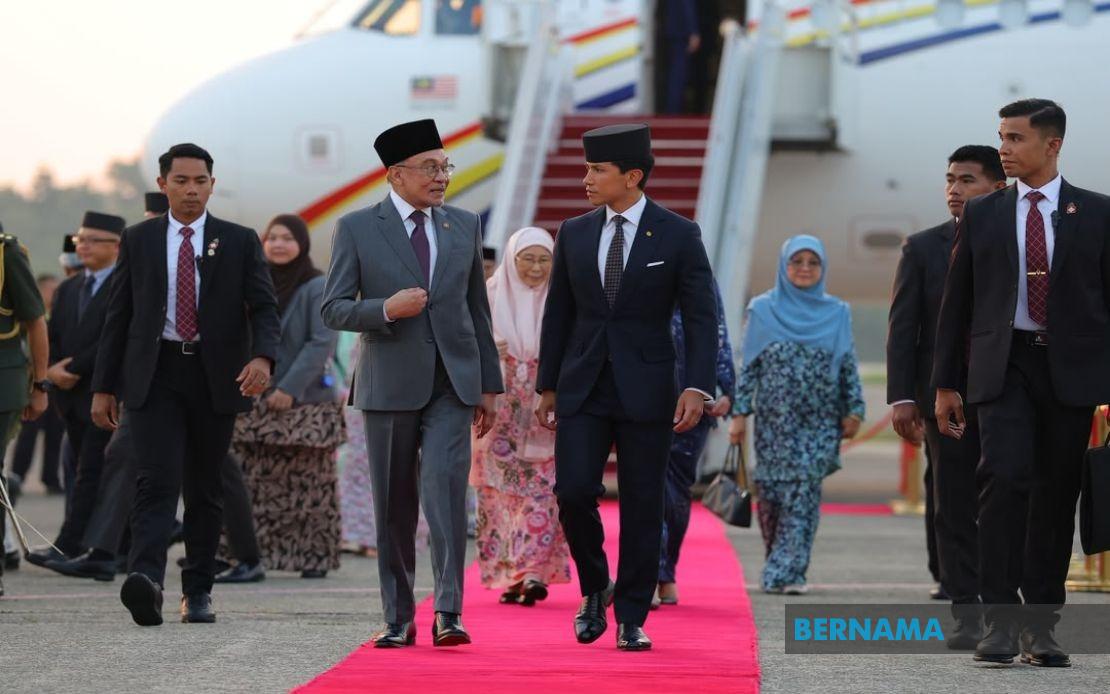
Prime Minister Datuk Seri Anwar Ibrahim touched down in Brunei on Wednesday evening to commence a two-day working visit centred on the 27th Annual Leaders' Consultation (ALC-27), a flagship mechanism for high-level bilateral engagement between Malaysia and the sultanate. The prime minister's special aircraft landed at Brunei International Airport at 6.10 pm, with Anwar accompanied by his wife, Datuk Seri Dr Wan Azizah Wan Ismail. The arrival was marked by a formal reception from Brunei's Minister of Foreign Affairs Prince Abdul Mateen Bolkiah, underscoring the significance both nations place on this annual dialogue.
A substantial Malaysian delegation supported the prime minister's visit, reflecting the diplomatic weight assigned to the engagement. Foreign Minister Datuk Seri Mohamad Hasan travelled alongside the delegation, joined by Foreign Ministry secretary-general Tan Sri Amran Mohamed Zin and Malaysian High Commissioner to Brunei Datuk Mohd Aini Atan. This composition signals that discussions will span not merely ceremonial exchanges but substantive policy matters requiring input from Malaysia's highest diplomatic leadership.
The centrepiece of Anwar's visit involves an audience with Sultan Hassanal Bolkiah at Nurul Iman Palace on Thursday, followed by a four-eyed bilateral meeting between the two leaders. Such intimate consultations provide rare opportunity for candid discussion on matters of state concern beyond what public forums typically permit. These sessions traditionally allow monarchs and prime ministers to navigate sensitive regional dynamics and recalibrate cooperation frameworks where friction may have emerged.
A significant development emerging from the consultation involves bilateral disaster management cooperation. Sultan Hassanal Bolkiah and Anwar are scheduled to witness the signing of a Memorandum of Understanding on this front, reflecting growing recognition that natural catastrophes and environmental threats transcend borders and demand coordinated regional response. For Malaysia and Brunei, both vulnerable to tropical weather patterns, flooding, and transboundary haze, formalising such cooperation mechanisms represents pragmatic statecraft that protects citizens regardless of which side of the border they inhabit.
The ALC-27 framework itself merits understanding within the broader architecture of Malaysia-Brunei relations. As the highest-level bilateral mechanism available to both governments, the annual consultation provides structured opportunity to review the trajectory of cooperation across economic, security, cultural, and diplomatic domains. Beyond bilateral matters, the forum permits both leaders to align positions on regional and international issues where their interests converge, strengthening collective voice within ASEAN and on the global stage.
Trade dynamics between Malaysia and Brunei reveal an asymmetrical but substantial relationship. During 2025, bilateral trade totalled RM5.86 billion (US$1.37 billion), with Malaysian exports dominating at RM4.20 billion (US$0.98 billion) against imports of RM1.66 billion (US$0.39 billion). This pattern reflects Malaysia's role as a primary supplier of manufactured goods and agricultural products to Brunei's smaller, more specialised economy. The first half of 2026 showed continued momentum, with bilateral trade reaching RM2.38 billion (US$600 million) across the six-month period, suggesting the relationship remains economically vibrant despite global uncertainties.
For Malaysian business interests and policymakers, the ALC-27 carries implications beyond diplomatic symbolism. Economic cooperation discussions typically examine tariff arrangements, investment frameworks, and sectoral opportunities. Brunei's sovereign wealth and strategic location within the ASEAN framework mean that deepening commercial ties with the sultanate offers Malaysian companies access to wider Southeast Asian networks and positioning within the region's increasingly integrated supply chains. Conversely, Brunei values Malaysia's economic dynamism and manufacturing capacity as stabilising force within regional trade.
Regional context adds further dimension to this bilateral engagement. As two ASEAN members with shared maritime boundaries and overlapping strategic interests, Malaysia and Brunei must navigate questions of maritime demarcation, transboundary resource management, and collective responses to external pressures on ASEAN cohesion. The South China Sea remains an area where careful consultation between ASEAN members strengthens collective negotiating position relative to extraregional powers. Similarly, discussions on Myanmar, the Philippines, and Laos reflect each nation's stake in ASEAN stability and effectiveness.
The disaster management MoU assumes particular significance given climate change acceleration across Southeast Asia. Malaysia and Brunei both experience increasing frequency and intensity of meteorological events that demand sophisticated early warning systems, coordinated evacuation procedures, and mutual assistance protocols. Formalising cooperation in this domain positions both nations to respond more effectively when crises strike, while also signalling to international partners their commitment to regional resilience.
Anwar's visit also reflects Malaysia's broader diplomatic strategy under his tenure as prime minister. Having elevated engagement with neighbouring states and regional organisations, Anwar has positioned Malaysia as an active participant in shaping the regional order rather than a passive observer. Regular high-level consultations with counterparts in Brunei, Singapore, Thailand, and Indonesia constitute the operational substance of this approach, moving beyond rhetoric to sustained institutional engagement.
Looking ahead, outcomes from ALC-27 will likely extend beyond formal agreements to influence Malaysia's approach to ASEAN's collective agenda in coming months. Whether on security matters, economic integration, or responses to external pressures, alignment between Malaysia and Brunei strengthens ASEAN's overall coherence. For Malaysian readers, particularly those in businesses dependent on regional trade or those concerned with border security and disaster preparedness, the substance of these discussions carries tangible implications for national prosperity and safety.

