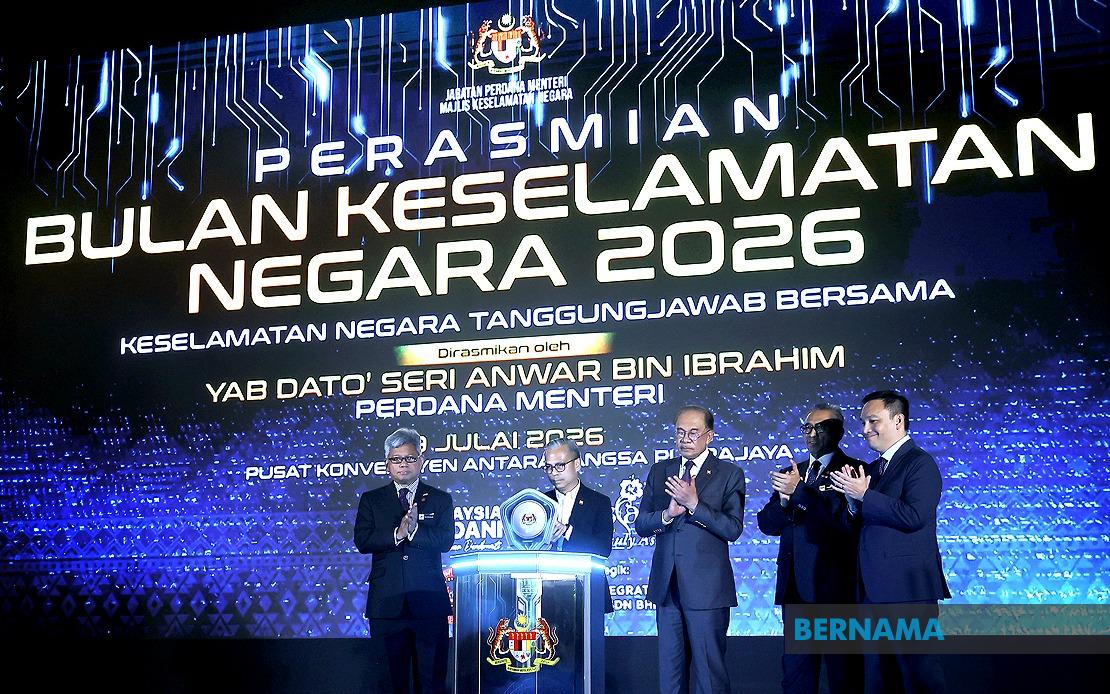
Prime Minister Datuk Seri Anwar Ibrahim has issued a pointed warning about the dangers of allowing divisive identity politics to dominate the national conversation, particularly as Malaysia confronts a rapidly evolving security landscape that demands urgent and unified attention. Speaking at the launch of National Security Month 2026 in Putrajaya on July 9, Anwar expressed frustration with the country's continued preoccupation with longstanding racial, religious and state-based grievances, arguing that such backward-looking disputes distract from far more pressing threats to national cohesion and safety.
The Prime Minister's remarks underscore growing anxiety within the highest levels of government about the manner in which traditional identity-based politics continues to shape parliamentary debates and public discourse, even as new technological and digital security challenges emerge that require immediate, coordinated responses. Anwar's intervention reflects a strategic pivot within the administration toward repositioning national priorities around shared security interests rather than the communal and regional fault lines that have historically dominated Malaysian political discourse. His comments came as the government formally marked the start of a month-long security awareness campaign led by the National Security Council, bringing together senior officials including Communications Minister Datuk Fahmi Fadzil, Chief Secretary to the Government Tan Sri Shamsul Azri Abu Bakar, and National Security director-general Datuk Raja Nurshirwan Zainal Abidin.
Anwar was notably candid about his concerns during parliamentary interactions with colleagues, frequently reminding them that the nation's legislative focus remains fixed on dated controversies. He highlighted the incongruity between the substance of ongoing political arguments—often centred on historical grievances tied to race, religion, state boundaries and regional identity—and the substantive security challenges that Malaysia now faces. The Prime Minister characterised this mismatch as symptomatic of a leadership class that has yet to fully appreciate the magnitude or complexity of contemporary threats, suggesting that the diversion of attention and resources toward identity politics represents a strategic vulnerability.
The nature of modern security threats facing Malaysia has fundamentally transformed in recent years. Rather than conventional military or internal stability concerns, the nation now confronts sophisticated cyber-attacks, digital infrastructure vulnerabilities, technological espionage, and information warfare tactics that exploit social divisions to destabilise institutions. These emerging threats operate across borders and at speeds that exceed traditional governmental response mechanisms, rendering many conventional approaches to security management increasingly obsolete. Anwar's emphasis on the need for government to engage proactively with new security challenges reflects recognition that Malaysia's bureaucratic and political systems have historically responded reactively rather than anticipatory, waiting for crises to crystallise before mobilising resources.
The Prime Minister's call for institutional transformation extends beyond mere rhetorical repositioning. He has stressed that leaders across all government departments, agencies and ministries bear responsibility for fundamentally reorienting their operational cultures away from routine bureaucratic practice toward dynamic, forward-looking security management. This institutional imperative requires rapid familiarisation with emerging technologies, the cultivation of expertise in digital security domains, and the development of integrated responses that cut across traditional departmental silos. Anwar's characterisation of contemporary security challenges as fundamentally different from those that shaped previous governance approaches suggests dissatisfaction with the pace at which Malaysian institutions have adapted to new threat environments.
For Malaysia's regional position, Anwar's framing carries particular significance. Southeast Asia faces intensifying geopolitical competition between great powers, growing transnational criminal networks leveraging digital technologies, and climate-related security pressures that threaten regional stability. Nations that remain internally divided along identity lines face particular vulnerability to external manipulation and destabilisation. By urging Malaysian political leaders to transcend divisive identity narratives, Anwar is essentially advocating for the kind of institutional cohesion and strategic clarity that regional stability increasingly demands. His emphasis on unified national purpose resonates with similar calls from other Southeast Asian capitals grappling with how to maintain internal unity while navigating volatile external circumstances.
The timing of Anwar's intervention reflects a broader debate within the Malaysian political establishment about the sustainability of identity-based mobilisation strategies as the primary mechanism for political competition. As technology and security threats evolve, traditional approaches to political legitimacy and coalition-building that rely on communal appeals and regional grievances may increasingly appear inadequate to address substantive national challenges. Anwar's positioning suggests that his administration intends to stake political legitimacy increasingly on competence in managing complex security and economic challenges rather than solely on ability to manage communal and regional sensitivities.
Yet translating this rhetorical call for transcendence of divisive politics into actual institutional change will prove substantially more difficult than articulating the need. Malaysian political culture remains deeply embedded in networks, institutions and incentive structures built around identity-based politics over several decades. Individual politicians, civil servants and voters have developed considerable investment in these existing frameworks. Anwar's exhortation toward unified focus on security challenges, while strategically sound, confronts deeply entrenched patterns of political behaviour and institutional practice that will not shift quickly or easily in response to statements from the highest office alone.
The launch of National Security Month 2026 provides an opportunity for the government to move beyond rhetoric toward substantive programmes that actively build institutional capacity for addressing emerging threats while simultaneously cultivating national narratives that emphasise shared security interests. Such efforts could include enhanced public education about contemporary security challenges, investment in technological expertise across government, and deliberate cultivation of multi-communal security institutions that operate according to professional rather than identity-based principles. Whether the government can translate Anwar's warning into sustained institutional transformation remains an open question that will significantly shape Malaysia's resilience in coming years.

