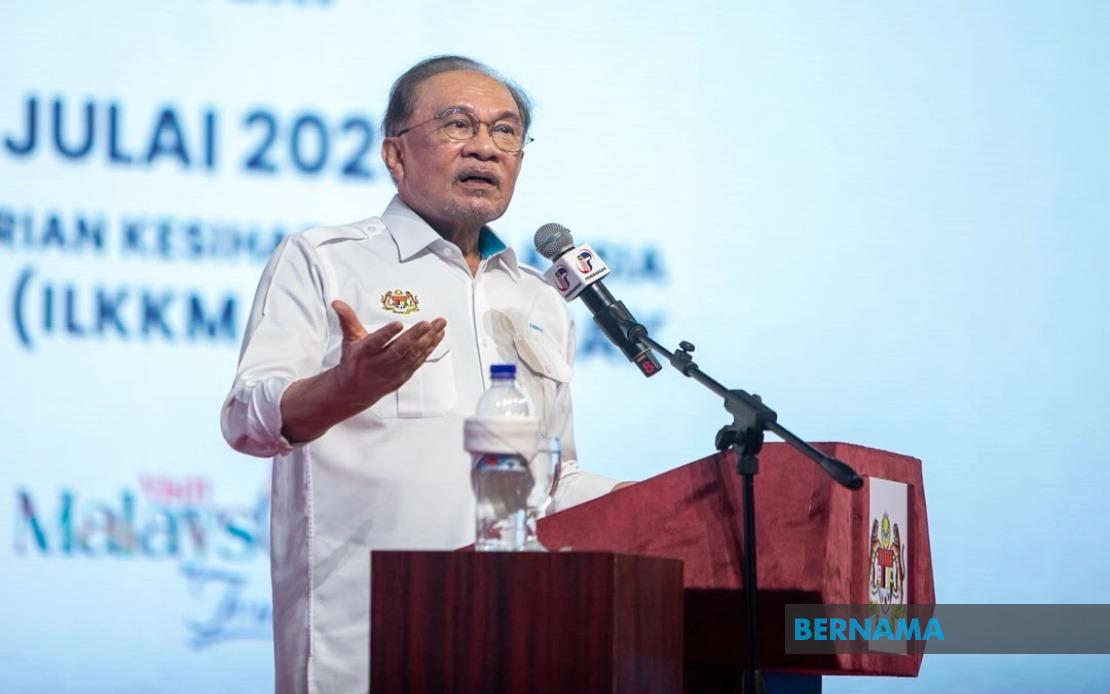
Prime Minister Datuk Seri Anwar Ibrahim has issued a clarion call to younger Malaysians to deepen their appreciation for the nation's independence struggle and grasp the profound significance of the sovereignty achieved through generations of sacrifice. Speaking at the launch of the 2026 National Month and Fly the Jalur Gemilang Campaign in Ipoh, Anwar stressed that contemporary society risks losing sight of the pivotal historical narrative that shaped the country's journey toward freedom and self-determination.
The Prime Minister framed national pride not merely as an emotional exercise or ceremonial observance, but as an intellectual and moral reckoning with history. He articulated a comprehensive approach to nation-building that begins with historical understanding, progresses through symbolic acts of unity such as flying the national flag, and culminates in collective commitment to securing Malaysia's future prosperity and global standing. This three-pronged strategy reflects an attempt to bridge the disconnect between younger citizens who have never experienced colonial rule and the lived experiences of those who fought for independence.
Anwar's remarks carry particular weight given Malaysia's demographic composition, with roughly half the population born after the nation's major democratic transitions. The younger generation has inherited a stable, independent nation without witnessing the institutional and psychological struggles that characterised the independence movement and early decades of statehood. This generational gap poses a subtle but persistent challenge to national cohesion, as the emotional and historical anchors that bound earlier Malaysians together become increasingly abstract to those who have only known freedom.
The Prime Minister explicitly referenced the physical and emotional toll borne by independence fighters, invoking the trinity of blood, sweat and tears as a metaphor for the comprehensive sacrifice demanded by the struggle for self-governance. By personalising these abstract historical forces, Anwar attempted to communicate that independence was not an inevitable outcome or a gift passively received, but rather a hard-won achievement purchased at considerable human cost. This framing serves to elevate the perceived obligations of contemporary Malaysians to honour those sacrifices through responsible citizenship and national stewardship.
The launch event itself demonstrated the government's commitment to making National Month a vehicle for cultural and civic renewal rather than mere ceremonial decoration. The participation of Communications Minister Datuk Seri Fahmi Fadzil, National Unity Minister Datuk Aaron Ago Dagang, and Perak Menteri Besar Datuk Seri Saarani Mohamad underscored the cross-portfolio importance assigned to this initiative. The presence of the National Unity Minister particularly signalled that the government views historical education and patriotic engagement as foundational elements of its broader cohesion agenda, especially in a multi-ethnic society where different communities may hold varying historical perspectives.
For Malaysian policymakers and educators, Anwar's intervention highlights an emerging priority: the deliberate cultivation of historical consciousness among citizens who lack direct memory of the independence era. Schools and civic institutions increasingly bear responsibility for transmitting not merely factual knowledge about independence, but the emotional and moral resonance of that historical moment. Without sustained engagement with these narratives, there is a risk that national identity becomes increasingly shallow and susceptible to divisive narratives that emphasise sectional interests over shared national purpose.
The timing of the 2026 campaign carries symbolic significance as well, representing a forward-looking gesture from a government conscious that Malaysia's next phase of development will be shaped by citizens currently in secondary and tertiary education. By launching celebrations three years in advance, the government appears intent on creating an extended period for reflection and renewal rather than confining patriotic sentiment to a single month of observance. This extended timeline also provides opportunity for educational institutions and civic organisations to develop substantive programming that engages young people in meaningful exploration of independence history.
Anwar's address also implicitly acknowledges debates within Malaysian society about how to reconcile competing historical narratives and diverse communal experiences of the independence era. By emphasising shared struggle and collective sacrifice, the Prime Minister attempted to locate a unifying historical framework that transcends specific ethnic or religious perspectives. This approach recognises that while different communities experienced the independence process differently, the ultimate achievement of national sovereignty created a common foundation upon which all subsequent generations have built their lives and aspirations.
The broader implication of this intervention extends beyond Malaysia's borders. Throughout Southeast Asia, nations are grappling with how to maintain historical consciousness and national cohesion in increasingly globalised, digitally-connected societies where traditional sources of cultural transmission hold diminishing sway over younger populations. Malaysia's attempt to revitalise connection to independence history reflects a regional concern that generational change, economic transformation, and technological disruption may erode the civic foundations upon which post-independence nations were constructed. Anwar's emphasis on deliberate historical education and national engagement offers one model for addressing this challenge, prioritising institutional responsibility for cultural continuity while acknowledging that patriotism must be earned through understanding rather than imposed through rhetoric.

